Spoken Versus Written Emotion Labeling Differences
Speaking forces immediacy while writing invites the deliberation that sustains emotional change.
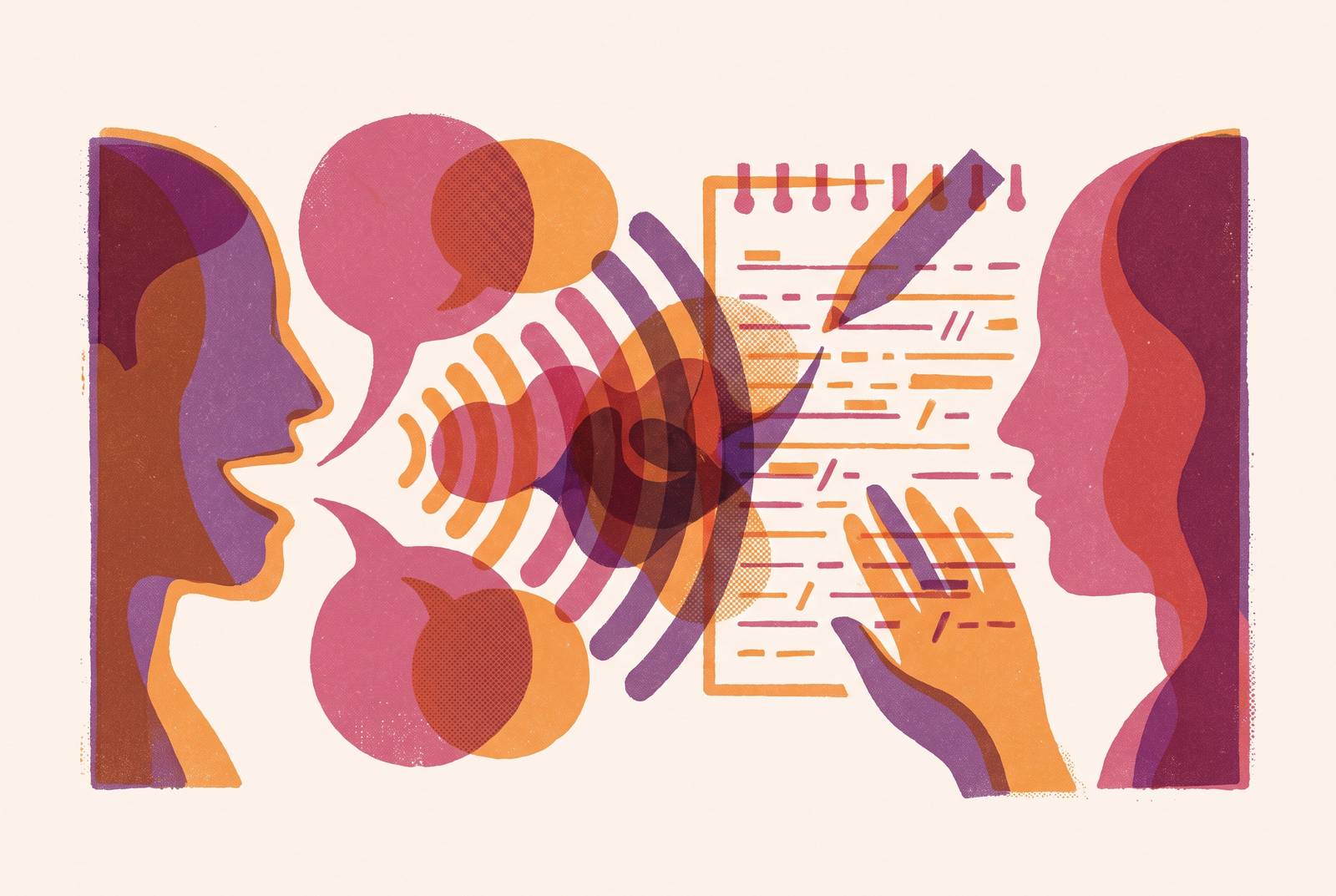
Affect labeling means putting a feeling into words, and until fairly recently nobody had bothered to test whether it actually worked. It came out of talk therapy, got treated as common sense for decades, and only in recent years has it been run through an fMRI machine and checked against a control group. The finding holds up: naming an emotion changes it. What the research hasn't settled, and what this piece is actually about, is whether saying the word out loud and writing it down produce the same change, or something different enough to matter, and the evidence says the second one is closer to true.
How emotional vocabulary shapes the emotions it names, not just describes them
Start with a strange claim from affective neuroscience: the brain doesn't keep a fixed library of emotions waiting to be discovered and described. It builds emotional experience out of learned concepts, the way a chef builds a dish out of ingredients that don't taste like anything specific until they're combined. A vaguer concept produces a vaguer dish. Someone with three words for distress ("bad," "stressed," "off") is working with a smaller pantry than someone who can tell irritation apart from resentment and dread, and that gap in vocabulary is not cosmetic. It changes what the brain can actually do with the raw material of the feeling.
There's experimental backing for this beyond theory. Research on emotion words, shows that hearing or producing a word like "angry" lights up distributed brain regions carrying specific information tied to that word's content. Taking the word away causes something measurable to break down: emotion perception itself gets worse. The label acts as scaffolding the feeling leans on while it's still being built, the same way a cast holds a bone in place while it knits.
A field study by Nguyen, Rajendran, and Nanayakkara, published in the International Journal of Human-Computer Studies, tested this directly. Over 24 days, 33 participants used a conversational agent that scaffolded granular affect labeling without ever teaching a single regulation technique. Emotion regulation ability improved anyway. No breathing exercises, no reframing tricks, just better words. Which raises an obvious follow-up: if the label alone does that much work, does it matter whether it comes out of a mouth or through fingers on a keyboard? That's the question the rest of this piece tries to answer, and the honest answer turns out to be yes, quite a bit, and the two mediums are not interchangeable the way most self-help advice treats them.
What speaking does that writing does not, the case for oral disclosure
Some direct comparisons between oral and written disclosure have found speaking winning on several fronts, including cognitive change and adaptive coping, measured against a matched writing condition. Not a proxy study, not an inference stitched together from two separate experiments run years apart. A head-to-head.
Why would speech have an edge? Consider the production pressure involved. There's no backspace key when talking. The word has to come out now, roughly right, and that forces an actual decision instead of an infinite editing loop. Writing lets someone hover over "anxious" for ten minutes, second-guessing whether "on edge" fits better. Speech doesn't grant that luxury. It forces commitment, and commitment turns out to be a decent proxy for honesty: a first-pass answer, blurted under mild time pressure, tends to land closer to true than the fifth draft ever does.
Speech also carries information words alone don't hold. Intonation, pitch, pacing, the little catch in someone's voice when they land on a hard word. A 2025 systematic review in JMIR on speech emotion recognition calls speech "one of the most prominent and accessible channels for conveying emotional states," and those acoustic layers riding alongside the words are a good chunk of why. A page doesn't tremble.
There's a social layer too. Oral disclosure, even aimed at a scripted prompt or an app, activates something closer to conversation than confession. The sense of a listener, even a simulated one, seems to lower the guard a bit. And for anyone who thinks faster than they type, a real category of person and not a personality quirk, the blank page can act like a small wall. Speaking just walks around it.
Most affect-labeling research treats verbal labeling as an outcome to measure rather than a production process to open up and inspect. Nobody has fully cracked what happens in the gap between the impulse to speak and the word that actually lands. That gap matters for what comes next, and writing turns out to fill it differently.
What writing does that speaking does not, the case for written disclosure
Foundational work on expressive writing flips the comparison around. Extended expressive writing protocols have produced improvements in health outcomes and self-reported stress lasting well beyond the writing period itself. Oral disclosure research has not consistently demonstrated that same kind of extended longitudinal payoff. Speech wins the sprint. Writing wins the marathon, and if the goal is a single good conversation, that marathon advantage barely matters, but if the goal is six months from now, it's the only number that does.
The slowness that looked like a liability in the speech comparison turns into the asset here. Writing forces words onto a fixed, re-readable surface, and that friction slows production down, which in turn encourages more deliberate word choice. It's the mirror image of speech's forced commitment: instead of grabbing the first word available, the writer gets room to test three before settling on one.
Slowness alone doesn't explain the full benefit, though. Research on written disclosure has found that combining cognitive processing with emotional expression, actually thinking through why the feeling showed up rather than just describing it, tends to produce better outcomes than pure emotional venting, which on its own has not reliably delivered the same benefits. Catharsis on paper, on its own, doesn't do the job. The thinking has to sit right next to the feeling, not trail behind it.
Newer evidence backs the precision angle too. Work applying natural language processing to written emotional descriptions has suggested that written language may hold more emotional signal than simple numeric rating scales can capture. Written language holds more signal than a slider from 1 to 10 ever could.
Then there's the handwriting wrinkle, which sounds almost too specific to be real but checks out anyway. Some neuroimaging research has found that handwriting, not typing, produces different patterns of brain activity linked to contemplation and memory, suggesting the pen may still carry a distinct advantage on this one axis, in a world where almost nobody writes by hand anymore.
There's a cognitive offloading effect on top of all this. A written record acts like external memory: it holds the feeling steady on the page so working memory doesn't have to keep gripping it, which frees up bandwidth to keep questioning the feeling instead of just holding onto it. Writing also imposes structure almost by accident, a beginning, a middle, an end, even in a rushed journal entry, and that narrative shape is itself a mild form of reappraisal whether the writer means it to be or not.
Where descriptive and expressive speech diverge, a distinction most comparisons miss
Most speaking-versus-writing comparisons skip a wrinkle that changes how the descriptive semantics and contextual content of speech get classified in emotion recognition. Research out of the University of Ottawa, from Guo, Francoeur, Nejadgholi, and colleagues, draws a sharp line inside speech emotion recognition between descriptive semantics (the contextual content of what's said) and expressive semantics (the signal of the speaker's actual emotional state in the moment). These are not the same channel. One is what the words mean. The other is how the voice sounds while saying them, and conflating the two is where a lot of "I talked about my feelings" self-reporting goes wrong.
That split matters for anyone trying to label a feeling out loud. Speak spontaneously about a bad day, and the output tends to be rich in tone but potentially thin in precision. It feels like disclosure. It might never deliver the specific word the brain actually needs in order to regulate. Venting and labeling can look identical from the outside while doing close to opposite work on the inside, and most people get this backwards: they assume talking it out is the same skill as naming it accurately. But it is not the same skill.
Written labeling, by contrast, tends toward the descriptive end, given the nature of the medium. The medium nudges toward talking about the emotion rather than erupting from inside it. It's a case for steering it. It's a case for steering it. A structured oral prompt, name the feeling, then say what caused it, pulls spoken labeling out of pure expressive mode and toward something closer to what writing does by default anyway.
A related challenge for anyone studying this is that acted emotion and non-acted emotion are difficult to cleanly separate in speech data. Which raises an uncomfortable personal version of the same question. When someone names a feeling out loud, are they labeling it, or performing it a little for whoever's listening, even if that listener is an app or an empty room? It deserves sitting with rather than rushing to answer.
How emotional granularity interacts with medium over time, spanning more than one session
Granularity isn't something a person either has or lacks, like eye color. It builds through repeated practice, and the medium shapes how that practice unfolds across weeks, not inside a single session. One good journal entry proves very little. Forty of them start to show a pattern.
Written journaling has a built-in advantage here: it leaves a searchable trail. Reread an entry from three weeks back, and it becomes possible to check whether the label chosen at the time actually held up. Maybe "anxious" was really "resentful about a boundary that never got set." Rereading creates a calibration loop, an actual audit of past labels, and speech rarely offers that same rewind function unless every conversation gets transcribed, which nobody is doing.
Speech has its own long-game advantage, though: speed. Regular oral practice builds faster access to precise words in the moment, and the moment is exactly where regulation is needed most. Nobody stops mid-argument to sit down and free-write.
Research on both expressive writing and oral disclosure lands on a finding that cuts across both mediums: structure beats format. An unstructured version of either speaking or writing underperforms a structured version of either one, and that symmetry is the real headline here, because it means the medium fight is partly a distraction from the variable that actually does the work. Unstructured repetition, in speech or on paper, risks curdling into rumination, looping the same feeling instead of resolving it. Structured prompts, in either mode, interrupt that loop by forcing cognitive processing to sit next to the emotional content instead of getting drowned out by it.
The 2026 conversational-agent study bears this out directly. The regulation gains over those 24 days came from repeated, scaffolded, granular labeling through conversation, accumulated gradually rather than delivered in one breakthrough session. Spoken and conversational modes build granularity over time just fine. They need scaffolding to do it, the same way writing needs a prompt instead of a blank page.
Personality and goal structure as the deciding factors in choosing a mode
So which mode wins? Neither, universally, and treating this as a contest with a single champion is where most of the popular advice on this topic goes wrong. The Pennebaker and Smyth framework keeps surfacing the same conclusion: structure determines the outcome more than format does, and the right structure depends on who's doing the labeling and what they're actually trying to get out of it.
Some people think faster than they type, or freeze at a blank page the way some people freeze at a blank canvas. For that person, speaking produces a more honest first-pass label, and honest beats polished almost every time in this context. Other people need to see a sentence sitting still on a page before they can tell whether it's actually true. That's a real cognitive style, not a preference dressed up as one. For that person, writing produces sharper labels, plus the added benefit of a rereading feedback loop months down the line.
Goal matters as much as personality does. Immediate regulation right after something rough happens favors spoken disclosure, given the faster cognitive change Esterling and colleagues found back in 1994. Long-term pattern recognition, noticing that every Sunday night brings the same dread, favors a written record, since speech leaves no trail without transcription. Building raw vocabulary and granularity benefits from scaffolded conversation, the way the 2026 study demonstrated across its 24 days, and working through one specific stressful event benefits from written journaling that pairs cognitive processing with the emotional content rather than emotion-only venting, as the 122-student study found.
There's also a relational piece that doesn't reduce to either category above. Some people regulate better when disclosure feels like a dialogue, even a simulated one. A prompt that talks back mimics conversation. A blank page just sits there, silent and a little judgmental. Preferring the former isn't a weakness, just a different wiring.
For anyone starting from zero, the advice simplifies considerably: pick whichever medium creates the least friction and actually start. The theoretically superior label that never gets made helps nobody. The mediocre label made consistently, on the other hand, compounds like interest.
How to build a labeling practice that matches the mode to the moment
Neither medium wins outright, and by this point that shouldn't land as a surprise. The practical move is a hybrid one: use whichever mode lowers the barrier to daily practice, and swap in the other mode when the goal driving that choice shifts.
A workable rhythm looks something like this. Daily practice happens in whichever medium will actually get used, since consistency beats theoretical advantage every time an actual busy week gets in the way. Weekly or monthly review happens in the slower, written mode, because that's where the rereading and pattern-spotting live.
Prompts shape the outcome more than medium does, especially early on. A decent prompt, spoken or written, points attention at both the feeling and its assumptions: what's actually being felt, and what does that feeling assume about the situation causing it? Most people skip that second half entirely, and skipping it is exactly what separates labeling from venting.
For spoken practice, the real skill is nudging expressive speech toward descriptive speech. "Name the feeling, then say what caused it" is a small instruction doing a surprising amount of work, mostly by keeping venting from masquerading as labeling. For written practice, the equivalent move is refusing to stop at the label. Writing "I feel anxious" and putting the pen down is a thin version of writing "I feel anxious because I'm assuming this conversation will go badly, and that assumption might just be wrong." One sentence sits there. The other one interrogates itself.
Guided voice-journaling tools, built around structured prompts rather than an open mic, split the difference well: they strip out the difficulty of starting from a blank page while keeping the cognitive scaffolding that makes labeling precise instead of merely cathartic.
Across every mode and every study mentioned above, one thing holds steady: granularity is the actual mechanism, independent of the app, the pen, or the microphone. The regulation benefit lives in the effort spent finding the specific word instead of settling for the nearest approximate one, and that effort is available in either medium to anyone willing to push past "fine" or "bad" and sit with the harder, more accurate word for another few seconds.
Sources
- JMIR Mental Health - Speech Emotion Recognition in Mental Health: Systematic Review of Voice-Based Applications
- Beyond happy and sad: Exploring granular affect labeling to enhance emotion regulation ability - ScienceDirect
- Semantic Differentiation in Speech Emotion Recognition: Insights from Descriptive and Expressive Speech Roles
- researchgate.net
- pmc.ncbi.nlm.nih.gov
- kellercenter.hankamer.baylor.edu