Children's Emotion Vocabulary Development and Regulation
Naming emotions helps children regulate them more than simply experiencing them.
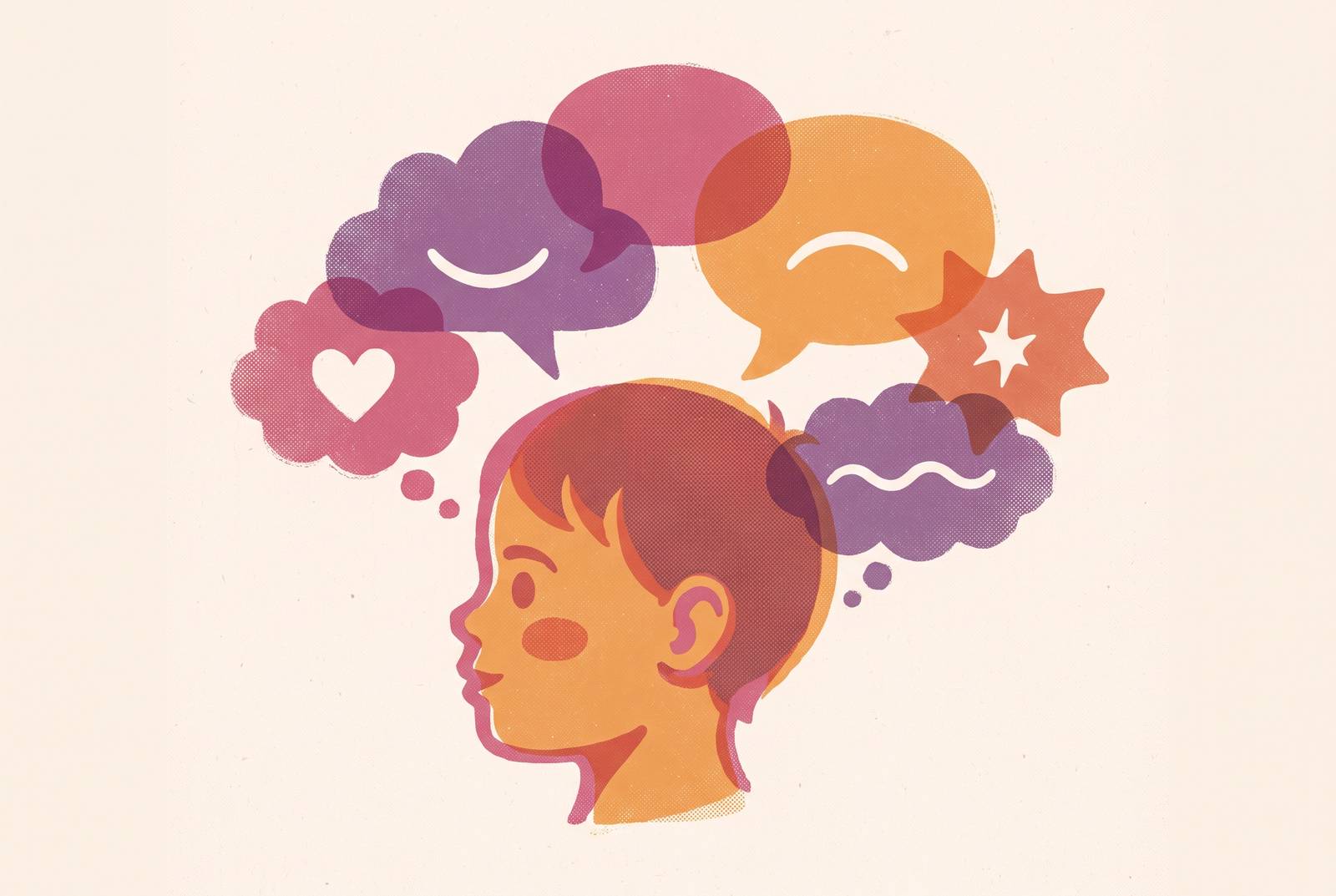
A four-year-old who screams "I'm ANGRY" mid-tantrum is not describing a feeling that already sorted itself out. She's doing the sorting, in real time, using the only tool she has: a word. That's the reversal at the heart of a growing body of research on children's emotion vocabulary. The common assumption runs the other way: kids feel something, calm down eventually, and then, sometime later, learn to slap a label on it. The evidence says the label often comes first, and it's the label that does a good chunk of the calming.
This matters because it flips the practical question parents and teachers ask. Instead of "how do I get this kid to self-regulate," the better question becomes "does this kid have the words." Constructionist theories of emotion, the framework guiding most of this research, treat emotion concepts the way they treat other concepts: built through language, not innate categories waiting to be discovered. A caregiver says "you seem frustrated" enough times, paired with the right context, and the child eventually links that specific internal state to that specific word. That link, once formed, is not decoration on top of the feeling. It becomes part of how the child processes the feeling.
A study published in the journal Emotion, run out of UNC Chapel Hill, tested this directly with a path analysis and found that children's emotion word knowledge predicted parent-reported adaptive emotion regulation, not the reverse. Regulation, in this context, doesn't just mean "stops crying faster." It means identifying what's happening internally, interpreting why, and responding in a way that fits the situation. All three of those steps run through language.
How emotion vocabulary grows from infancy through adolescence
Infants have feelings long before they have words for them. Anger, joy, fear appear in crying, in facial expressions, in the kind of laugh that sounds like a tiny engine starting up, all within the first months of life. There's no vocabulary yet. The infant is a feeling without a filing system, and the caregiver acts as the filing clerk, narrating: "oh, you're upset," "look how happy you are."
Toddlerhood, roughly ages one to three, is where the filing system starts to build itself. Kids begin recognizing and expressing basic emotions with more clarity, and with a caregiver's guidance, the first flickers of actual regulation appear. It's clumsy. It's clumsy and inconsistent. It sometimes looks like a full meltdown followed by a perfectly calm "I mad." But something is forming.
By preschool and early school age, the vocabulary stretches past the four or five basic categories into more complicated territory: disappointed, nervous, proud. This is also roughly when kids start using emotion words to negotiate, which any parent who has heard "I'm not tired, I'm just resting my eyes because I'm sad about bedtime" can confirm is a mixed blessing.
Emotional vocabulary, by most tracking, roughly doubles every two years until around age 12. Emotional vocabulary, by most tracking, roughly doubles every two years until around age 12, the same shape as a savings account with a good interest rate. Emotional vocabulary, by most tracking, roughly doubles every two years until around age 12, which is compounding, the same shape as a savings account with a good interest rate, except the currency is words like "humiliated" and "relieved" instead of dollars. That's compounding, the same shape as a savings account with a good interest rate, except the currency is words like "humiliated" and "relieved" instead of dollars. A gap that opens early doesn't stay the same size. The gap doubles too.
What happens in the brain when a child names a feeling
The mechanism behind all this is affect labeling, the clinical way of saying "putting feelings into words," and it produces a specific, measurable neurological effect." It sounds almost too simple to be a real intervention, and yet the neuroscience backs it up with a specific, measurable effect.
In foundational fMRI work, participants viewed emotional stimuli. When they simply looked, the amygdala, the brain's alarm system, lit up. When they were asked to name the emotion, that amygdala activation dropped, by as much as 30% in that research, and a different region switched on instead: the right ventrolateral prefrontal cortex, the part associated with cognitive control. In plain terms, naming the emotion moved the processing job from the reactive part of the brain to the reflective part. That's not a metaphor for regulation. That is, structurally, what regulation looks like on a scan.
Labeling isn't just its own regulation strategy. Converging research suggests it may make other strategies work harder.
So when a teacher says "name it to tame it" (a phrase that shows up often enough in child development circles to feel like a jingle), it is a reasonably literal description of amygdala-to-prefrontal-cortex traffic, not a feel-good slogan. It's a reasonably literal description of amygdala-to-prefrontal-cortex traffic.
Why emotion vocabulary precision matters when it is absent
The story gets more interesting than "know more words."" The relevant skill is emotional granularity: the ability to draw fine lines between emotional states instead of dumping everything into "good" or "bad." It's emotional granularity: the ability to draw fine lines between emotional states instead of dumping everything into "good" or "bad." Not just sad, but disappointed. Not just mad, but resentful, or overwhelmed, or embarrassed and trying not to show it.
A kid who knows fifty words but only ever reaches for "sad" and "mad" doesn't get the same regulatory payoff as a kid with fifteen words who can actually tell "nervous" apart from "annoyed." Quantity is necessary but not sufficient. Precision is the variable doing the real work, because assigning an accurate meaning to an internal state is what lets a person figure out what to actually do about it. "I'm frustrated because this puzzle piece won't fit" points toward a solution. "I'm bad" points nowhere.
The failure case for granularity has a clinical name too: alexithymia, marked by difficulty identifying and describing one's own emotions, a flattened imaginative capacity, and a thinking style oriented almost entirely outward, toward events and objects rather than internal states. It's linked to a range of mental health difficulties, though research specifically on alexithymia in young children remains thin. A meta-analysis found a statistically significant, if modest, negative relationship (r = -.10) between alexithymia and measures of emotional granularity. Emotional granularity, alongside emotional awareness more broadly, appears to mediate the link between alexithymia and how well someone regulates emotion. The gap between having words and having precise words is not cosmetic. A kid who can navigate a bad day differs from a kid who's stuck inside one, unable to say why.
How the language environment (books, caregivers, and shared reading) builds emotion vocabulary
Where does this vocabulary actually come from? Research on picturebooks points to them as a surprisingly outsized source, one that increases both the frequency and the range of emotion words a child encounters, beyond what shows up in ordinary caregiver speech.
That's a little counterintuitive. Wouldn't a child hear more emotion words just living life, listening to parents talk? Apparently not as many, and not as varied. Books aimed at preschoolers for shared reading contain more unique emotion words than ordinary caregiver speech, and that exposure advantage is a meaningful feature of the shared reading context.
Part of the reason is structural. Illustrated books hand a child two channels at once: the character's face on the page, drawn mid-emotion, and the word for that emotion spoken aloud in the same breath. Two channels landing at the same moment build a stronger connection than either one alone. Everyday speech leans hard on "happy" and "sad" because they're fast and reliable. Books have more patience. They'll spend a page on "puzzled," "determined," or "delighted," words that rarely come up organically at the dinner table.
The caregiver's own talk during that shared reading time, what researchers term "emotion talk," meaning verbal references to feelings, their causes, their consequences, and how to manage them, turns out to be a measurable variable in its own right. Current intervention research tracks the rate of emotion talk during reading sessions as a key outcome, which says something about how much weight that fifteen minutes before bed is quietly carrying.
How emotion vocabulary teaching plays out in practice: classroom frameworks and structured exercises
One core finding should reshape how adults think about "kids pick this up naturally": explicit, intentional teaching of emotion words is not redundant with everyday exposure. It fills gaps that incidental exposure leaves open, and those gaps are largest for children coming from lower-resource language environments. Waiting for vocabulary to happen on its own is a bet, and not a great one for kids who need it most.
The simplest version of this teaching is naming-in-the-moment: an adult saying "you look frustrated because the block fell" as it's happening. This does two jobs at once. It models affect labeling live, and it hands the child the exact word they'd need to do it themselves next time. It's a direct, practical application of the affect-labeling finding above, without any specialized equipment.
From there, the work becomes expansion toward precision, sometimes visualized as expanding outward from a small set of basic emotion categories into finer bands: anxious versus terrified, annoyed versus furious versus resentful. This is granularity work specifically, not just vocabulary padding.
A few structured exercises show up repeatedly in this space:
Feeling logs, where kids write or dictate one specific emotion word from their day along with a single sentence about its cause, combine affect labeling with the well-documented principle that articulating an experience helps drive the underlying cognitive change. Story-based discussion after a picture book, asking what a character felt and why, then pushing kids to pick the most precise word available rather than the first one that comes to mind, draws directly on the picturebook research findings. Sorting and matching activities, like ranking emotion words by intensity or matching a word to a situation, build both breadth and granularity at once.
For kids who find writing effortful, and there are plenty, speaking the experience aloud (naming it, describing it, tracing where it came from) does the same neurological job as writing without the fine-motor and spelling barriers stacked on top. Some kids process by thinking out loud. That's just a different valid entry point into the same mechanism. That's just a different valid entry point into the same mechanism.
Children who face additional barriers: language disorders, dyslexia, adversity, and low-SES environments
The UNC study's sample matters as more than a methodological footnote. Of the 252 children studied, the majority came from low-SES households, and the group was 37.3% Black or African American, 10.3% multiracial, 7% Asian or Asian American, and 42.5% White, meaning predominantly non-white and lower-income. That's the population in which the vocabulary-to-regulation pathway was actually demonstrated, and it's also where the stakes of a vocabulary gap run highest.
Children's emotion word knowledge mediates the relationship between verbal intelligence and adaptive regulation. In plain terms, verbal ability mediates the link between socioeconomic background and regulation. Close the vocabulary gap, and part of that broader gap in regulation should, in theory, close with it.
Adversity complicates the neural side of the story too. In high-risk families, the language environments that build this vocabulary are often thinner, and the regulatory scaffolding that supports affect labeling may be less consistently available. That's a case for more explicit, scaffolded instruction for these kids, not less; the "they'll pick it up eventually" approach was already a weak bet, and it's an especially poor one here.
Developmental Language Disorder (DLD) adds another layer, and it's more common than most people assume: it affects a meaningful share of school-age children. Kids with DLD often struggle specifically with emotion recognition, which ripples into social and behavioral outcomes well beyond language class. A 2025 study examined technology-based emotion recognition interventions, working through both basic and more complex emotions, an approach built specifically because incidental exposure clearly wasn't closing the gap on its own for this group.
What parents and educators can take away: a summary of the evidence-based levers
Restated: emotion vocabulary is not a symptom of good regulation showing up after the fact. It's an input. Teach the words, and there's a real, evidence-backed case that regulation itself develops alongside them, not after them.
The strongest lever, by the weight of evidence here, is dull in the best way: daily shared reading with active emotion talk built in. It's the highest-leverage, lowest-cost habit in this entire body of research, mostly because picture books hand children vocabulary that ordinary conversation simply doesn't generate on its own.
Naming emotions in the moment comes next: modeling affect labeling inside real interactions, not staged lessons. The amygdala-dampening effect from the fMRI research is available in basically any conversation where an adult says the word out loud instead of assuming the kid already knows it.
Deliberately pushing toward precision matters as a separate, distinct step, not an automatic byproduct of a bigger vocabulary. And having kids produce emotion language themselves, whether through writing (the feeling logs, the journals) or speaking it aloud, deepens the conceptual understanding in a way that only receiving language passively doesn't quite match.
What the research doesn't support is a wait-and-see approach: assuming regulation shows up on schedule without vocabulary input, or treating emotional difficulty later in life as some fixed trait rather than something partly addressable through language enrichment, even years in.
One equity note worth closing on, because it keeps this from turning into a checklist parents can complete and consider the job done: in the UNC path analysis, parents' own difficulties regulating their emotions directly predicted their children's dysregulation, independent of the child's vocabulary. Supporting a child's emotion word knowledge matters. It's not a substitute for the adult's own capacity to stay regulated in the room. The language environment and the relational environment are running side by side, and asking one to do the other's job is where the whole strategy quietly falls apart. They're running side by side, and asking one to do the other's job is where the whole strategy quietly falls apart.
Sources
- Full article: Picturebooks Increase the Frequency and Diversity of Emotion Vocabulary in Children’s Language Environments: Modeling Potential Benefits to Emotional Literacy, with Pedagogical Resources
- Full article: Emotion-specific vocabulary and its relation to emotion understanding in children and adolescents
- Children’s Emotion Word Knowledge is Associated with Adaptive Emotion Regulation: Links to Family-level and Child-level Factors
- Children's Emotion Word Knowledge Is Associated With Adaptive Emotion Regulation: Links to Family-Level and Child-Level Factors
- Learning through language: The importance of emotion and mental state language for children’s social and emotional learning - ScienceDirect
- (PDF) The acquisition of emotion-laden words from childhood to adolescence
- researchgate.net