Affect Labeling fMRI Evidence in Adults
Naming emotions dampens brain activity tied to fear and stress.
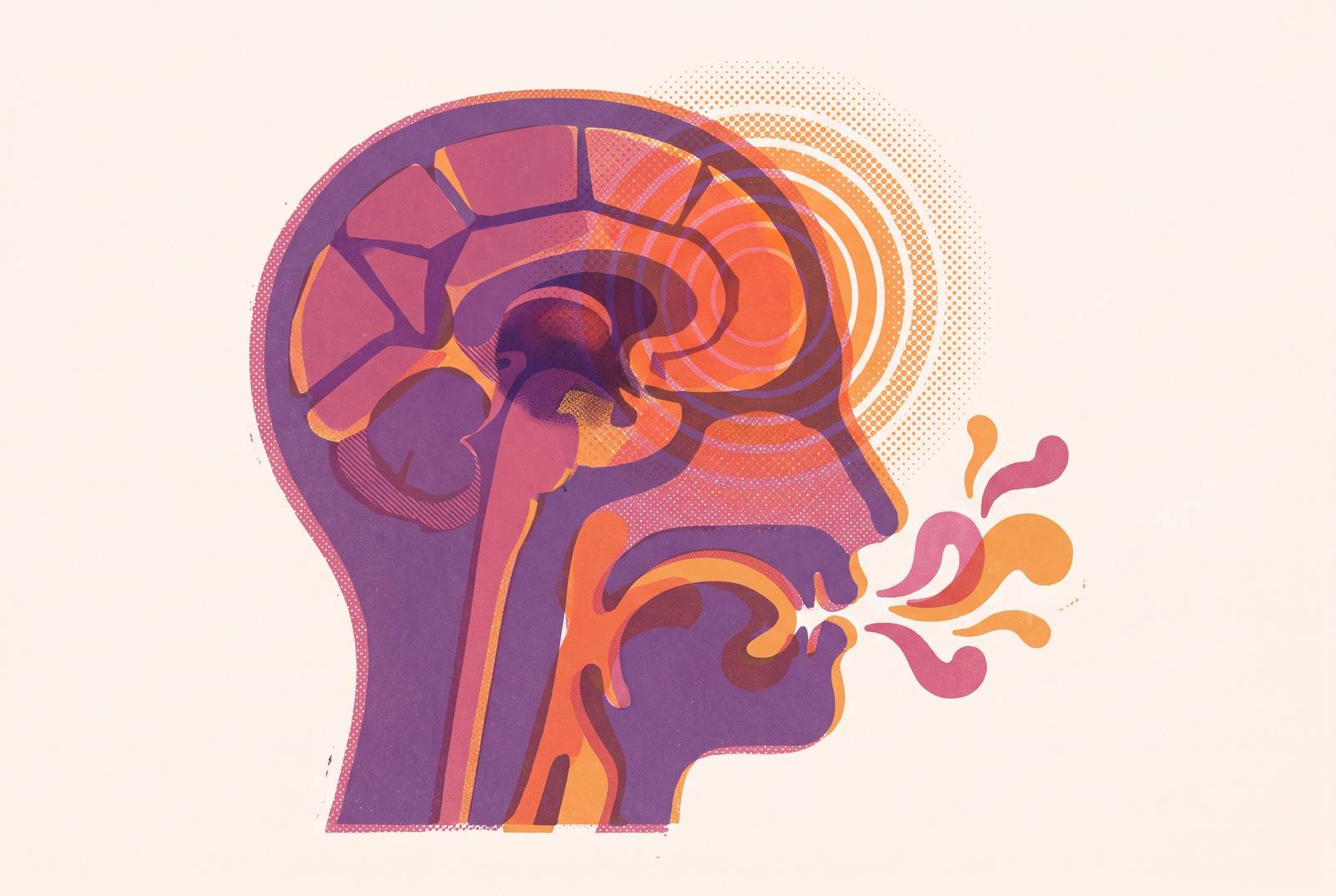
Naming a feeling changes what the brain does with it: amygdala activity drops, and the work of processing that feeling scatters across prefrontal and language regions instead of sitting stuck in the brain's alarm system. That's affect labeling, and roughly twenty years of fMRI research have dragged it out of the therapist's office and onto the scanner readout. This piece walks through what that research actually shows, where it gets messy, and why "just name your feelings" turns out to be a much stranger instruction than it sounds.
Affect labeling happens on its own, unlike a technique you deploy on purpose the way you'd count to ten or do box breathing. It's the act of identifying and naming an emotion, silently or out loud, and researchers treat it as something that happens on its own, with regulatory side effects riding along for free. The intuition producing this idea is old. Therapists have told clients for decades that naming a feeling helps tame it, and a broad range of self-help practices has been built on that same premise without much systematic proof behind it. What changed is that fMRI let researchers actually check whether the premise holds up, instead of just trusting its good reputation. The scanner measures the BOLD signal, the change in blood oxygenation that follows neural activity. That gives good spatial resolution (researchers can tell which regions are working) at the cost of poor timing (the signal lags actual neural firing by several seconds). That tradeoff doesn't matter much here, since the interesting question isn't millisecond timing, it's which regions light up and which go quiet when someone puts a feeling into words.
A recent paper in Trends in Cognitive Sciences pushes this further, treating affect labeling as a perceptual decision instead of a coping response. In this account, evidence from facial expressions, appraisals, body sensations, and action tendencies piles up over time toward a threshold, and whichever label crosses first gets reported. Researchers model this with formal decision-making frameworks borrowed from perceptual psychology. That reframes "naming a feeling" as a computation with inputs, accumulation, and a decision boundary, a soft skill you either have or don't. If naming an emotion is a measurable neural event with its own decision dynamics, it's something that can be studied, trained, and possibly optimized. That's the rest of this piece.
The Lieberman et al. 2007 study and the amygdala-dampening finding that anchored the field
Matthew Lieberman and colleagues published the paper almost everyone else cites first, in Psychological Science in 2007 (Vol. 18, No. 5, pp. 421 to 428). The finding: affect labeling, compared to other ways of processing an emotional image, dampened amygdala and limbic response to negative pictures. That's the headline, and the mechanism underneath it, prefrontal circuitry recruited to put a lid on the amygdala, is what made the paper last two decades instead of two years. The mechanism underneath it is prefrontal circuitry recruited to put a lid on the amygdala, and that mechanism is what made the paper last two decades instead of two years.
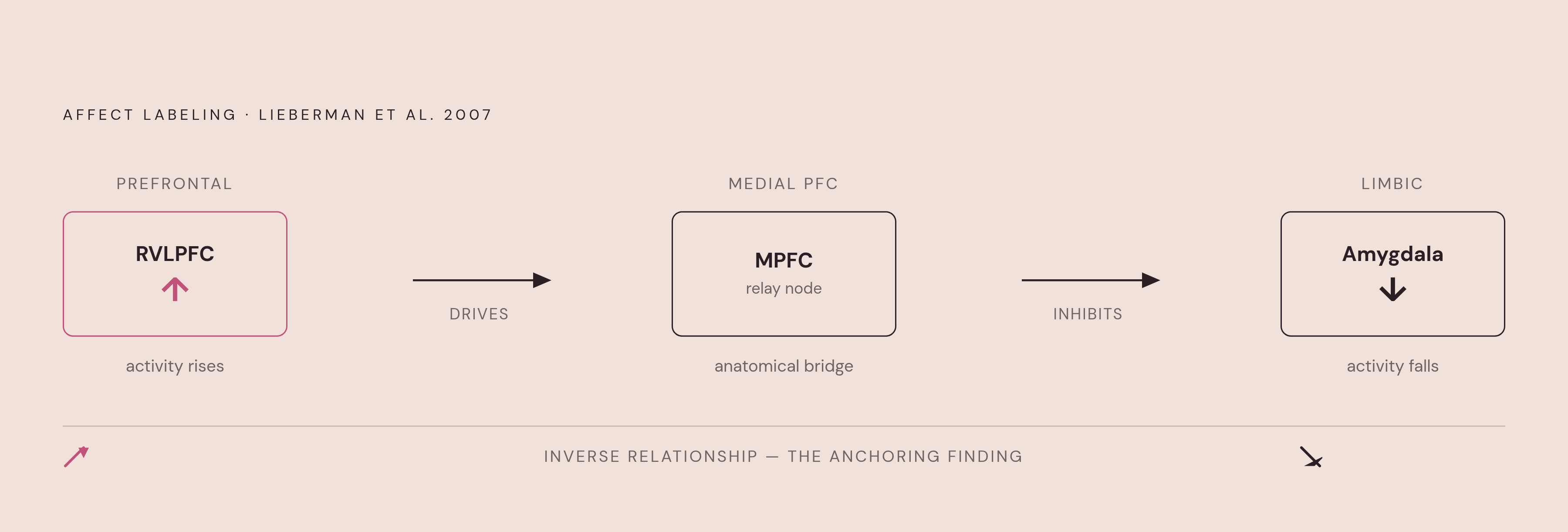
Right ventrolateral prefrontal cortex (RVLPFC) activity rose during affect labeling, moving in the opposite direction from amygdala activity: as RVLPFC went up, amygdala went down. Medial prefrontal cortex (MPFC) sat in the middle of that relationship, and MPFC appeared to play a mediating role in the relationship between the two regions. That's not a throwaway detail. MPFC has dense anatomical wiring straight into the amygdala, and it shows up repeatedly in both rodent and human research on extinction, the process by which a learned fear response fades. So this wasn't some arbitrary third region researchers stumbled into. It was a plausible physical route for a prefrontal region to actually reach the amygdala's dial and turn it.
The payoff of the study's careful design was a clean, three-part circuit: RVLPFC up, amygdala down, MPFC as the go-between. Every study covered from here forward is, one way or another, poking at that circuit: replicating pieces of it, or finding out it's a lot more complicated than three boxes and two arrows.
How the prefrontal-amygdala circuit works during emotion naming
RVLPFC isn't an emotion specialist, and treating it like one is where a lot of pop-psychology summaries go wrong. The broader literature describes this region as a general brake, involved in stopping prepotent, reflexive responses across motor tasks, cognitive tasks, and emotional tasks alike. So affect labeling probably works by borrowing a stop-signal mechanism the brain already uses for impulse control generally, not by running some bespoke emotion-only regulatory program. That's a meaningful correction to the popular version of this story, which tends to imagine a dedicated "feelings brake" sitting in the prefrontal cortex waiting for emotions specifically.
Language regions get pulled into this more directly than a simple "prefrontal cortex controls amygdala" story would suggest. A Dynamic Causal Modeling study across 45 healthy participants tested 64 competing models of how these regions influence each other, and Bayesian Model Averaging traced the amygdala's dampening signal back to Broca's area (the classic speech production region, BA 44/45), though more strongly to right VLPFC. Broca's area doing regulatory work is a genuinely odd finding if the assumption is that language sits downstream, printing labels after the "real" emotional processing already happened. It suggests the machinery for producing words sits inside the regulatory loop, not bolted on after the fact.
The activation pattern isn't a two-region story either. Bilateral VLPFC, bilateral DLPFC, and dorsomedial PFC show overlapping activity in studies comparing affect labeling and related regulatory strategies, and lateral temporal cortex, the anterior temporal lobe, and dorsomedial PFC (regions tied to both emotional experience and semantic processing) join in too. Reaching for the meaning of an emotion word looks like part of the regulation itself, a step folded into the "real" work rather than happening before or after it.
And here's the detail that should make anyone pause: labeling your own feelings produces roughly the same signature, RVLPFC up, amygdala down, as labeling the emotional content of something external, like a photo of someone else's angry face. The brain doesn't seem to draw a hard line between describing what's out there and describing what's going on inside. Talking about a stranger's fear in a photograph and talking about your own fear apparently run through the same circuitry. Strange thing to sit with, honestly.
The 2024 representational similarity analysis: emotion words engage a distributed network, not a single hub
Kent Lee and Ajay Satpute at Northeastern ran a study published in Social Cognitive and Affective Neuroscience (Vol. 19, Issue 1, nsae043, July 2024) with 25 participants, using representational similarity analysis to ask a sharper question: where, exactly, does the brain store information about emotion words? The answer wasn't one hub. Prefrontal regions, midline cortical regions, and sensorimotor regions all carried information about emotion words, and that spread overlapped heavily with the regions known to handle actually experiencing emotion.
That's a bigger claim than it first sounds like. The word "angry" isn't a linguistic tag pulled from some mental dictionary, filed neatly under A. It activates a wide, distributed set of regions that overlaps with the regions doing the feeling itself. The label and the felt state aren't neatly separable the way "concept" and "experience" are separable on a whiteboard.
There's a clinical thread hiding in this, too. If semantic access to emotion words gets impaired, that doesn't just leave someone short on vocabulary. It interferes with emotion perception itself, since the two systems overlap. That reframes vocabulary-building exercises, the kind of thing a journaling prompt or a therapist's word list is built around, as something closer to perceptual training than communication practice.
It also complicates the tidy story from the Lieberman work. "RVLPFC suppresses amygdala" is accurate but incomplete. The regulatory effect looks like it runs on a broad semantic-emotional network getting mobilized, not one inhibitory region leaning on one target. Harder to draw as a simple diagram, sure, but it might explain why affect labeling holds up across so many formats: spoken, written, therapist-guided, solo journaling at the kitchen table. A redundant, distributed system tends to be a resilient one.
How affect labeling compares to reappraisal in the scanner, and the effect of combining them
Reappraisal, consciously reframing how you think about a situation ("this rejection means I'm free to find a better fit," instead of "this rejection means I'm unlovable"), is the other major emotion regulation strategy in the fMRI literature. Worth setting it next to affect labeling directly. A comparison study in healthy older adults (N = 39) found both strategies activated overlapping prefrontal regulatory regions, both reduced amygdala activity by similar amounts, and both tracked with similar drops in self-reported distress. The one place they diverged: affect labeling produced relatively stronger prefrontal engagement.
So the two strategies land in roughly the same place, lower amygdala, lower distress, but they take different roads to get there. That distinction matters for anyone building a practice or a tool around either one. Interchangeable outcomes don't mean interchangeable mechanisms, and treating them as swappable is probably a mistake.
Combining them stacks the effect. A study by Yoshimura, Nakamura, and Morimoto (Neuroscience Research, May 2023) had participants do reappraisal after first doing affect labeling. Compared to reappraisal alone, the combined sequence increased activity in bilateral inferior frontal gyrus and medial frontal gyrus, decreased right amygdala activity further, and increased functional connectivity between the right amygdala and prefrontal cortex. Related work using other neuroimaging methods has found a similar general shape, with the combined sequence producing higher lateral prefrontal activity than reappraisal alone.
Not everything lines up neatly, though. Some research has found that affect labeling can, under certain conditions, actually get in the way of the reappraisal that follows it. Sequencing and context clearly matter here, and nobody has pinned down why the order helps in some setups and backfires in others. For anyone designing a structured reflection practice, whether that's a therapy protocol or a journaling prompt sequence, the order of "name it" versus "reframe it" carries real functional weight. It's a variable with a measurable neural consequence, not a stylistic choice.
Affect labeling as an attenuator of all emotion, not just a negative-affect reducer
It turns down positive feelings too, and about as much, which quietly wrecks the "affect labeling calms you down" story. Applied to negative stimuli, affect labeling reduces self-reported distress. Applied to positive stimuli, it has been found to reduce self-reported pleasure as well. The effect doesn't discriminate by valence, and that alone should make anyone rethink the popular framing of naming emotions as a purely soothing act.
Affect labeling behaves like an attenuator, not an alleviator of negative feeling specifically, and that distinction is the whole point of this section. An alleviator would be a targeted antidote to distress, something that knows fear from joy and only touches the fear. An attenuator is a volume knob. It turns down whatever's currently playing, whether that's a horror movie soundtrack or a marching band, and it doesn't care which one it's holding.
Neurobiologically, that argues against the dampening mechanism being narrowly wired to threat detection. A pure threat-suppression circuit would not be expected to touch the amygdala's response to a genuinely happy picture, yet the effect appears more general than that. The mechanism is more general than the original threat-focused framing suggested, acting on emotional arousal broadly rather than picking out fear or anger specifically.
So here's the awkward practical issue nobody likes answering: if naming an emotion mid-experience turns the volume down on it, is that always what someone wants? Naming your fear during a job interview probably helps. Naming your joy at your kid's graduation while it's happening might blunt the very moment worth being present for. Timing and context decide whether the attenuation is a feature or a cost, and that tension carries straight into the next question: what happens to the memory afterward.
A 2026 fMRI study on affect labeling, memory encoding, and later retrieval
A study accepted by Brain and Behavior, with 37 participants, asked something the earlier literature had mostly skipped: does labeling an emotion while encoding a memory change how well that memory gets recalled later? Behaviorally, yes. Affect labeling during picture encoding boosted recognition performance later on, across the board.
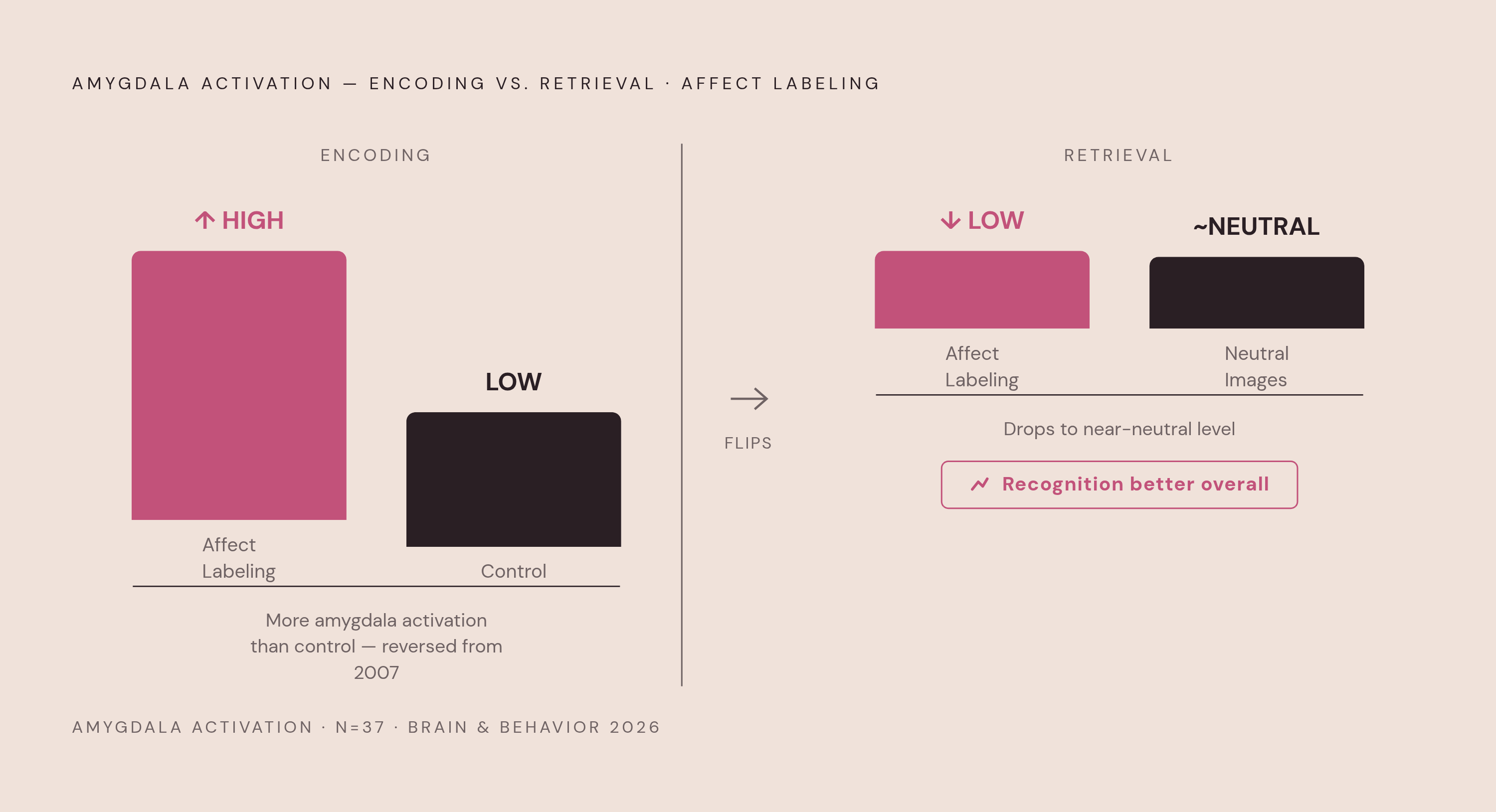
The fMRI data behind that behavioral bump reveal something genuinely odd. During encoding, negative pictures in the affect-labeling condition produced greater amygdala activation than pictures encoded under a person-labeling condition or under simple viewing: the opposite of what the classic 2007 regulatory story would predict. Then, at retrieval, the pattern flipped. Pictures labeled during encoding produced reduced amygdala responses, dropping to something close to the amygdala's response to neutral images.
Parahippocampal gyrus activity during the labeling phase, a region tied closely to memory formation, offers a plausible explanation for the better recognition scores. The amygdala isn't simply switched off by affect labeling. It gets engaged differently depending on which phase of the memory process is running: heightened at encoding, which may help consolidate the memory in the first place, then dampened at retrieval, which may take the sting out of re-experiencing it later.
That's a real complication for the tidy one-line summary that's circulated since 2007 ("affect labeling reduces amygdala activity"). The direction of the effect depends on timing, and the regulatory payoff at retrieval may exist precisely because the amygdala worked harder during encoding, not despite it. More amygdala now, less amygdala later, and the "later" part is the one that actually is felt as feeling better about a memory. Flips the intuitive story on its head.
How emotional granularity, alexithymia, and mindfulness moderate the neural effect
Affect labeling doesn't land the same way for everyone, and the literature names four moderators: alexithymia, emotional granularity, mindfulness, and language context.
Emotional granularity, the precision with which someone recognizes, tells apart, and puts words to their own emotional states, looks like the moderator that matters most. Higher granularity tracks with better biological and psychological markers and stronger social and functional outcomes generally. Lower granularity appears consistently across mood disorders, anxiety disorders, substance use disorders, schizophrenia, PTSD, personality disorders, and eating disorders. The population that would benefit most from affect labeling as a regulation tool is, on average, the population with the thinnest emotional vocabulary to actually do it with.
Alexithymia, difficulty identifying and describing one's own feelings, sits right next to that problem. If the regulatory mechanism runs on access to emotion words, and the Lee and Satpute 2024 finding that impaired word access disrupts emotion perception backs this up, then alexithymia is a plausible bottleneck on the entire mechanism, upstream of everything else discussed in this piece. It's a plausible bottleneck on the entire mechanism, upstream of everything else discussed in this piece.
Timing and intensity remain underexplored, and that's a real gap, not a minor footnote to wave away. The process model of emotion regulation treats both as major factors in how well any regulation strategy works, yet most fMRI studies run on fixed stimulus durations that don't vary these conditions in any realistic way. So the honest state of the science: affect labeling is not a uniform tool that works the same for everyone at every moment. Its effectiveness depends on how fine-grained a person's emotional vocabulary already is, and on where in the arc of an emotional episode someone actually uses it.
The Torre and Lieberman (2018) four-mechanism framework for the regulatory effect
Torre and Lieberman, writing in 2018, laid out four candidate explanations for why naming an emotion changes its neural footprint. Only some of these have direct fMRI backing, and the four should not be treated as equally proven, because they aren't.
Symbolic abstraction is the best-supported of the four, by a wide margin. Converting an emotional stimulus into language means sorting it into an abstract category, and the evidence backs that up in a fairly literal way. Labeling aversive images with abstract, almost bland terms like "object" or "human" produced arousal reduction similar to labeling the actual emotion depicted. Even categorizing a threatening image as simply "natural" or "artificial" increased vlPFC activity. That points toward higher-order processing regions registering something like "categorized, filed, dealt with" through the act of sorting itself, independent of whether the category has anything to do with emotion.
Self-reflection and social communication are the other two mechanisms Torre and Lieberman name, and neither has direct neuroimaging confirmation behind it yet. They remain theoretically reasonable, plausible enough to show up in every citation of the framework, but they're proposals rather than findings at this point, and treating them as settled science overstates what the evidence actually shows.
The fourth mechanism, symbolic abstraction from arousal, is a cousin of the first but focused specifically on the arousal-reducing side of moving from raw felt experience to a linguistic category. It lines up cleanly with the valence-general attenuation finding from earlier: if labeling reduces arousal regardless of whether the emotion is good or bad, this mechanism predicts exactly that.
None of the four mechanisms rule each other out, and the fMRI evidence right now doesn't cleanly separate which one carries the most weight in any given case. The distributed, overlapping network Lee and Satpute mapped in 2024 might eventually be the tool that sorts this out, since a network view naturally accommodates multiple mechanisms running in parallel instead of forcing a pick-one answer.
Translating the fMRI evidence into a clinical intervention: the PTSD pilot
All this circuitry mapping eventually has to answer a harder question: does any of it help people with clinically significant emotional distress? An open trial pilot led by Burklund, Davies, Niles, Torre, Brown, Vinograd, Lieberman, and Craske, out of UCLA, published in Frontiers in Psychology in 2024, took a first run at that question with combat veterans.
The study compared 20 veterans with combat-related PTSD to 20 trauma-exposed veterans without a PTSD diagnosis. Before any intervention began, baseline fMRI scans confirmed what the basic science would predict: the PTSD group showed significantly higher PTSD symptoms, higher depression symptoms, and higher amygdala reactivity to trauma-related cues than the control group. That baseline is the direct clinical mirror of the amygdala hyperreactivity Lieberman's original 2007 work identified in healthy volunteers responding to negative images. The lab finding and the clinical population line up, which makes this pilot worth taking seriously rather than filing under "interesting but irrelevant."
That's where two decades of fMRI research and an actual clinical pilot meet. The mechanism identified in healthy volunteers looking at photos in a scanner, RVLPFC engaging, amygdala settling, language regions doing more than just naming things, is the same mechanism a PTSD intervention now tries to recruit on purpose, in a population where that circuit doesn't run the way it should on its own. Whether structured affect labeling can reliably move that needle in a clinical population is still an open question, one the pilot data has only started to answer. That unfinished status is the right note to end on, rather than a bow tied too neatly around a story still being written.
Sources
- The process of affect labeling: Trends in Cognitive Sciences
- More than labels: neural representations of emotion words are widely distributed across the brain | Social Cognitive and Affective Neuroscience | Oxford Academic
- Changes in neural activity during the combining affect labeling and reappraisal - ScienceDirect
- Putting Feelings Into Words - Matthew D. Lieberman, Naomi I. Eisenberger, Molly J. Crockett, Sabrina M. Tom, Jennifer H. Pfeifer, Baldwin M. Way, 2007
- researchgate.net
- onlinelibrary.wiley.com