Emotional Granularity and Psychological Resilience
Precise emotional awareness helps the brain regulate stress more effectively than vague feelings.

Emotional granularity is the brain's ability to construct specific, differentiated emotional states rather than lumping everything into vague buckets like "stressed" or "bad." Psychologist Lisa Feldman Barrett is credited with naming it, and the research since then treats it as a trainable skill, one that predicts how people actually behave under pressure, not just how they describe their feelings afterward.
The common shorthand for granularity, "just label your feelings," is a leftover from an earlier version of the idea. Barrett herself moved past it. Granularity isn't a vocabulary exercise where you swap "bad" for a fancier synonym off a feelings wheel poster. It's about whether the brain can construct a precise, context-specific instance of emotion in the first place. Someone with high granularity holds those as three distinct events, each with its own cause and its own next move. That difference sounds small. It isn't. Treating granularity as a labeling problem leads to surface-level fixes (a better vocabulary list). Treating it as a constructive capacity, the way current research does, opens up actual training methods, which is what most of this piece is about.
This exists on a spectrum, not as a trait you either have or don't. A 2021 review in Frontiers in Psychology (Hoemann, Feldman Barrett, and Quigley) frames it explicitly as something that develops with practice, rather than a fixed dial someone is born with.
How finer emotional distinctions change what the brain does under stress
Naming an emotion does something measurable to the brain, and Matthew Lieberman's fMRI work mapped it out. When people put a specific word to an emotional state, amygdala activity drops and activity rises in the ventrolateral prefrontal cortex (Lieberman et al., 2007). That's the neural signature of what's called affect labeling, and it's not just naming for the sake of naming. It's routing.
Higher-order cortical regions also appear more engaged during this kind of reflective processing. Think of it as the switchboard operator sitting between raw feeling and deliberate thought, deciding which calls get put through. When granularity is high, the emotional signal seems to get routed through this higher-order circuitry instead of triggering a purely reactive response. The label isn't decoration. It's traffic control.
A 2025 study in Biological Psychiatry: Cognitive Neuroscience and Neuroimaging, published in May of that year, pushed this further by testing it in a population that theory alone couldn't answer for: adolescents who'd actually been exposed to violence. Eighty teenagers between 13 and 18, with varying levels of violence exposure, watched emotion-eliciting videos, and 69 of them underwent fMRI scanning. When asked to label their emotional response (versus simply counting something neutral in the video), they showed greater activation in the medial and ventrolateral prefrontal cortex. The mechanism held up even in kids whose nervous systems had legitimate reasons to be dysregulated. That's a meaningful finding, because it suggests the benefit of labeling isn't reserved for people who are already calm, well-resourced, and sitting in a wellness retreat somewhere. It shows up under real adversity.
There's also a Default Mode Network angle: without structured emotional processing, the brain tends to cycle through unresolved states. Without structured emotional processing, the brain tends to cycle through unresolved states, which is a clinical way of describing what everyone knows as rumination, replaying the same argument in the shower for the fourth time. Structured emotional processing seems to interrupt that loop by replacing an open-ended vague ache with something concrete that can be resolved. The point isn't that granularity makes people feel less. It's that it makes the brain process more accurately, and accuracy changes what happens next.
What low granularity predicts, and why the stakes are behavioral not just emotional
Here the research shifts from mood to behavior. A 2015 review in Current Directions in Psychological Science by Kashdan, Feldman Barrett, and McKnight found that under intense distress, people with low emotional granularity are more likely to turn to binge drinking, aggression, and self-injurious behavior. Not because they feel worse, necessarily, but because an undifferentiated feeling gives the brain nothing specific to act on. If everything registers as one flat signal, the response tends to be similarly blunt: escalate, numb out, lash out.
The same review found low-granularity individuals show sharper neural reactivity to social rejection, along with more severe anxiety and depressive symptoms. Other clinical work ties poor emotional differentiation specifically to borderline personality disorder (Suvak et al.; Dixon-Gordon et al.) and to major depressive disorder (Demiralp et al., 2012, Psychological Science). Across all of it, the pattern repeats: when the brain can't tell "hurt" from "humiliated" from "afraid," it can't select a regulatory strategy that actually fits the problem. It just escalates or shuts down, the emotional equivalent of a fire alarm that only has one setting no matter what's burning.
A study of 407 junior high school students in China adds a wrinkle: lower positive emotional granularity directly predicted social anxiety symptoms. Lower positive emotional granularity directly predicted social anxiety symptoms. Negative emotional granularity also related to the kids' ability to use cognitive reappraisal (basically, reframing a stressful situation), though its directional role in the network differed from positive granularity's. So positive and negative granularity aren't mirror images of the same skill. One acts upstream, shaping the anxiety. The other trails behind it, shaped by the anxiety that's already there. That's not a footnote. It changes how anyone designing an intervention should think about which side of the emotional ledger to target first.
Put together, these findings make granularity a resilience variable in the most literal sense: it changes what people do when things go sideways, not just how they narrate the experience afterward.
How high granularity enables faster recovery, especially through positive emotion
Resilience, in Tugade, Fredrickson, and Barrett's 2004 definition (Journal of Personality), is the capacity to bounce back from a bad event by deploying positive emotion as a coping tool. Their research adds that positive emotional granularity, the ability to represent positive emotion with real specificity, is its own distinct trait, separate from simply "being an optimist" or "staying positive."
The psychophysiological data backs this up in a fairly concrete way. People with high resilience showed faster cardiovascular recovery after negative emotional arousal, meaning heart rate and related measures returned to baseline more quickly, and the researchers attributed the speed of that recovery to positive emotion doing real regulatory work, not just riding shotgun. That raises a fair question: why would knowing the difference between "relief" and "interest" speed up a heartbeat's return to normal? The likely answer is that precision lets someone identify which resource is actually available in the moment. Relief says the threat has passed. Interest says there's something worth engaging with. Warmth says a connection is intact. A vague sense that "things are fine" doesn't give the nervous system anything to grab onto. A specific one does.
This should be separated clearly from toxic positivity, because they get confused constantly. Granular positive emotion doesn't require manufacturing good feelings that aren't there or slapping a silver lining on a bad quarter. It only asks that whatever positive emotion does exist gets represented accurately instead of dismissed or flattened. And this loops back to the constructive framing from the first section: bouncing back isn't a passive process where the nervous system just settles down on its own timer. It's an act of construction, the brain building a new state out of the raw material available, and granularity determines how precisely that construction job gets done.
Why reflective writing is a particularly direct way to train this capacity
Writing has a structural advantage that just sitting and thinking doesn't: it forces sequential commitment. Rumination lets a feeling stay foggy indefinitely, drifting around without ever needing to resolve into a specific shape. Writing doesn't allow that. The moment a pen hits paper (or fingers hit keys), there's a decision to make about which word goes down, and that decision surfaces the exact gap between "I feel bad" and whatever is actually causing it.
James Pennebaker's research set the benchmark here decades ago, and it still holds up as one of the most replicated findings in the field. Four days of expressive writing, 15 to 20 minutes each session, produced improvements in immune function, and better emotional regulation (Pennebaker, 1997). Part of why the protocol works is structural: the same emotional territory gets revisited across multiple sessions instead of being dumped once and abandoned. That repetition is what builds differentiated representations over time, rather than a single cathartic unload that fades by Thursday.
But there's a catch, and it's an important one. A study comparing journaling interventions across 122 students found that the benefit only appeared when emotional expression was paired with cognitive processing, not from emotional expression alone. The benefit only showed up when emotional expression got paired with cognitive processing, with the writer also working through what the event meant, not just how it felt. Pure venting, in other words, isn't granularity training. It might even backfire. The skill gets built in the move from "I feel bad" to "I feel this specific thing, because of this specific situation, and here's what I make of it."
Journaling that does this right activates several systems at once: the prefrontal cortex organizing the thoughts, the hippocampus encoding the experience into a narrative structure, and language centers converting something abstract into concrete words. That combination, happening simultaneously, is what separates journaling from simply mulling something over on a walk. And the effects aren't fleeting. Research on gratitude writing has found neural changes associated with the practice that appear to persist beyond the writing sessions themselves. The brain doesn't just feel different in the moment. It appears to rewire, at least somewhat durably.
Which journaling methods actually develop granularity, and which do not
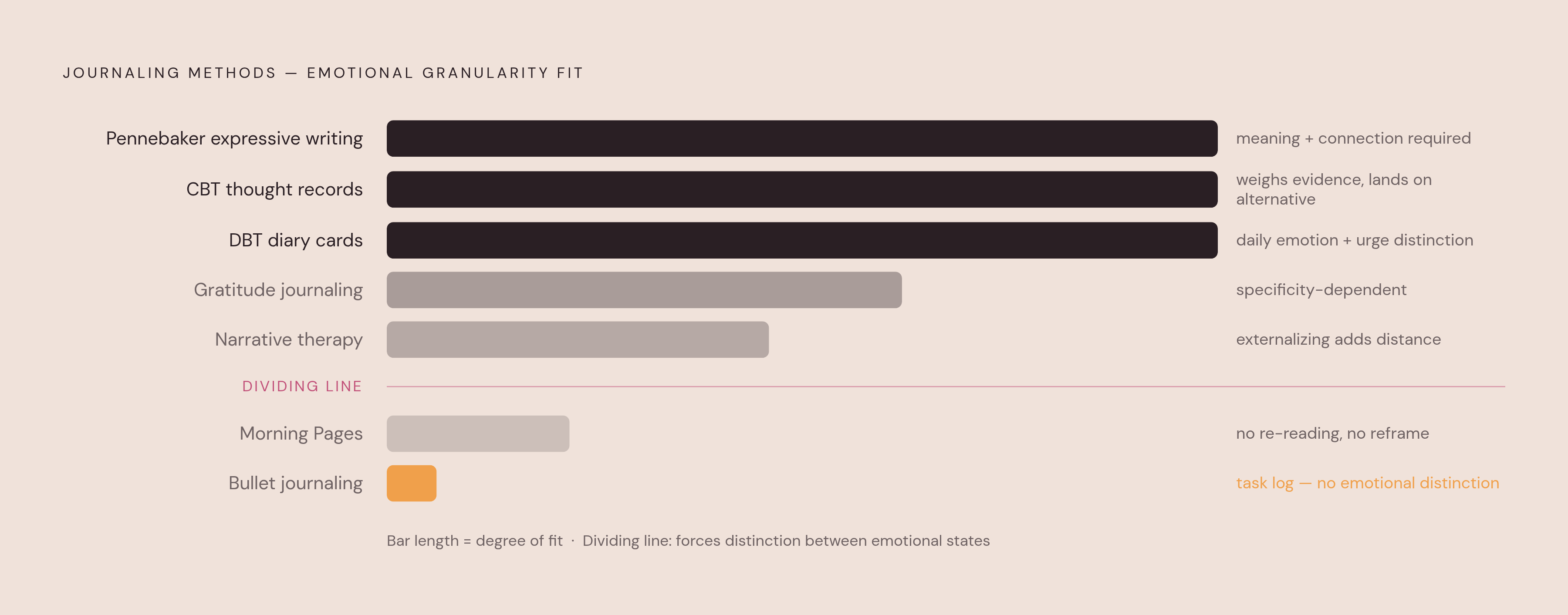
Not every kind of journaling does this job, and it's important to be blunt about which ones don't, because "journaling" has become a catch-all term that covers wildly different activities. The test is simple: does the method require distinguishing one emotional state from another, and does it pair emotional expression with some cognitive framing? If both boxes get checked, granularity gets trained. If neither does, the method might still be useful for something, just not for this.
Pennebaker's expressive writing protocol checks both boxes. Around 15 to 20 minutes, three or four consecutive days, same emotionally significant topic each time, writing not just what happened but what it meant and how it connects to the rest of life. The multi-day repetition is structurally load-bearing here, not incidental.
CBT thought records do the same job through a different mechanism. Identify a specific automatic thought, weigh the evidence for and against it, land on a more balanced alternative. Every step demands precision, because a vague thought can't be evaluated against evidence in any meaningful way.
DBT diary cards are arguably the most granularity-specific tool on this list, even though they were built for clinical use. Tracking emotions, urges, and skill use daily trains the habit of fine-grained emotional observation almost by brute repetition, the same way a musician builds pitch discrimination through daily scales.
Gratitude journaling is a partial fit, and the deciding factor is specificity. "Three things I'm grateful for" builds real granularity when the entries are concrete and change day to day. It builds very little when the entries repeat the same three categories on autopilot (family, health, coffee, forever). Dr. Robert Emmons' research at UC Davis found weekly gratitude writing increased well-being overall, but the granularity payoff specifically depends on how precise the writing actually is.
Morning Pages, the Julia Cameron method of stream-of-consciousness pages first thing in the morning, is a weak fit for this particular purpose. It's genuinely good for clearing mental clutter and unsticking creative blocks. But the method instructs against re-reading entries in the early weeks, which limits the cognitive processing step that the journaling research identifies as essential. Without that step, the writing stays closer to venting than to training.
Bullet journaling isn't built for this at all. It's a task-and-event logging system, efficient at what it does, but it doesn't touch emotional distinction unless someone bolts on reflection pages, which then borrow from other methods entirely.
Narrative therapy techniques, like writing a letter to a part of yourself or externalizing a problem as a character with its own name and voice, land as a moderate fit. The externalizing move creates distance, and distance is often what makes an emotion examinable instead of overwhelming.
The thread running through everything that works: the method requires making a distinction. Between what happened and what it meant. Between one feeling and the one sitting right next to it. Between an automatic thought and a considered response.
How to structure a granularity-building writing session in practice
Start with the vague label. That's allowed, even expected. Write down "I felt stressed at work today" and treat it as a rough draft, not a finished conclusion. The actual work begins with interrogating that sentence rather than stopping at it: what kind of stress was this, specifically? Directed at what? Mixed in with anything else that was quietly riding along?
A prompt sequence can operationalize this without much fuss. What was felt, first pass, broad label totally fine at this stage. What else showed up alongside it, since most "stress" is really two or three emotions wearing a trench coat and pretending to be one. What specifically triggered it, since context is what keeps the emotion from ballooning into a general mood that colors everything else. What was the impulse in that moment, the urge to leave, snap, hide, or explain, since the action tendency reveals what the emotion was actually doing rather than just how it felt. And finally, what that reveals about a value or a need causing it all, which is the cognitive framing step that separates this from plain venting.
Pennebaker's 15 to 20 minute benchmark holds up well as a target, though shorter sessions can still work if that cognitive-plus-emotional pairing stays intact. Consistency across sessions builds the skill, while length does not. The skill builds through repeated differentiation practice across many sessions, not through one marathon 90-minute entry that tries to solve everything at once.
Voice journaling deserves a mention here too. Speaking a prompt sequence out loud produces roughly the same cognitive externalization as writing it by hand, since the driver of granularity is committing to specific words, not the physical act of holding a pen. That opens the practice up to people who find writing tedious or who simply think more clearly out loud than on a page.
And unlike Morning Pages, this kind of session actually benefits from being reread. The compounding effect shows up across sessions, not within a single one, as patterns start surfacing: the same word, "overwhelmed," showing up week after week as a catch-all, prompting the obvious follow-up of what's actually causing that word to get reached for each time.
This isn't confined to journals and lab experiments anymore, either. An active clinical trial (NCT07200388), run by The Hong Kong Polytechnic University and titled "The Role of Emotional Granularity in Enhancing Resilience Among Young and Middle-Aged Colorectal Cancer Survivors," is testing granularity training as a structured intervention for cancer survivors managing long-term recovery. Whatever the results turn out to be, the fact that the framework has moved from Barrett's 2004 paper into an active clinical trial with cancer survivors says something about how far the idea has traveled. It's no longer a concept confined to psychology journals. It's being tested against something as concrete and high-stakes as survivorship itself.
Sources
- Emotional Granularity and Cognitive Reappraisal Affect Social Anxiety and Interpersonal Relationships in Adolescents: A Bayesian Network Analysis - PubMed
- Granularity of emotions in brain and behavior and resilience to childhood violence exposure - PMC
- cdn.clinicaltrials.gov
- Psychological Resilience and Positive Emotional Granularity: Examining the Benefits of Positive Emotions on Coping and Health | Request PDF
- Editorial: The role of emotional granularity in emotional regulation, mental disorders, and well-being - PMC
- Frontiers | Emotional Nuance: Examining Positive Emotional Granularity and Well-Being
- Emotional Granularity Effects on Event-Related Brain Potentials during Affective Picture Processing
- onlinelibrary.wiley.com