The Catharsis Hypothesis and Venting Research
Venting anger usually intensifies it; arousal reduction and structured writing work better.
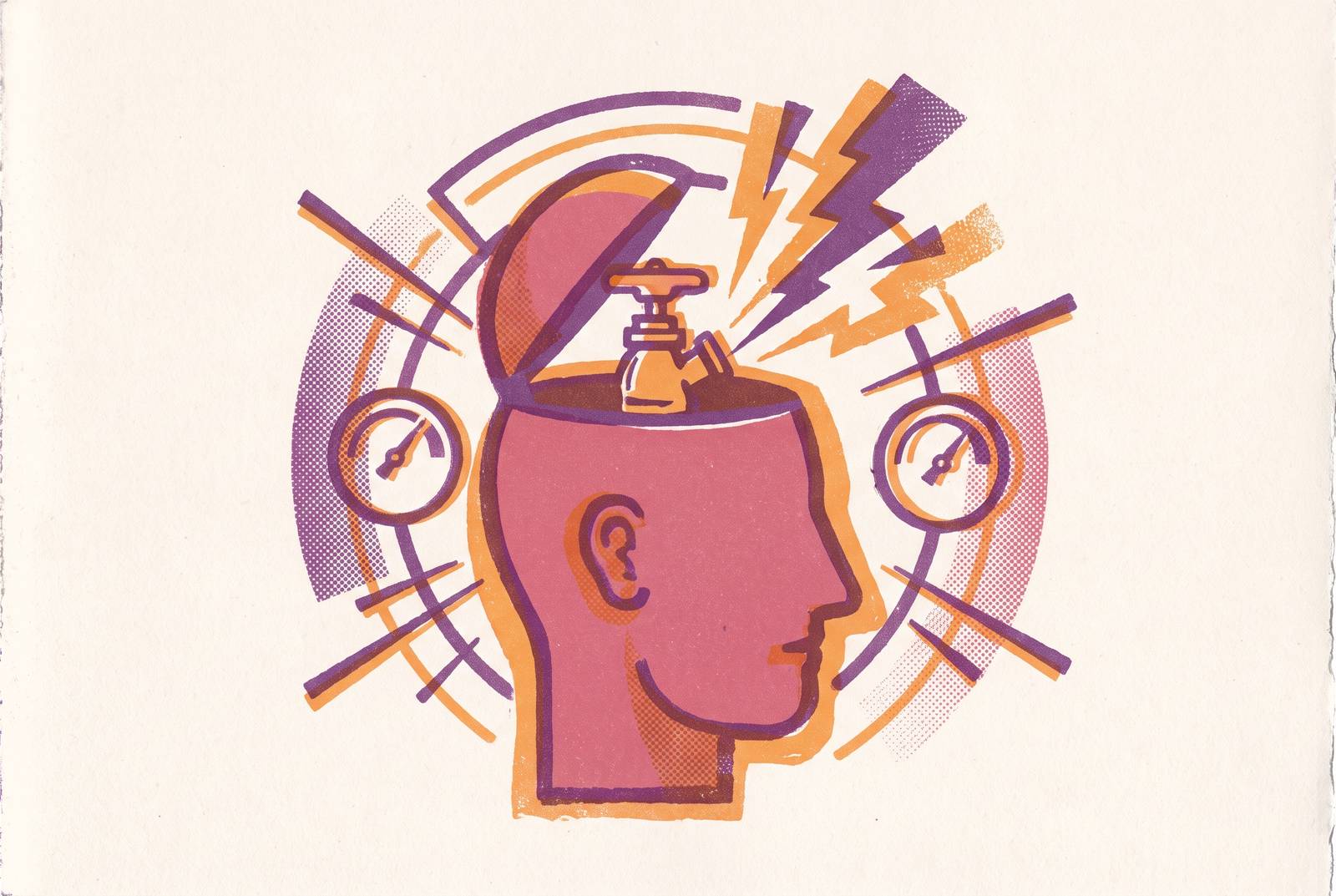
The catharsis hypothesis promises that expressing anger will purge it, but controlled research finds that raw venting often sustains the state it is meant to relieve. The useful alternative is a different kind of emotional work, using arousal reduction, reflective thought, and structured expressive writing to move beyond discharge and change an experience.
Why the catharsis hypothesis has survived so long despite failing the evidence
The idea of catharsis has an old and persuasive starting point. Aristotle's Poetics describes tragedy as purging pity and fear through the arousal of those very emotions. The modern belief that acting out anger drains it offers a similarly intuitive account of emotional relief. Something unpleasant builds up inside, letting it out releases it, and the pressure falls. As a metaphor, it is wonderfully economical.
Its staying power also owes something to a genuine experience. Venting can feel good, and that feeling appears to validate the explanation attached to it. Yet feeling relief after an action does not establish that the action has reduced anger or made aggression less likely.
What controlled research actually finds when people vent
A rage room gives the catharsis hypothesis a concrete form. Smashing objects seems to turn anger into an action that should exhaust it. Anger is a state that arousal-raising expression can maintain and rehearse. The supposed fire extinguisher can turn out to be a fuel pump.
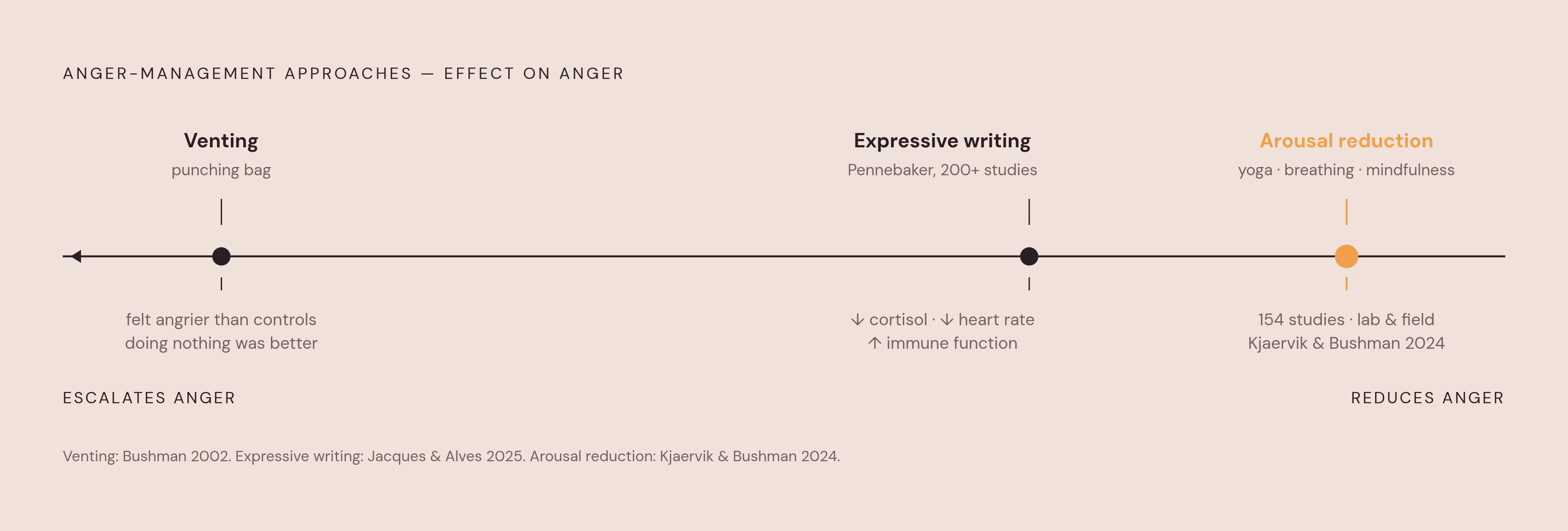
Brad Bushman puts the verdict bluntly with the statement, "There's not a shred of scientific evidence to support catharsis theory". Angered participants who hit a punching bag while thinking about the person who had angered them subsequently felt angrier and behaved more aggressively than participants in distraction or control conditions. Doing nothing was more effective than venting. Rather than ending the angry episode, rumination prolonged it, while the good feeling associated with venting could reinforce aggression.
Research on sports fans finds that watching violence primes aggressive thoughts. Twardawski et al. (2024), writing in Aggressive Behavior, tested aggressive fantasizing, a technique sometimes used therapeutically with victims. They found that it amplified subsequent aggressive inclinations, supporting the escalation hypothesis. The effect was strongest among people who already tended to show their anger outwardly, which shows that even an imagined outlet can keep anger going.
The important distinction the research actually supports — discharge versus processing
These findings could seem to imply that emotional expression itself is the mistake. That would draw the boundary in the wrong place. The important distinction is between discharge, which expresses an emotional state, and processing, which helps make sense of it. Both may involve strong feelings and candid language.
Kennedy-Moore and Watson (1999) showed that venting without meaning-making often increases distress. Admitting or speaking an emotion aloud can leave expression short of cognitive integration, the work of connecting raw feeling to an understandable account of an experience. A repeated account of a grievance may remain emotionally vivid without becoming any more workable.
This distinction also changes what counts as evidence of progress. The intensity of a disclosure is not, by itself, evidence that it has helped. Neither is the relief that follows an emotionally charged retelling. The relevant change is whether expression produces a clearer understanding. That is why two activities that look equally expressive can have different effects, and why even a structured exercise is not automatically useful.
What arousal reduction actually does to an angry or stressed state
Before that cognitive work comes a more immediate target, the body's level of arousal. Kjaervik and Bushman's 2024 meta-analytic review, spanning 154 studies, used the Schachter-Singer two-factor theory of emotion as its framework. This theory treats anger as having both a physiological and a cognitive component. Earlier research had focused too narrowly on the cognitive side. Their findings place the body's contribution back at the center of the explanation.
Arousal-reducing activities reliably reduced anger in both laboratory and field settings. These included slow-flow yoga, mindfulness, progressive muscle relaxation, diaphragmatic breathing, and taking a timeout. Kjaervik states that "Reducing arousal, and actually the physiological aspect of it, is really important". The same strategies that work for stress also work for anger because they interrupt the arousal cycle that venting extends. Calming works on a part of anger itself as well as being a polite way to handle it.
This also explains a counterintuitive finding about vigorous exercise. Although often recommended as a healthy outlet, it raises arousal and can be counterproductive specifically for anger. Ball sports and playful physical activity seem to reduce arousal more than straight jogging, so the kind of movement matters as well as whether someone moves or stays still. To start managing anger in the moment at little cost, try counting to ten, taking a timeout, or using a breathing app.
How structured expressive writing engages the brain differently from venting
When the aim is to understand an experience, writing puts it into words outside the mind, creating cognitive distance from difficult material. That distance gives thought a form that can be organized. The regulatory benefit comes from the structure brought to emotional content.
Constructing a narrative around emotion recruits the prefrontal cortex, the brain's regulation center. The work shifts from raw amygdala-driven reactivity toward narrative processing. James Pennebaker's early research at the University of Texas found that people who did expressive writing for 15–20 minutes over several days had less anxiety, lower cortisol levels, and better immune function. Regular reflective journaling over time also builds connectivity between the prefrontal cortex and the limbic system, with lower reactivity and reductions in anxiety and depressive symptoms. These findings put structured writing in a different category from venting.
More recent work adds physiological evidence. Jacques and Alves (2025), in the Quarterly Journal of Experimental Psychology, tested reappraisal-based and self-compassion-based expressive writing with college students. Both forms decreased heart rate and alexithymia, while the reappraisal group showed a higher LF/HF ratio. Crucially, the study's findings apply to the particular ways of framing an experience that it tested.
The Pennebaker protocol — what the most-tested expressive writing framework requires
The Pennebaker protocol turns that general account into a defined practice. Studied in more than 200 experiments, it asks participants to write about their deepest thoughts and feelings regarding a stressful experience. Each session lasts 15–20 minutes, with sessions held over three to four days in a row. This is a bounded exercise focused on emotionally significant material, rather than an open-ended record of daily events. Its constraints distinguish it from both ordinary journaling and an occasional written outburst.
Within each session, the writing is continuous and uncensored. There is no editing and no concern for grammar, because polishing the prose is not the task. Dropping those demands cuts down on the self-censorship that can get in the way of processing. The premise is that expressing emotion in writing leads to cognitive and emotional processing, which can then improve psychological and physical health. The structure lies in the focus and the sustained engagement.
That engagement with difficult material can produce short-term distress during writing. Immediate comfort is therefore not a reliable measure of whether the exercise is doing its intended work. Equally, discomfort is not a reason to assume that more writing must always be better. Outcomes depend on the person, the type of difficulty, and the framing of the instructions, so claims that writing lets someone become their own therapist oversell it. The method has a limited scope.
Within that scope, expressive writing is best suited to acute stress, unresolved events, and major transitions. Reflective prompt-based journaling helps people learn about themselves and keep making plans. The choice is therefore not between a serious method and an inferior substitute. It is between tools designed for different jobs.
What format and medium actually change about the writing practice
Once the purpose is clear, the medium presents a practical tradeoff between depth and ease. Handwriting uses more brain regions at the same time through fine motor engagement, spatial awareness, and tactile feedback. That multisensory processing creates stronger neural encoding of the material. Pen and paper therefore offer more than an aesthetic preference. Their physical demands are part of how the experience is processed.
Digital writing's main advantage is lower friction. A device already at hand makes it possible to capture thoughts during a commute or at the end of a day without finding a notebook and pen. Habit-formation research consistently identifies friction reduction as an effective way to maintain a behavior. A richer medium offers limited value if using it is so inconvenient that the practice rarely happens. For an ongoing routine, the best format is the one that makes meaningful engagement likely.
Convenience, however, is not the only digital consideration. Cloud-based journals risk exposing data, while local-first tools that keep everything on-device and never transmit it keep that data private. That matters when the material is vulnerable. Voice-first journaling can also remove the blank-page barrier, allowing an experience to take conversational shape before the more demanding written processing begins. Many practitioners use a hybrid, capturing quick audio or written notes on a mobile device and returning to pen and paper for deeper sessions when time allows.
When expressive writing is not enough and what to do instead
The most important limit follows directly from the distinction between processing and rehearsal. Writing can become rumination when it repeatedly reactivates an emotional memory without moving toward narrative coherence or insight. More expression is not necessarily more progress. The meaningful test is what the activity is doing to the experience.
An exercise can have clear instructions and still orient attention toward escalation rather than regulation, as the aggressive-fantasizing evidence demonstrates. The cognitive frame matters as much as the act of expression. For acute trauma, unsupported expressive writing is outside the protocol's appropriate scope, and professional guidance is the appropriate alternative. A short writing framework should not be asked to carry a burden for which it is not suited.
When anger is highly activated, use arousal-reducing tools such as breathing or a timeout. The conclusion is not that difficult emotions should stay unexpressed. Relief becomes regulation only when the response changes the state.