Pennebaker Expressive Writing Paradigm Replication Record
A landmark writing study's effects have shrunk as researchers tried replicating it.

The Pennebaker expressive writing paradigm is built on a simple bet: that people who kept traumatic secrets showed higher rates of illness, and that putting the trauma into words changes that trajectory. The theory he built to explain this was inhibition theory: keeping a secret is an ongoing metabolic tax, one that keeps the autonomic nervous system working overtime to suppress what the mind wants to process. It's a tidy story. It also, by Pennebaker's own later admission, never found direct empirical support, which is a fairly remarkable thing for a researcher to say about the theory that launched his career.
The experiment that tested this ran in the fall of 1983, with graduate student Sandy Beall doing the legwork journals.sagepub.com blog.mylifenote.ai. Forty-six college students got randomly assigned to write either about trauma or about something trivial, four days running, 15 minutes a day, with no elaborate apparatus and no longitudinal tracking beyond a health-center log journals.sagepub.com blog.mylifenote.ai. That's it. No elaborate apparatus, no longitudinal tracking beyond a health-center log. And yet the result was hard to ignore: the trauma-writing group visited the campus health center at about half the rate of the control group over the following six months The effects of expressive writing intervention in cancer patients and survivors: A rapid umbrella review. A sample that size probably shouldn't produce a result that clean. But it did, and it was replicated two years later.
The 1988 follow-up, run with Kiecolt-Glaser and Glaser, reproduced the health-center effect and added something the first study couldn't offer: immune changes theoretically consistent with better health journals.sagepub.com. That's the finding that turned a curious classroom result into a research program. The protocol itself has stayed remarkably stable since then: continuous, uncensored writing about the same emotional upheaval across four sessions, no editing, no grammar policing, no red pen. It sounds almost too simple to work. That may be why the next four decades of researchers kept trying to break it, replicate it, or figure out why it sometimes refused to show up at all journals.sagepub.com blog.mylifenote.ai. Pennebaker's starting premise held that people who kept traumatic secrets showed higher rates of illness, with roughly 15% of surveyed students reporting a pre-17 sexual trauma and that group reporting far higher symptom rates journals.sagepub.com.
How the replication record accumulated and fractured
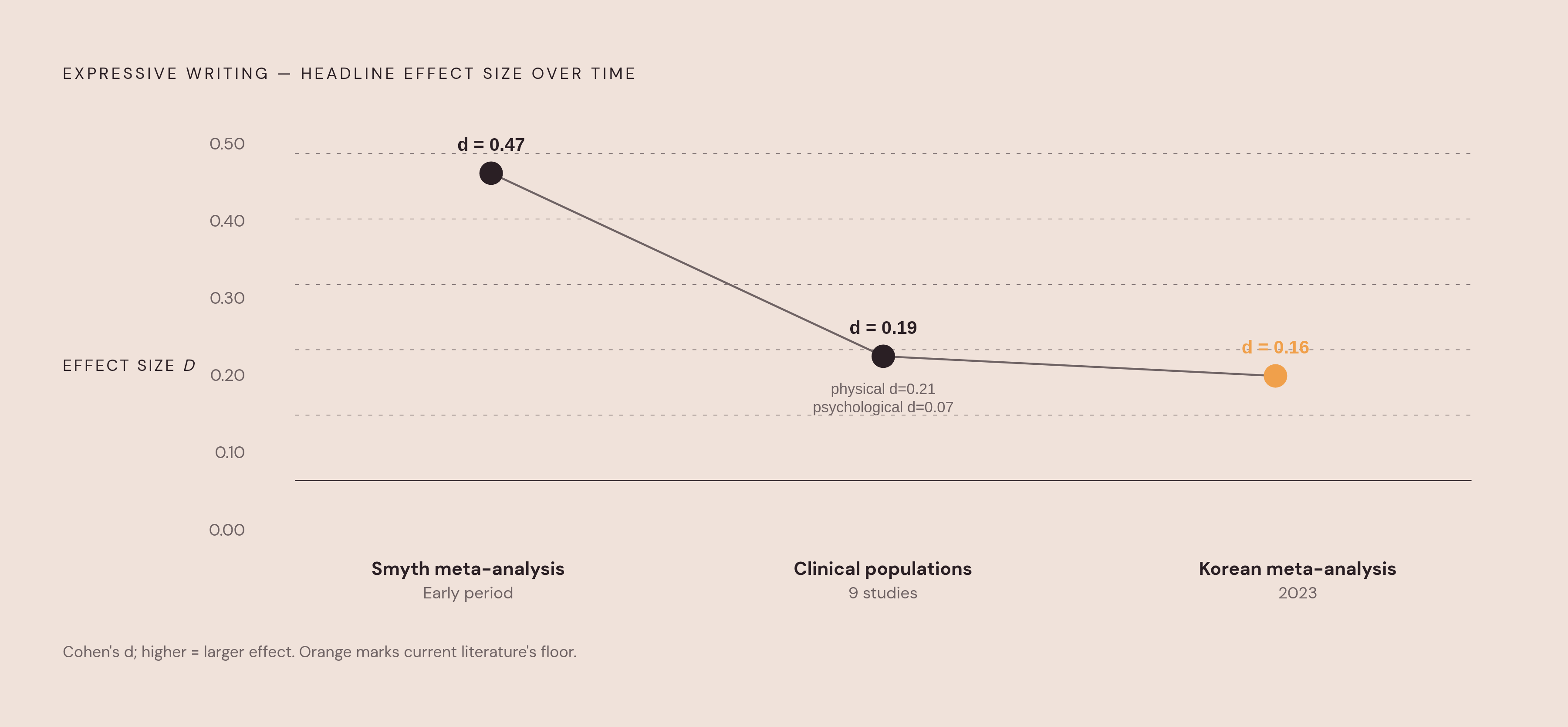
Smyth's first meta-analysis found an effect size of 0.47, a moderate effect that set high expectations ijmio.com.
A later meta-analysis focused on nine clinical-population studies found an overall health effect of d =.19, with physical health outcomes (d =.21) doing noticeably better than psychological ones (d =.07) journals.sagepub.com. That's a meaningful gap: writing about your worst day seems to do more for your immune system than for your mood, at least in aggregate. And the test of homogeneity across those nine studies came back non-significant: no single moderator explained why some studies worked and others didn't journals.sagepub.com. Which is another way of saying the effect is real but the recipe for reliably producing it hadn't been isolated.
Then came a 2023 meta-analysis in a Korean population, landing at an effect size of 0.16, not statistically distinguishable from Western meta-analyses but a long way from Smyth's original 0.47 ijmio.com. Lining those numbers up shows a pattern that should make anyone pause before citing the biggest effect size in the room: Smyth's 0.47, versus a 2023 Korean-population meta-analysis effect size of 0.16, suggesting the early estimate was inflated ijmio.com. Effect sizes have shrunk as the literature has grown, a trajectory that looks a lot like early positive bias correcting itself over time, the kind of decline replication researchers have flagged in plenty of other corners of psychology. None of this means the effect isn't real; the research base has grown large enough to support meta-analysis while staying heterogeneous enough that pooled numbers smooth over real differences in method, population, and delivery. It means the research base has grown large enough to support meta-analysis while staying heterogeneous enough that pooled numbers smooth over real differences in method, population, and delivery, the kind of differences the next section digs into directly. The claim of 200+ peer-reviewed studies is widely cited, with the aggregate finding described as positive but modest blog.mylifenote.ai.
Which protocol variables predict whether the effect appears
The replication record gets useful here because it becomes a diagnostic tool instead of a scoreboard. Frattaroli's meta-analysis isolated a set of conditions under which expressive writing reliably produced larger effects: at least three sessions, each running 15 minutes or longer, topic examples provided upfront, and participants steered toward writing about something recent rather than digging up ancient history. Studies meeting all three criteria showed a larger overall effect size than the literature at large.
Timing between sessions matters too. Studies with intervals of 1–3 days between sessions yielded significantly higher effect sizes scribd.com. Too close together and there's no time for the material to marinate. Too far apart and the continuity that seems to matter, the sense of returning to unfinished business, breaks down.
Then there's engagement, measured crudely but effectively by how much people actually wrote. One study compared traditional expressive writing against an "acceptance-enhanced" version (AEEW) and found condition differences only for participants who wrote longer essays; for that group, AEEW outperformed both control and traditional EW, while traditional EW did not differ significantly from control. Among that subgroup, the acceptance-enhanced version beat both the control condition and traditional expressive writing outright. But traditional EW, on its own, failed to significantly outperform the control group. Which raises an obvious question: is expressive writing failing to replicate in some studies, or is it simply not getting run long enough, spaced correctly, or written into with any real commitment?
That question gets sharper with the 2007 finding that expressive writing shifts the actual language people use, increasing causal terms like "because" and "effect," alongside insight words like "consider" and "know" journals.sagepub.com blog.mylifenote.ai. That's cognitive processing appearing on the page in real time, not emotional venting, which suggests the linguistic work itself, not just the release of pent-up feeling, is where the benefit lives. More recent protocol experiments have tried to isolate that mechanism directly. A lot of what looks like "replication failure" in this literature is actually a fidelity problem. Changing the dosage, the spacing, or the depth of engagement means testing a different intervention, so it shouldn't surprise anyone when it doesn't produce the same result. In 2025, protocol variation studies examined turning-point writing, a narrative about a life-changing moment, compared with traditional EW for emerging adults aged 18–25, alongside reappraisal EW and self-compassion EW as alternatives, both aiming to induce emotion regulation through cognitive restructuring.
Neural evidence for the proposed mechanisms
Inhibition theory was always the founding story: suppressing a trauma costs the body something, ongoing physiological upkeep that writing supposedly relieves, letting stress hormones and immune function drift back toward baseline. It's an intuitive metaphor, holding something in as a kind of muscle strain. The trouble, as already noted, is that Pennebaker's own later account never found direct empirical confirmation for it.
A competing account has picked up more support over time: narrative coherence. The idea here isn't that disclosure itself heals, it's that organizing a chaotic memory into a coherent story reorganizes how that memory sits in the mind, restructuring it into something less disruptive. That's a meaningfully different theory from inhibition theory, because it locates the healing in the construction of the story, not in the act of confession.
And there's direct evidence against the simplest version of catharsis theory, the idea that just getting the feelings out is what matters. Writing only about the emotions tied to a trauma, without engaging the facts of what actually happened, produces weaker outcomes than writing about both the event and the feelings together. Venting alone doesn't seem to be doing the heavy lifting.
What about the brain itself? A cognitive-load hypothesis would predict that expressive writing reduces activation in brain regions associated with the effort of suppression, areas like the dorsolateral prefrontal cortex, once that suppressive labor gets released onto the page. It's a clean, testable prediction. Nobody has actually tested it. No expressive writing intervention in this literature has examined neural processing directly. The entire mechanism conversation, inhibition, narrative coherence, cognitive load, is built on inference from behavior and self-report rather than anything measured inside a scanner. Pennebaker's own synthesis, after decades of running this research program, is that there's no single mediator: expressive writing sets off a cascade of effects rather than pulling one clean lever. That's honest, and it's also a little unsatisfying, in the way most honest answers in psychology tend to be. It also explains why different prompts might activate different parts of that cascade, producing different downstream effects between, for instance, a turning-point narrative and a self-compassion variant. They may not be triggering the same mechanism at all.
Who benefits and who doesn't (the individual-difference moderators)
Pennebaker's own hunch, based on his early work, was that reticent people, the habitual suppressors, the ones who keep things bottled by disposition rather than circumstance, stand to benefit the most from being handed permission to write it all out. That's intuitive. If inhibition is the cost, then the people paying the highest inhibition tax should get the biggest refund.
But there's a competing idea, sometimes called the matching hypothesis, which holds that people who already tend to feel and express emotion openly are the ones who benefit more, because expressive writing plays to a skill they already have rather than asking them to build one from scratch. Both hypotheses have empirical support behind them, which means the honest answer is that the field doesn't currently have a settled account of who benefits most. Other candidate moderators floating around the literature: how someone typically handles stress, their capacity for self-regulation, and the shape of their interpersonal relationships. None of these have hardened into a reliable predictive profile yet.
Cultural background adds another layer. Expressive writing is fundamentally about expression of suppressed thoughts and emotions, and its effect may differ for people from Asian cultural contexts where emotional suppression is more normative, consistent with though not proof of the Korean meta-analysis effect size of 0.16. The 2023 Korean meta-analysis, with its effect size of 0.16, sits comfortably with that idea ijmio.com. It is consistent with the cultural explanation without proving it. It's consistent with it, which in this literature counts as progress.
Gender, oddly, has barely been examined as a moderator in this replication record at all, despite an obvious hypothesis sitting right there: does traditional masculinity, with its own norms around emotional expression, predict differential benefit? Nobody seems to have run that analysis with any rigor.
The most useful recent data point comes from a 2025 grief-focused meta-analysis covering 13 randomized controlled trials, built to a recognized standard for systematic review reporting doi.org. Overall effect sizes were small, Hedges' g = 0.388 for grief and 0.308 for depression doi.org. But subgroup analysis found something sharper: effects jumped to moderate, g = 0.583, when studies used a higher number of sessions, and jumped further still, to g = 0.679, when therapist feedback was part of the delivery doi.org. That therapist-feedback number is the standout finding in this entire section, because it implies something uncomfortable for anyone hoping expressive writing is a fully do-it-yourself intervention: unsupported, solo writing may simply be a weaker version of the same tool.
What the positive-writing literature adds against the EW standard
Expressive writing asks people to confront the worst thing that happened to them. A parallel literature has grown up around the opposite proposition, positive writing, which skips the trauma confrontation entirely. A 2025 systematic review in PLOS ONE covered 51 studies across seven positive-writing techniques, and found that gratitude letters and "best possible self" exercises produced the most consistent improvements in wellbeing.
That sounds like good news for anyone who'd rather not relive their worst day for a research protocol. But the same review delivered a blunter verdict on its own evidence base: every included study was rated poor or fair in quality. That's a harsher judgment than anything leveled at the Pennebaker literature, which for all its shrinking effect sizes and unresolved moderators, at least has decades of meta-analyses, immune assays, and health-center records behind it. Positive writing is lower-cost, emotionally speaking. Nobody has to dig up a trauma to write a gratitude letter. But lower emotional cost hasn't come with a correspondingly rigorous evidence trail.
There's a structural reason the original Pennebaker findings commanded attention that positive-writing studies haven't quite matched: physical health outcomes, immune markers, health-center visit logs, are much harder to fake or unconsciously bias than a self-reported wellbeing scale. That's an odd kind of built-in credibility, and it's part of why a "horribly underpowered" 46-person study from 1983 still gets cited today journals.sagepub.com blog.mylifenote.ai. Neither branch of this literature, expressive or positive, has landed on a clean, high-quality evidence base yet. Neither one should be treated as settled science.
What the replication record means for someone who wants to use expressive writing
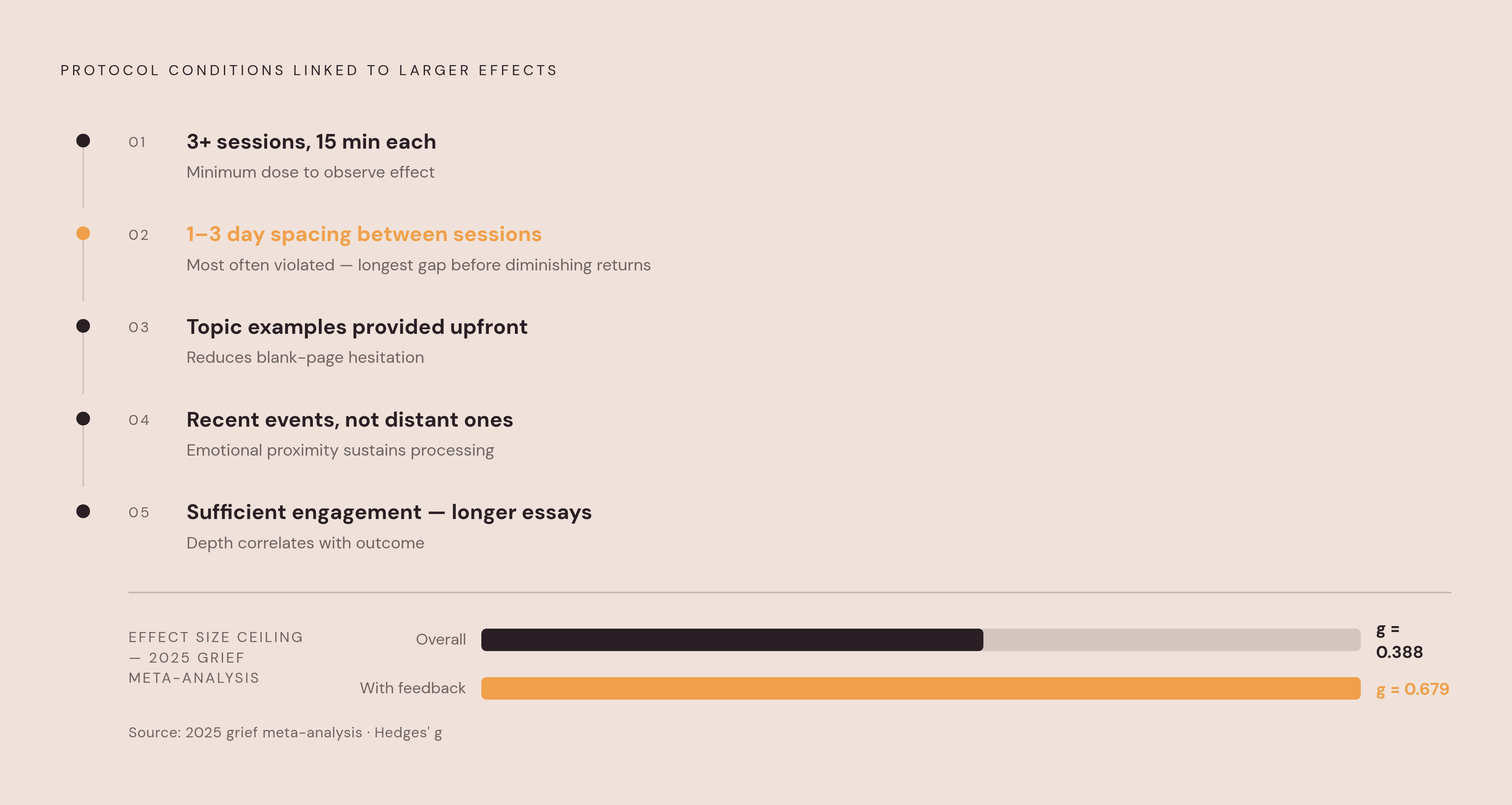
Stripping away the meta-analytic noise reveals a fairly specific operating manual. The conditions the evidence consistently favors: at least three writing sessions, each running a minimum of 15 minutes, spaced one to three days apart, focused on something recent rather than a decade-old wound, with enough genuine engagement to produce writing that actually runs long scribd.com. Skipping any of those conditions creates a real chance of running a diluted version of the protocol and mistaking it for a failed one.
Solo practice versus guided practice is a separate distinction. The grief meta-analysis found that therapist feedback pushed effect sizes from small into moderate territory doi.org. That doesn't mean writing alone is worthless, the original 1983 study, after all, involved no therapist at all journals.sagepub.com blog.mylifenote.ai. It does mean anyone expecting guided-therapy-level results from an entirely unsupervised four-day writing stretch should adjust expectations downward, just slightly journals.sagepub.com blog.mylifenote.ai.
None of this makes expressive writing a universal fix. Effect sizes across the modern literature run small to moderate, physical outcomes have consistently outperformed psychological ones, and some people, possibly the more reticent among us, seem to get more out of it than others, though the field hasn't nailed down exactly who. What's clearer is the shape of the mechanism that seems to matter most: writing that builds toward some kind of narrative coherence, connecting the event to the feeling to some larger sense of what it meant, consistently outperforms writing that just cycles through raw emotion without ever organizing it.
None of the theorizing above needs to be resolved before someone puts pen to paper, or fingers to keyboard, or voice to a recorder, and some people find that speaking, through apps like Joice, a voice journaling app where you talk through your thoughts and it responds in real time with follow-up questions, removes the friction of the blank page more reliably than typing does. The core demand of the protocol was never about the medium. It was continuous, unedited, private output, the removal of every barrier between a thought and its expression. Whatever format lowers the friction of just starting, and keeps someone returning across multiple sessions rather than quitting after one, is doing the job the research keeps pointing back toward: engagement, continuity, and enough runway for a messy story to become a coherent one.