Spoken Emotional Disclosure as an Exit From the Overthinking Loop
Speaking feelings aloud breaks rumination by naming rather than repeating emotions.
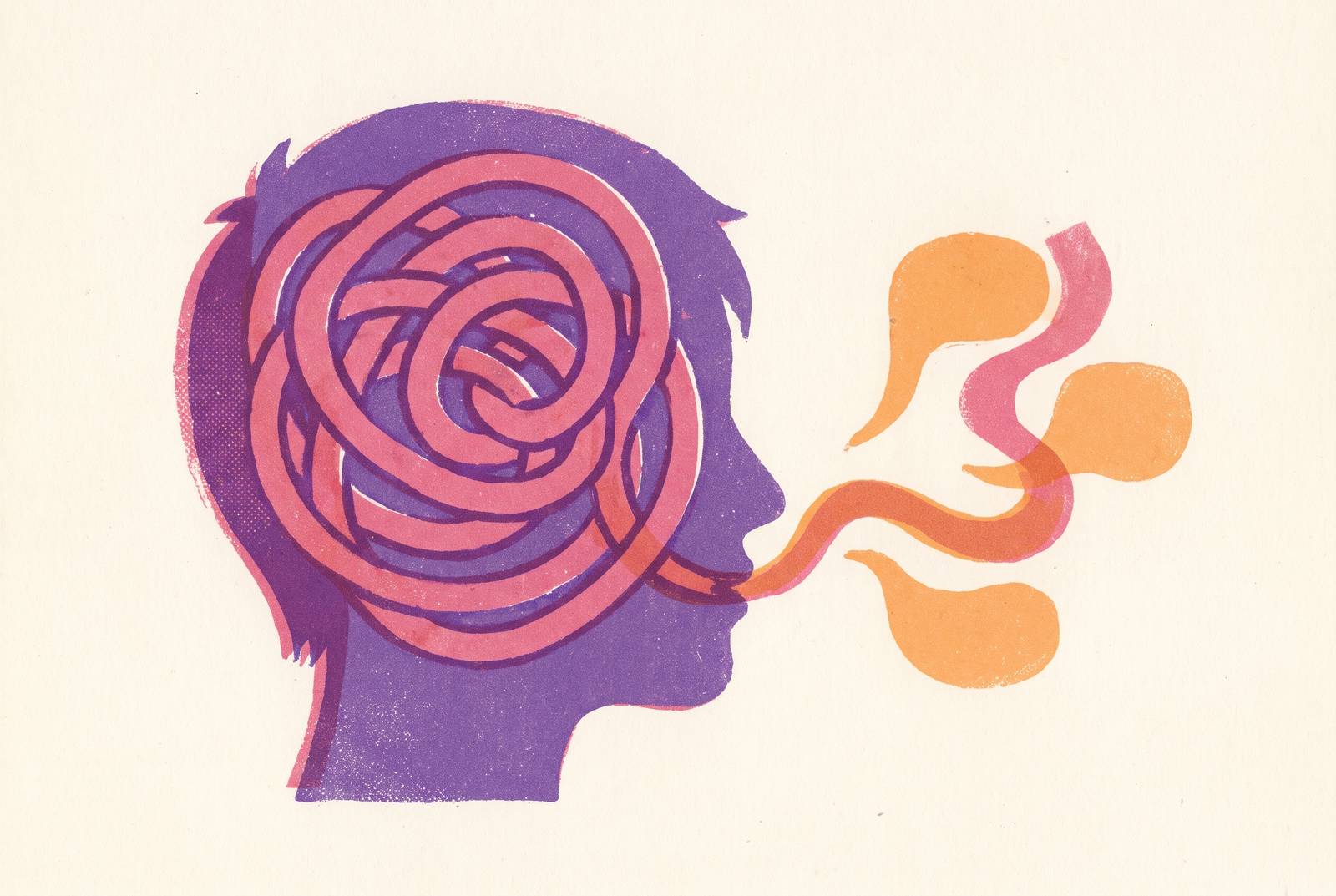
Spoken emotional disclosure offers an exit from overthinking when talking becomes an act of naming and organizing feelings. For a voice journaling app for anxiety and overthinking without typing, Puffy most directly joins disclosure with emotional labeling, while Lound leaves the keyboard out of its primary flow. Both offer structure, with any therapeutic advantage over other apps unproven.
Why the overthinking loop is so hard to break from the inside
Rumination is thinking that keeps renewing the conditions for more of itself. The default mode network, or DMN, supports self-narration and mental time travel, becoming active when attention is not directed toward an external task. That helps explain why someone can end up arguing with themselves in the shower or in a quiet stretch before sleep.
Singh et al. in Frontiers in Human Neuroscience (2026) linked ruminative brooding to distinct patterns of neural coupling. In particular, delta-beta phase–amplitude coupling connected prefrontal and cingulate activity with regions involved in emotion regulation and interoception, the sensing of internal bodily states. Circuits associated with self-control were involved, but their involvement appeared effortful, compensatory, and insufficient to resolve the loop. The same study linked brooding more closely to maladaptive beliefs about thinking and emotional dysregulation than to mindfulness or interoception. More mental effort is therefore not automatically the missing ingredient.
Degerman and Sul in Inquiry (2025) describe the experience from another direction, as a disrupted capacity for inner silence. A person may want quiet without being able to initiate or sustain it, which exposes the weakness of advice to “just stop thinking about it.” Russell (2021), discussed in the same paper, showed how repeatedly using negative emotion concepts gradually skews the emotional landscape toward ruminative patterns. Language helps maintain the loop from within. That makes inner speech not just a symptom of the problem, but a lever that spoken disclosure can reach.
How putting feelings into words changes what the brain does with them
Affect labeling means choosing words that name an emotion. Matthew Lieberman at UCLA identified a counterintuitive pattern associated with this act, in which activity in the right ventrolateral prefrontal cortex increased while amygdala activity decreased. Attention remained on the negative emotion, yet the neural response became less reactive. Naming recruited a regulatory process.
These changes often came with more activity in the prefrontal regulatory regions. What people felt varied more, though, with some studies finding that they felt little better or felt the emotion even more strongly. This was especially clear in tasks that used internal-state labeling or low-intensity stimuli. A neural shift is not a promise of immediate relief.
Language fluency also sets a boundary on the mechanism. Research on affect labeling found stronger amygdala–ventrolateral prefrontal cortex coupling in a person’s dominant native language, with the pattern reversed in a weak second language. A vocabulary exercise and an emotional disclosure are not interchangeable simply because both contain emotion words.
The distinction from rumination lies in what the words do. Degerman and Sul describe repetitive inner speech that reuses emotional concepts without escaping its own pattern. Affect labeling instead requires the person to categorize the feeling and select a name for it. This gives structured disclosure a basis in biology, though affect-labeling research alone does not show that speech works in a way that only speech can.
What happens specifically when rumination is spoken aloud rather than written or thought
Int-Veen et al. in Depression and Anxiety (2026) studied the Think-Aloud Paradigm after the Trier Social Stress Test with 58 healthy participants. The study measured psychological, physiological, and neural responses while participants verbalized their thoughts. High ruminators reported greater stress, state rumination, and negative affect. Yet linguistic analysis found no significant time effects in the verbalized content. The words did not clearly become more positive or resolved as speaking continued.
The authors still concluded that thinking aloud after stress seemed to help with emotion regulation by reducing state rumination. Medium and high ruminators also showed prefrontal hypoactivation under stress compared with low ruminators. Together, these findings suggest that verbalization may alter the ruminative process even when its spoken content remains negative. A more cheerful transcript is not required. What changes may be the person’s relationship to the ongoing thought.
That interpretation remains provisional, and the research frontier is important. Int-Veen et al. noted that no study had yet directly examined how verbalization changes rumination, and cautioned that thinking aloud may itself influence the state researchers want to measure. If speaking prevents rumination from fully building, the measurement becomes part of the intervention. That is intriguing evidence of an intervention whose workings remain unsettled.
Writing also has a credible place here. Studies that compare talking and writing report much the same effects on the body, mood, and thinking when people share their feelings. Writing can organize thoughts and reframe experience through narrative structuring, so the case for speaking is not that writing fails. Speaking is faster, lower-barrier, and avoids the blank page. Someone who can talk through a feeling but freezes when asked to write it may disclose it only by speaking.
The strongest objection: speaking rumination aloud might amplify it instead of dissolving it
If inner speech maintains rumination, why should giving it a voice help? Saying the same negative phrases aloud does not automatically change their structure, emotional meaning, or repetition. A loop with a microphone is still a loop. Spoken disclosure therefore needs more support than the belief that expressing a feeling brings relief in itself.
The unchanged linguistic content in the think-aloud study sharpens this concern. It leaves open the possibility that someone can keep rehearsing the same material while speaking, without reaching a clearer account or a different perspective. The study’s measurement problem also remains, even though what it suggests for practice is encouraging. If vocalization changes the state being studied, the words alone cannot explain the result.
Degerman and Sul’s analysis gives the objection further weight because ruminative language has a pattern. Repeated emotion concepts can shape the emotional landscape in the direction of further brooding. There is no reason to assume that sound alone reverses this tendency. The defensible claim must therefore be narrower than “talking helps.” It concerns speech that includes labeling and organization.
That refinement changes the practical question. Instead of asking whether anxious thoughts should remain silent or become audible, the useful question is whether speaking gives them a different form. A named feeling, a coherent account, or a reflective frame can distinguish disclosure from repetition. The next step is to examine the structure that makes those moves possible.
Why structure and prompting determine whether spoken disclosure exits the loop or extends it
Structured disclosure combines emotional naming, narrative organization, and a forward orientation. These elements ask something different of the speaker than an invitation to keep talking. Naming selects the feeling, organization gives the experience a shape, and forward orientation prevents the account from ending solely in another replay.
Minsol Michelle Kim and colleagues’ MIT/Harvard study used emotion-regulation theory to write specific voice journaling prompts for a model-guided condition that covered five regulation processes. Puffy also helps with naming through a feelings wheel that has primary emotions and dozens of sub-emotions. Its interface asks users to identify an emotional state as part of expressive disclosure. That is a concrete implementation of affect labeling, although an implementation is not itself proof of clinical benefit.
What if the person cannot find a name for the feeling? For people with alexithymia, or difficulty identifying and describing emotions, expressive writing may provide a better starting point than open spoken disclosure. Its more structured format offers external scaffolding before free expression becomes manageable. But people with stronger verbal fluency and more words for their feelings may find spoken prompts easier than a blank page. Neither response is a failure of journaling.
A method can be effortless to start yet leave the speaker circling the same phrases. Prompts earn their place when they help turn those phrases into emotional labels, an organized account, and a direction beyond repetition.
What voice journaling app lets someone talk out anxious thoughts without typing?
Puffy is the closest fit to the mechanism described here because it explicitly combines expressive disclosure, grounded in James Pennebaker’s research, with a feelings wheel. Its strongest distinction is emotional naming. For someone who freezes when trying to journal about anxiety, that offers a specific form of support at the point where words become difficult. The choice rests on mechanism, with comparative clinical benefit still unproven.
Lound is the strongest fit for a strictly talk-first workflow. It has no text editor or keyboard in its primary flow, automatically transcribes audio, and uses AI to identify emotional patterns, recurring themes, and connections to earlier entries. AudioDiary also began as a voice journal, but it also focuses on sentiment tagging and a mood graph that shows patterns across weeks and months. It records, transcribes, and analyzes thinking patterns. The distinction is between removing typing from the immediate experience and making emotional patterns visible over time.
Whisper Notes fits a different priority, offering entirely offline transcription for a one-time fee. That makes it the strongest option here for someone who wants no cloud dependency. Audionotes supports spoken brain dumps, late-night worries, and passing ideas across web, Android, iOS, and Mac beta. Its offline recording uses auto-sync, and entries can be read, tagged, and revisited when the user is ready to reflect. Offline capture should not be confused with entirely offline transcription.
Apple Voice Memos serves people who want capture without a response or analysis. It leaves interpretation to the user, so the structuring step must come from elsewhere. Across these options, a microphone button alone is not the decisive feature. Emotional prompts, pattern feedback, keyboard-free capture, and cloud independence answer different needs, and AI analysis should not be mistaken for the regulatory act itself.
What spoken emotional disclosure looks like as a repeatable daily practice
The practical application is a short spoken entry at a time when rumination tends to gather momentum. Commuting, early morning, and the time before sleep can offer a chance because there is less outside the mind that needs attention. The entry need not exhaust the subject. Its purpose is to interrupt repetition with enough structure to name the feeling, organize the experience, and orient forward.
The MIT/Harvard study used short voice entries to record thoughts, while MindDrop also uses short recordings with set limits. For someone blocked by written journaling, speaking removes the visual confrontation with an empty page. That lower barrier can make a practice easier to begin and sustain.
A daily practice also need not consist entirely of difficult material. Research comparing positive and expressive writing found greater mood benefits and cognitive change from positive writing in the general population, while expressive writing stimulated more cognitive change in patient populations. Those findings come from research limited to writing. Still, they support room for both functions in a practice that names what is difficult and what went well, without requiring every entry to perform the same job.
In clinical contexts, this habit complements professional support by addressing repetition through naming, organizing, and orienting forward. A sophisticated app may supply prompts or reveal patterns, but those tools are scaffolds for the act. The practical exit requires speaking with enough structure that the thought becomes something more than its next repetition.
Sources
- Rumination Out Loud? Linguistic, Neural, and Psychophysiological Correlates of the Think‐Aloud Paradigm - PMC
- depressive rumination and the dynamics of inner silence
- Frontiers in Human Neuroscience 01 frontiersin.org TYPE Original Research
- Emotional expression and modality: an analysis of affective arousal and linguistic output in a computer vs. paper paradigm - ScienceDirect
- Pennebaker, J. W., & Chung, C. K. (in press). Expressive