Verbal Processing in Grief and Traumatic Loss
Naming grief rewires the brain's emotional and memory systems in ways plain rumination cannot.

Grief is not a metaphor for pain. It is a physical event that reorganizes the brain, and in doing so, it damages the very systems a person needs to recover from it. The injury and the healing mechanism run through the same neural real estate.
Start with the prefrontal cortex, the region responsible for emotional regulation and decision-making. During acute grief, activity there drops, which means the part of the brain meant to keep feelings in check is, quite literally, offline when it is needed most. Layer onto that the supramarginal gyrus, a region tied to phonological processing and verbal working memory. Grieving parents show measurable atrophy there, linked to deficits in cognitive inhibition rather than a breakdown of verbal working memory itself, according to a 2025 narrative review by Statharakos in Brain Science Advances. That distinction matters more than it sounds. It means the damage sits close to language systems without fully disabling them, which is exactly the kind of detail that makes verbal processing plausible as an intervention rather than wishful thinking.
The same review maps disruption across the amygdala, hippocampus, and prefrontal cortex, along with the default mode network and reward circuitry. None of this happens in isolation. Hormonal systems shift too: oxytocin and cortisol both climb, and epigenetic modifications to stress-related genes compound the effect, which goes some distance toward explaining why grief looks so different from one person to the next. The biology gives a partial answer for why.
None of this is cause for alarm on its own; grief is supposed to feel disorienting because the brain is adapting to an absence it was never built to expect. But when the disruption persists past what is culturally and clinically expected, it gets a name. Prolonged grief disorder is now a formal diagnosis in both the DSM-5-TR and the ICD-11, each specifying a minimum duration of symptoms before the label applies, marked by intense yearning, a disrupted sense of identity, and real functional impairment. That formalization separates PGD from ordinary bereavement, from PTSD, and from major depression, and it matters for everything that follows: if grief can fail to resolve on its own, there is a reasonable question about what helps it resolve, and why.
How traumatic grief fragments memory into intrusive images
Traumatic loss does something ordinary grief does not. It stores the experience of loss in a format the brain cannot easily retrieve or make sense of, which is a different problem than sadness, and a harder one to solve.
Here is the mechanical distinction. Non-traumatic memories get filed by the hippocampus in narrative form: beginning, middle, end, with context and meaning stitched in. Traumatic memories skip that filing system. A plain verb: intrusive images appear instead of narrative, fragments that arrive uninvited and carry the full emotional charge of the original moment. A 2026 mixed-methods study published in Memory found that these intrusive grief-related images are directly associated with prolonged grief symptoms and with maladaptive grief cognitions. In other words, the fragment does not fade the way a story fades. It repeats.
Why does it repeat instead of resolving on its own, the way most difficult memories eventually soften? The honest answer is that traumatic grief frequently travels with PTSD and prolonged grief disorder at the same time. A Concordia University thesis by Theresa Xiong, completed in April 2025, found this overlap to be common rather than incidental. That co-occurrence matters because the memory dysfunction and the grief itself are not separate ailments running in parallel. They reinforce each other: the intrusive image keeps the loss raw, and the raw loss keeps generating intrusive images.
The dual-process model offers a useful frame for what healthy grieving looks like against this backdrop. It describes an oscillation between loss-oriented coping (confronting the reality and pain of the loss) and restoration-oriented coping (attending to life's practical demands, taking breaks from grief). That oscillation is supposed to happen. When traumatic intrusions dominate, though, the swing breaks down, and a person gets stuck in loss-oriented processing with no counterweight, which raises the risk of prolonged grief disorder considerably. The pendulum stops swinging. This is the diagnostic picture, and it is worth letting it sit uncomfortably for a moment rather than rushing to the fix. The fix is coming. Understanding what is broken, a filing system stuck on repeat, is the only way the fix makes sense later.
What happens in the brain when grief finds language
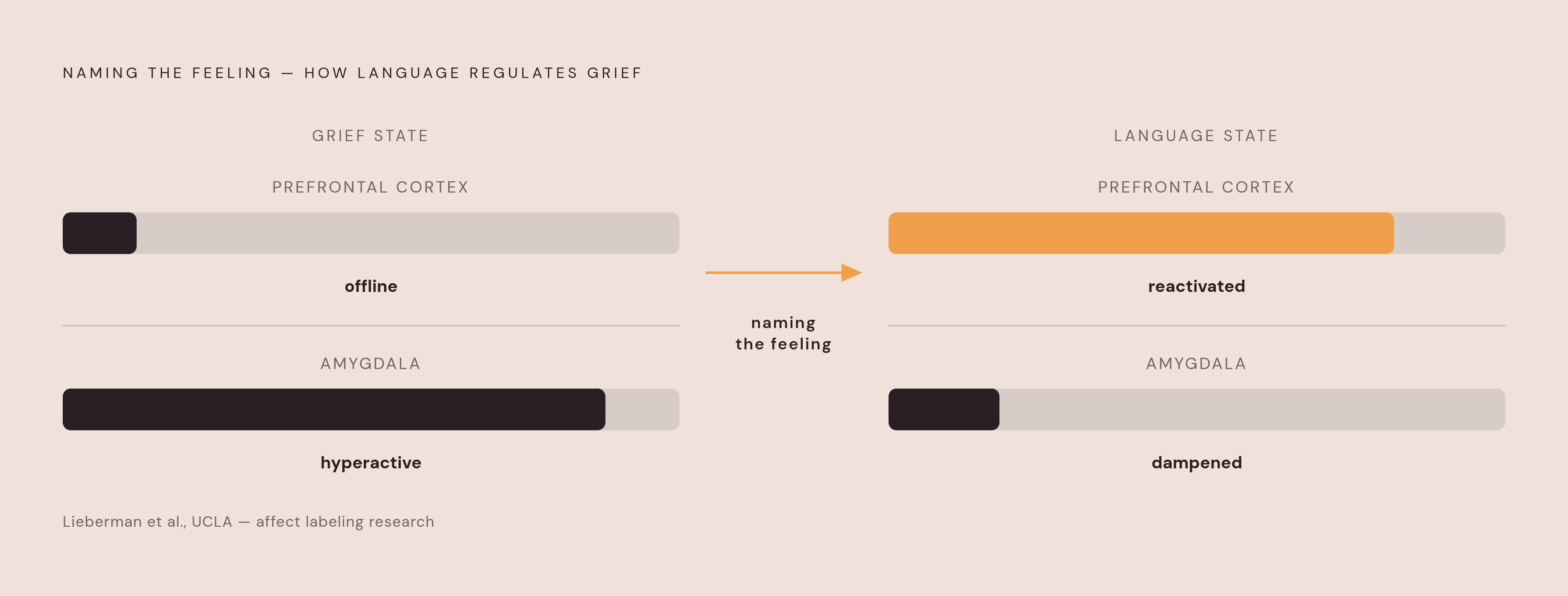
Naming grief out loud, or on paper, is not catharsis in the loose, feel-better sense people usually mean. It is a specific neurological operation, and it can be traced with some precision.
Matthew Lieberman's research at UCLA on affect labeling found that when people put a feeling into words, amygdala activation drops while activity in the right ventrolateral prefrontal cortex rises. Language routes the emotional signal through the regulatory system that grief had suppressed in the first place. The prefrontal cortex, the same region shown to go quiet during acute grief, gets reactivated specifically through the act of naming what is being felt. That coincidence reflects the mechanism itself. It is the mechanism doing what the earlier section said it could not do on its own.
What about the memory fragment, the intrusive image from the previous section? Expressive writing appears to move traumatic memories out of amygdala-format storage and back toward the hippocampal, narrative format, the one with a beginning, middle, and end. Writing also seems to bring the brain's two hemispheres into better communication; trauma disrupts that connectivity, and verbal narration works in part by restoring it. Pennebaker's research adds a further data point: expressive writing and narrative therapy reduce amygdala hyperreactivity to grief-related stimuli, which lowers the involuntary, intrusive quality of the memories themselves. The image stops arriving uninvited quite so often, because the story around it has somewhere to go now.
One might argue back immediately, and reasonably: doesn't talking about grief just stir it up again? Isn't dwelling on a painful memory the opposite of moving past it? It is a fair objection, and it hinges on a distinction that gets lost if the wellness framing takes over: unguided rumination and structured verbal processing are neurologically distinct activities. Rumination loops. It circles the same image without adding context, without resolution, the mental equivalent of rereading the same paragraph forever. Narrative processing moves. It adds sequence, cause, and consequence, converting fragment into story. Same subject matter, entirely different route through the brain.
Verbal processing works on a spectrum, from clinical therapy to personal journaling
If naming grief regulates the amygdala and rebuilds narrative memory, the format that naming takes turns out to be less important than whether it happens at all. That is not the same as saying every format works equally well for every kind of grief. It is closer to saying the mechanism runs through all of them, at different doses.
At the clinical end sits Complicated Grief Treatment, developed by Katherine Shear at Columbia University. CGT is the best-evidenced therapy available for prolonged grief disorder, and narrative retelling of the loss sits at its core. This is not a format someone improvises with a notebook and good intentions; it is a structured, therapist-guided protocol built for a diagnosable condition, and it should stay in that lane.
Further along the spectrum, toward the self-directed end, is the Pennebaker expressive writing paradigm from the 1980s: write about a distressing event for a short session, repeated across several consecutive days. It requires no therapist and reproduces outside clinical settings with reasonable fidelity. Somewhere between structure and freedom, Stockton and colleagues found in 2013 that guided prompts produce deeper emotional processing than open-ended freewriting for people in grief. Structure, it turns out, is doing real work here, not just organizing the page.
Unstructured journaling still earns its place, because grief does not move in a straight line, and honoring its unpredictability has value of its own; combining structured and unstructured writing can address different stages of the same process. Letter-writing to the person who died, telling them about the day, what went unsaid, what is happening back home, fits into the continuing-bonds tradition of grief theory, which treats an ongoing relationship with the deceased as healthy rather than something to be resolved away. That framing separates letter-writing from catharsis-only models; the point is not to purge the feeling but to sustain the relationship in a form that still fits.
There is also a rough map for where someone sits inside the process. The four-stage emotional processing model traces an arc from global, undifferentiated distress, to early naming of specific states like anger, fear, or shame, to negative self-evaluations and unmet existential needs, and finally to differentiated meaning-making with some positive self-regard mixed in. It is a scaffold, not a ladder with a required order, but it gives a person some way to locate themselves in something that otherwise feels formless. And the instructions given before writing shape the outcome: framing the exercise around reappraisal versus self-compassion produces measurably different emotion-regulation results, so the prompt itself is part of the mechanism, not just a warm-up act. Heather Stang's 8-Step Mindfulness and Grief System, covered in The Handbook of Grief Therapies and given the Association for Death Education and Counseling's 2025 Clinical Practice Award, pairs guided journaling prompts with nervous-system-focused meditation, a working example of structured verbal processing that lives outside formal therapy without pretending to replace it.
Who bears the heaviest grief burden and why standard approaches fail them
Grief is not distributed evenly across a population, and neither is the research base built to treat it. That mismatch deserves attention on its own terms.
Communities of color in the United States have absorbed grief that compounds in ways individual bereavement research rarely accounts for. This is not one loss to be narrated and integrated. It is layered, recurring, and often ongoing while the person is still trying to process the last instance of it.
So how well do existing verbal processing frameworks serve this population? Chang's review of meta-analyses found that many existing grief-intervention studies simply do not report participant race or ethnicity at all. That is not a footnote. It means large parts of the evidence base for verbal processing were built, tested, and validated without any deliberate attention to whether they work for communities of color specifically. A framework can be neurologically sound, backed by Lieberman's affect-labeling work and Pennebaker's writing protocols, and still carry blind spots simply because nobody checked who was in the sample.
Clinical symptom-reduction models can end up treating grief as a private malfunction to be corrected, when some of that grief is a coherent response to structural conditions that have not changed. Persistent, treatment-resistant grief in this context may not be pathology at all. It may be an accurate read of ongoing danger.
Age complicates the picture further. Children and adolescents do not grieve the way adults do; their grief comes in shorter, more intermittent bursts, and it appears through play and behavior more often than through words, shaped by where they are developmentally in understanding death and narrative itself. A verbal-processing framework built around adult narrative capacity will simply miss most of what a grieving eight-year-old is doing.
Columbia University researchers built the EMPATH framework to study exactly this kind of gap in practice, applying it to text-based crisis conversations with self-identified Black texters discussing grief through Crisis Text Line. The findings pushed back against a tidy story: persistent negative affect, gradual and uneven movement toward hope, distinct emotional roles played by texter and volunteer, and recovery trajectories that varied widely from person to person. Grief support through language, in other words, is not a straight line from distress to resolution, even when the support itself is working. EMPATH's authors also found meaningful gaps between synthetic dialogue and authentic conversation, a detail relevant for anyone weighing AI-assisted grief tools against the real, messier thing. Communities of color in the U.S. have faced compounding traumatic losses, from over 1 million COVID deaths in the U.S. overall, which disproportionately impacted communities of color, per Chang's April 2025 healing justice paper in Frontiers in Psychiatry, from police killings, and from structural conditions including incarceration, residential segregation, food insecurity, and environmental exposure, that create grief qualitatively different from individual bereavement.
Scaling verbal grief processing to displaced and underserved populations through online formats
If the access gap is the problem, online expressive writing is one concrete answer, tested rather than assumed. A 2026 study out of Ruhr University Bochum in Germany, published in the Journal of Immigrant and Minority Health, studied online thematic expressive writing for refugees diagnosed with prolonged grief disorder, comparing a restoration-oriented writing group against a loss-and-restoration-oriented group. Refugees are about as underserved a population as exists for clinic-based grief therapy: displaced, often without stable access to mental health services in whatever country they have landed in, frequently carrying losses that are both personal and collective.
The study's core finding: thematic expressive writing, used as a guided self-help tool, increased integrated grief and helped prevent further mental health deterioration in this population. That is a meaningful result because clinical therapy was never the alternative on the table for most of these participants in the first place.
The mechanism is not limited to bereavement in the traditional sense, either. An active clinical trial at the University of Alabama at Birmingham, registered as NCT06147258, is testing expressive emotional writing for grief resolution in adults with spinal cord injury, with an estimated completion date of December 2026. That extends the model to embodied loss, grieving a body's prior function rather than a person, showing how far the same underlying idea travels. The dual-process model, oscillating between confronting the loss and attending to restoration, produces the same pattern in both the refugee study and the spinal cord injury trial. Different populations, different kinds of loss, same oscillation doing the work. Online delivery removes the access barriers (geography, therapist availability, cost) that make clinic-based CGT unavailable to many of the highest-burden populations.
Choosing a format for verbal grief processing: spoken, written, and the tools that support each
Given everything above, does it matter whether someone speaks their grief or writes it? Both routes into language activate the same affect-labeling and narrative-reconstruction systems described earlier, so the honest answer is that speaking and writing are not competing methods so much as two doors into the same room. Voice-based journaling removes the need to face a blank page at all, which matters more than it sounds for someone in acute grief who finds writing effortful, or who simply thinks more clearly out loud than on paper. For that person, talking into a recording device may get closer to Lieberman's affect-labeling mechanism with far less friction than staring at a cursor.
Whatever the medium, structure keeps being the variable that matters. Guided prompts outperform open-ended freewriting for grief specifically, a pattern that held in the earlier discussion of Stockton's 2013 findings and holds again here regardless of whether the prompt arrives through an app, a workbook, or a therapist's question.
Privacy deserves real weight too, since grief writing tends to be about as unguarded as writing gets. Among web-based tools, one option built around locked, encrypted journals offers 256-bit AES encryption at its higher tier, with password protection applied per journal rather than per entry, among the stronger privacy setups available in the category, even if the interface shows its age next to newer native apps. Another well-known app protects entries with encryption described only in general terms in its privacy policy, without published specifics on encryption standards or a stated no-AI-training commitment, a gap some grief writers will want to weigh before trusting it with material this personal.
On the feature-rich end, one journaling app offers templates, automatic location and weather metadata, photo and video attachment, Markdown support, and optional daily prompts across five or more platforms, appealing to anyone who wants to preserve context and memory artifacts alongside the writing itself. A free, pre-installed option syncing across a single manufacturer's devices covers the no-setup-cost end of the spectrum, though it comes without guided prompts and stays locked to that one ecosystem.
For grief writers who want distance from a connected screen entirely, dedicated distraction-free devices exist for exactly that purpose. The Astrohaus Freewrite E Ink typewriter is designed to remove the internet from view entirely, and its Sailfish firmware, available for the Traveler and Smart Typewriter Gen3 starting November 19, 2025, delivers substantially faster key-press-to-character speed and lower power consumption. A pair of e-paper writing tablets, one with a color screen for richer annotation, the other black-and-white, both support handwriting and typing without notifications competing for attention. And at least one minimalist writing app has picked up recognition specifically for its distraction-free design, named a finalist for a 2025 interaction design award.
None of these tools is the right answer for everyone, and ranking them against each other misses the point. The right format follows the person's stage of grief and their own wiring, not a popularity contest. Someone newly bereaved may need the lowest possible friction, a voice memo, a locked app, five minutes before bed. Someone further along, doing the differentiated meaning-making described in the four-stage model earlier, may want the richer scaffolding of structured prompts and a searchable archive. The mechanism, naming the feeling, rebuilding the narrative, regulating the amygdala through language, stays constant across all of it. The format is just the door. Journey stands as one of the only major journaling apps covering Windows, iPhone, Linux, Android, Mac, Chrome OS, and web simultaneously, a reach relevant for grief writers on non-Apple hardware.
Sources
- Full article: Grief-related mental images and their association with prolonged grief symptoms and grief cognitions: a mixed-methods study
- Unraveling the Neurobiology of Grief: Insights into Brain and Behavior–Narrative Review - Nikolaos Statharakos, 2025
- Traumatic Grief: Understanding its Psychological Impact and ...
- A healing justice approach to grief in communities of color
- Empath: Tracing Multi-Level Emotion Dynamics in Crisis Counseling Dialogues
- The Effectiveness of Online Thematic Expressive Writing on Prolonged Grief Disorder, Anxiety, Depression, and Positive Mental Health among Refugees in the Transition Stage of Asylum Seeking - PubMed
- The Impact of Expressive Emotional Writing on Facilitating Grief Resolution in Adults With Spinal Cord Injury