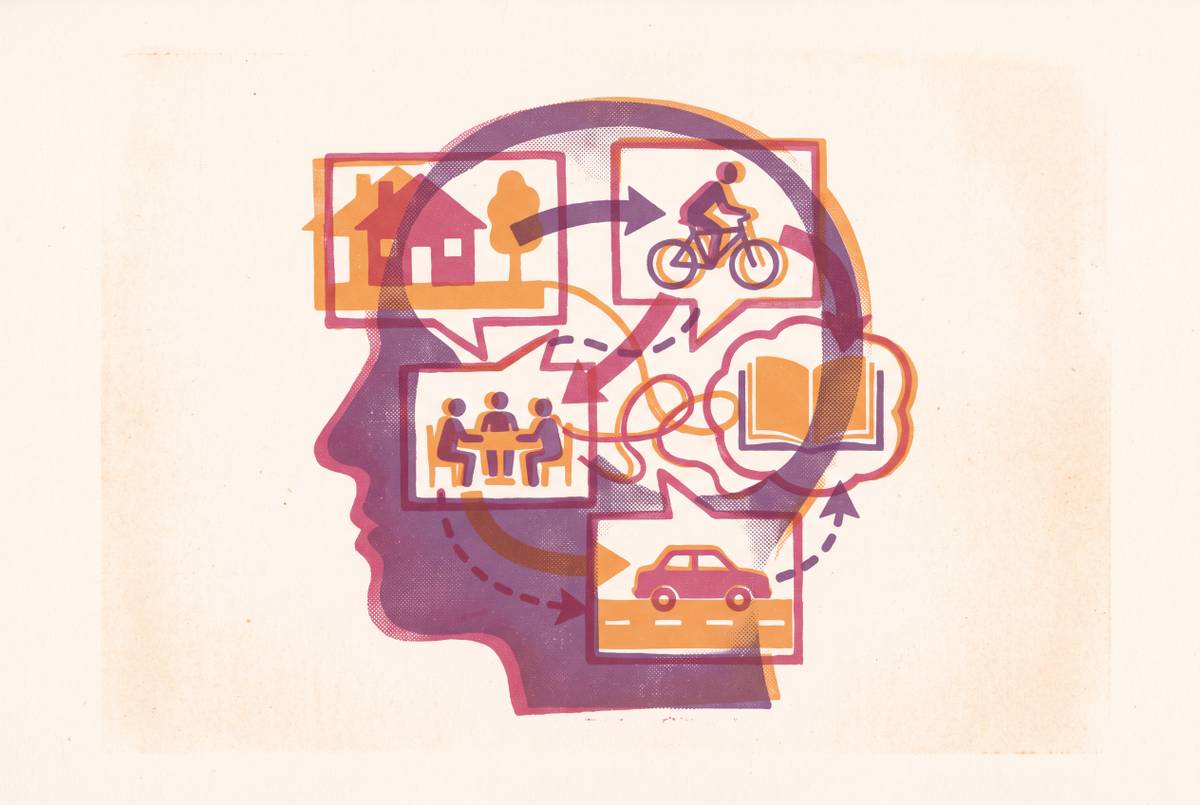
Narrative Identity Theory and Self-Continuity
The self emerges through the stories we tell about our lives, not the fixed traits we inherit.
Narrative identity theory makes one central claim: the self is not a fixed thing to be discovered but a story actively built, revised, and told. That means who someone is gets built rather than dug up, and it reframes everything that follows about memory, continuity, and change.
What narrative identity theory claims about the self
The self, in this account, is less like a mineral deposit waiting to be mined and more like a manuscript under continuous revision. Narrative identity theory holds that a person's sense of who they are gets assembled through the act of giving their life a story-like form: a beginning, a cast of characters, turning points, a thread of meaning that connects what happened to what it's supposed to signify. That's a deliberately active verb. Identity, on this view, is something done, performed repeatedly through the ordinary work of interpreting experience, not something had the way a person has a blood type or a birthdate.
This puts narrative identity in direct opposition to essentialist accounts, which treat identity as a stable inner property that persists no matter what a person does or says about themselves. A narrative theorist asks what story someone is currently telling about themselves, and notices that the story can change even when the underlying facts don't.
Consider two people who were both fired from a job at 30. Same event, same timeline, two entirely different selves emerging from it. This is the mechanism this whole piece is built around: the story is not a transcript of events but an interpretation that selects which events matter, sequences them, and assigns them meaning in light of where the person believes they're headed. Once that's established, the next question follows naturally: how does the brain actually pull off that sequencing and meaning-assignment, moment to moment, until it starts to feel like a continuous person instead of a pile of unrelated episodes?
How autobiographical reasoning builds a continuous self
Self-continuity, the felt sense that the person who woke up today is the same one who existed a decade ago and will exist a decade from now, is produced through a specific cognitive operation called autobiographical reasoning: the work of linking past, present, and future into one arc.
The basic unit of that work is the self-defining connection, walked through here concretely: the self is being rewritten from both directions simultaneously, which is exactly why it can feel continuous without ever being static.
The empirical case for this comes from a 2025 study by Asayama and Toyama, which tested narrative versus essentialist framings directly. The essentialist condition showed neither correlation. That's a fairly precise signature of autobiographical reasoning doing its job: the narrative frame doesn't just make people feel continuous, it makes that continuity depend on actively accepting and comparing across time, which is the whole operation this section describes. Every time someone says "I'm someone who..." and traces the claim back to a lived experience, they're repeating that operation in miniature.
What the brain does when it builds that story
None of this is metaphorical once it gets looked at from the neuroscience side. Constructing a self-narrative engages identifiable brain processes, and putting that narrative into language, especially written language, changes how those processes fire.
Affect labeling, the act of naming an emotion in words, activates the right ventrolateral prefrontal cortex. The act of narrating the experience in writing appears to reorganize how the brain handles it afterward, beyond just producing a record of what happened.
The medium matters at the neural level too. Writing by hand activates a broader network than typing, one that includes movement, sensory processing, and memory encoding together. That has implications for how deeply an experience gets consolidated, since more of the network doing the encoding tends to mean richer retrieval later. None of this licenses grand clinical claims. What it supports is a narrower, specific point: deliberate self-narration in writing is part of the construction process itself, not a passive printout of a story the brain already finished building.
What the narrative perspective enables
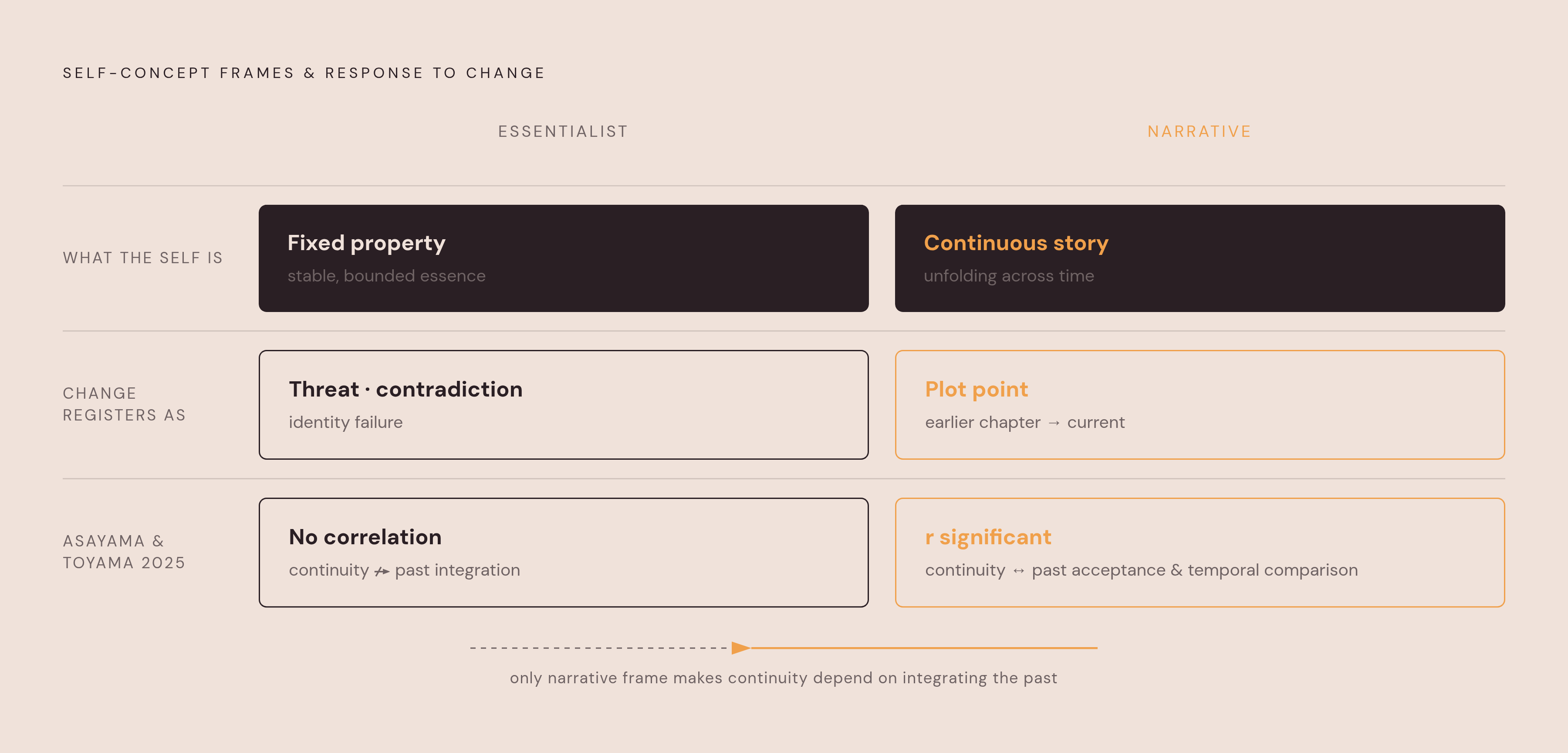
Because the brain treats narration as construction rather than reporting, the choice between narrative and essentialist self-concepts determines what a person can actually do with their own past. The two perspectives produce qualitatively different relationships to change, and only one of them handles change gracefully.
Under an essentialist view, the self is a fixed property, so any change in behavior, belief, or circumstance registers as a threat to that fixed identity. Under a narrative view, change gets absorbed rather than denied: an earlier version of the self who held different values or made different choices isn't a contradiction, it's a plot point, the earlier chapter that explains how the current chapter came to exist.
The Asayama and Toyama data from 2025 back this distinction up directly: self-continuity in the narrative condition correlated specifically with acceptance of the past and temporal comparison orientation, so the past wasn't just acknowledged but integrated into the ongoing story as material the present self grew out of. If the past is a meaningful chapter rather than an embarrassment to be buried, the future reads as the next chapter rather than a referendum on whether the earlier ones were acceptable.
One objection deserves a direct answer. That's a failure of narrative flexibility within the framework, not evidence against the framework itself: the same storytelling apparatus that built the constraining version can, in principle, rebuild it into something less rigid. That distinction, between a theory that's wrong and a practice that's gotten stuck, becomes important later in this piece, because what happens when the story-building capacity itself is underdeveloped or disrupted is a separate problem from whether the theory holds.
How narrative identity develops across the lifespan
Narrative identity is not handed to anyone at birth fully assembled. It develops, largely through adolescence and into adulthood, as the cognitive capacity for complex autobiographical reasoning comes online. Linking disparate experiences into one coherent arc is a developmental achievement, the kind of thing a ten-year-old genuinely cannot do the way a thirty-year-old can, regardless of how many experiences the ten-year-old has already had.
What happens when the conditions for that development are constrained offers a useful test case. A 2025 study examined narrative identity development in 503 personal stories written by youth in secure care in Sweden. Institutional settings of that kind can limit the raw material available for a coherent self-story, and they can also impose narratives from outside the person, institutional labels and case-file descriptions standing in for self-authored meaning. The result is a population facing particular, identifiable obstacles, imposed by the environment, in constructing a coherent account of who they are.
Trauma complicates the same mechanism from a different angle. Traumatic experience can fracture narrative coherence because the event resists integration into the existing meaning structure. It doesn't fit the story that was already being told, and forcing it in produces strain. The psychological consequence of a fragmented narrative, where past, present, and future selves fail to cohere, has a recognizable shape: a sense of being a different person across time, of not quite recognizing the person in an old photograph or an old diary entry, a missing throughline.
That outcome matters for a reason that goes beyond discomfort. Self-continuity underwrites agency. A person who doesn't experience their past and future selves as continuous with who they are right now has less motivation to act in ways that benefit those other-time selves, since there's less felt reason to sacrifice for a future self who seems, functionally, like someone else. Agency depends on believing the person who benefits from today's effort is still going to be you. This is the stake running under the rest of this piece: a fragile or underdeveloped self-narrative isn't just a storytelling inconvenience but a drag on the capacity to act in one's own long-term interest.
Deliberate practice and self-narrative coherence
Narrative identity, once built, doesn't maintain itself. Experience keeps accumulating regardless of whether anyone does the work of integrating it, and without that integration, the story doesn't stay neutral, it fragments, stalls, or drifts quietly out of alignment with the life actually being lived.
Memory alone doesn't substitute for the work. An unexamined experience gets stored, but storage and integration are different processes: autobiographical reasoning, the active linking of an event to the self's ongoing arc, has to happen on its own, deliberately, or the event just sits there as an isolated data point.
The barrier is rarely motivation in the abstract. It's closer to activation energy: the blank page itself functions as a real cost that, left unaddressed, reliably stops the narrative-building session before it starts, which means the mechanism that produces felt continuity simply never engages that day. If these are measurable dimensions that can rise or fall, they're not fixed traits, they're conditions that require active upkeep, the same way physical conditioning fades without repeated use regardless of how fit someone was two years ago.
Habit research offers a clue about how that upkeep actually gets sustained. Applied here, that means deliberate self-narration is subject to the same mechanics as flossing or a morning run: it needs an anchor in a specific context, a low cost of entry, and a cue that makes starting close to automatic. That sets up a concrete question. What does a structured practice built around those conditions actually look like?
Structured self-narration methods that build the story
Free-form diary writing can produce a record of events, but it doesn't reliably engage the specific operations, linking, naming, connecting, that autobiographical reasoning depends on, which is why structured approaches tend to do more of the construction work described earlier in this piece. One such approach is the R.E.F.L.E.C.T. framework, which sequences distinct stages rather than leaving the writer to free-associate: it opens with Recount, a plain recitation of facts without interpretation, moves into Emotion, where the instruction is to name feelings with precision rather than reach for a vague catch-all, and then proceeds through body sensation, pattern recognition, story examination, and self-compassion. Each stage is doing a different piece of the autobiographical reasoning process rather than repeating the same reflective gesture seven times. The precision demanded at the Emotion stage isn't a stylistic preference. A label like "bad" or "stressed" doesn't appear to engage the neural mechanism behind affect labeling the way a specific label like "dismissed" does, so the instruction to get precise is really an instruction to activate the right ventrolateral prefrontal cortex mechanism described earlier.
CBT journaling takes a more analytical route to the same underlying operation. By recording an automatic thought, weighing the evidence for and against it, and generating a more balanced alternative, the writer is directly revising the narrative interpretation attached to a specific event, which is autobiographical reasoning turned into a repeatable procedure rather than something that happens as a byproduct of writing. Shadow Work journaling goes after a harder target: the recurring relationship patterns and emotional triggers that make up the story structures most resistant to revision, the ones responsible for the "trap" problem raised earlier, where a narrative identity calcifies. That makes it a poor starting point for someone new to structured self-narration, since it asks the writer to confront the most entrenched material before building up the basic skill of linking event to self.
How the medium shapes the self's story
The question of handwriting versus typing versus app-based journaling isn't a tool preference dressed up as a decision.
Handwriting appears particularly suited to emotional processing and to working through difficult material. Structured, analytical exercises, cognitive reframing, CBT-style thought records, suit typing because the work there is revising and analyzing a thought, inside raw emotional material less, so the medium matches the cognitive mode of the exercise.
Where analog practice runs into a hard limit is pattern recognition. A paper journal captures what happened on any given day, but it does nothing on its own to surface the connections across entries that constitute the narrative arc. A 2026 practitioner analysis of journaling tools laid out the problem: spotting trends across weeks of handwritten entries requires manually reviewing all of them, and most people never do. The throughline stays invisible unless someone goes looking for it by hand.
Digital tools can, in principle, surface those patterns automatically, but doing so requires a real tradeoff that should be named. A journaling app built with end-to-end encryption can't read entries well enough to analyze them for recurring themes, since the encryption that protects privacy is the same property that blocks pattern analysis. A tool capable of surfacing those patterns necessarily has some form of access to what's written. That's a genuine design tension built into the category, not a bug one product happens to have solved, and it leaves the writer with an actual choice to make rather than an obvious right answer: privacy on one side, visible throughlines on the other, and no medium yet that offers both without compromise.
Sources
- Two Aspects of Past Self-Continuity from Narrative and Essentialist Perspectives - Akira Asayama, Miki Toyama, 2025
- Full article: Mixed Lessons: Narrative Identity Development Among Youths in Secure Care
- Narrative Identity Development In Adolescents And Young Adults: A Scoping Review - PMC
- Publications