Expressive Writing and Post-Traumatic Growth Evidence
Growth comes from cognitive processing during writing, not from emotional release alone.

The advice appears everywhere: when something hurts, write it out. Get it on the page, let it go, feel lighter. That advice assumes expressive writing works like a pressure valve, releasing pent-up emotion the way steam escapes a kettle. The evidence tells a different story: what predicts post-traumatic growth is not the act of emotional discharge but the presence of specific cognitive language during writing. Zheng, Lu, and Gan (2019) found that both the expressive writing condition itself and the frequency of causal and insightful words used while writing predicted growth, with meaning-making serving as the pathway connecting the two. Two people can sit down and write about the identical traumatic event for the identical twenty minutes and walk away with wildly different outcomes, because one of them processed the material and the other replayed it. Affect labeling, the act of putting precise words to an emotion, ranks among the most consistently replicated findings in affective neuroscience, and it calms the brain's fear response and strengthens regulation. But that calming effect is linguistic and cognitive, built on naming and structuring, not hydraulic release built on venting pressure.
What the brain is doing during expressive writing
Expressive writing produces changes in brain structure and function, and those changes line up with the cognitive-mechanism account far better than they line up with catharsis. One piece of this is a working memory benefit: when intrusive thoughts get offloaded onto the page, cognitive capacity that rumination would otherwise consume becomes available for other processing. That is a distinct effect from feeling better in the moment, and it explains why writing can reduce mental clutter even on days when the content itself is heavy. Over time, consistent engagement appears to build stronger connectivity between the prefrontal cortex and the hippocampus, infrastructure that makes future emotional processing more efficient. None of this should be read as dramatic or permanent rewiring. The direction of the effect is what the evidence supports, not a claim that a few journal entries reorganize the brain overnight. Still, this infrastructure argument answers a reasonable objection: if journaling effects are just a passing mood boost, why would anyone bother with it as a long-term practice? The mood boost is the visible part, but the structural shift is what persists, triggered only when the writing reaches a certain cognitive depth, which is exactly where the outcome data picks up the story.
What the evidence shows about outcomes, and where it falls short
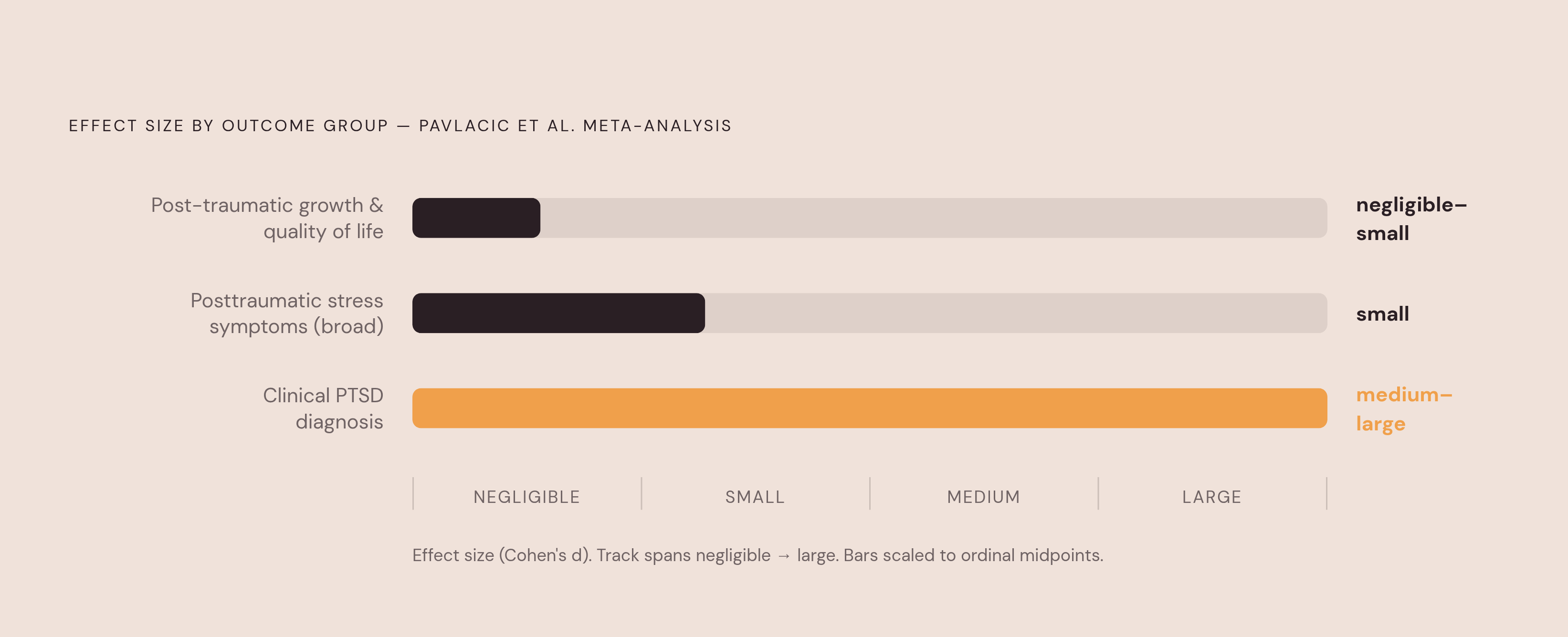
The outcome evidence for expressive writing is real, but anyone expecting a dramatic cure-all should recalibrate. Pavlacic and colleagues' meta-analysis found a small overall effect size for posttraumatic stress symptoms and negligible to small effect sizes for post-traumatic growth and quality of life across the general literature. Those numbers sound unimpressive on their own, and treated in isolation they might suggest the whole enterprise is overhyped. But one subgroup breaks the pattern: studies that required participants to carry a clinical PTSD diagnosis showed a medium to large effect size. The modest average, then, is not a verdict on whether expressive writing works; it is a map showing where it works best, with the strongest signal appearing exactly where the need is most severe. Zheng et al.'s study adds a layer that most outcome research misses entirely: expressive writing produced higher scores on presence-of-meaning and post-traumatic growth than neutral writing, and both the writing task itself and the frequency of causal and insightful cognitive words independently predicted meaning, which in turn predicted growth. That raises an important question for every other study in this literature that never counted causal or insightful words: if language quality varies across studies and nobody tracked it, the measured effect sizes could be systematically underselling what the intervention is capable of. A study full of participants who replayed their trauma without ever explaining or reinterpreting it would show weaker results than a study full of participants who did the cognitive work, even if both studies used the same instructions.
The specific cognitive moves that drive post-traumatic growth
Two language moves carry the weight of this entire mechanism: causal reasoning and insight generation. Everything else, including how long someone writes or how emotionally intense the material feels, turns out to be secondary. Causal language includes words like "because," "therefore," "since," and "which caused," the connective tissue that links a traumatic event to its context, its consequences, and its eventual meaning. Insightful language signals a different kind of movement: phrases like "I realize," "I understand now," or "what I hadn't seen before" mark the moment a writer builds a new frame around an old experience. Zheng et al. found that both writing task type and the frequency of these specific words predicted meaning, and meaning, not emotional arousal and not how long the session ran, was the variable that actually produced growth. A companion study co-authored by James W. Pennebaker (the researcher who originated the expressive writing paradigm in the 1980s) along with Dan McAdams and Elaine Reese, adds useful nuance here. That randomized controlled trial found no intervention effects for physical symptoms, anxiety, stress, life satisfaction, or thriving overall, but writing about meaningful relationships led to fewer doctor visits for illness six weeks later, especially in the expressive writing group, and participants in a turning-point writing variant reported reduced depressive symptoms. The results are not uniform across every outcome measured, and that unevenness is itself informative: the mechanism does not flip a single switch that improves everything at once. One might argue that if the benefit comes down to specific words, a writer could simply sprinkle "because" and "I realize" into an entry without doing any real cognitive work. That shortcut does not hold up, because causal and insightful language cannot be produced without the underlying cognitive act; the words are a symptom of meaning-making actually happening, not a costume a writer can put on without doing the work underneath, and meaning-making itself is the bridge connecting language to growth. The goal is not to drain an emotion but to build coherence, taking a fragmented, intrusive memory and shaping it into a narrative that fits inside how the writer already understands themselves and their world.
The Mechanism in Clinical Populations
The cognitive mechanism, if real, should appear most clearly in populations with genuine trauma and few other options. A 2026 qualitative study published in Supportive Care in Cancer, examining rural breast cancer survivors, offers exactly that test case. This is a population facing compounded disadvantage: geographical isolation limits access to facilities, support groups, and mental health services all at once, leaving survivors without the layered support a patient in a major metro area might take for granted. For this group, expressive writing functions less as a nice supplement and more as one of the only survivorship tools actually within reach, economical and scalable in a way that outpatient therapy or in-person support groups cannot match for someone two hours from the nearest oncology center. The accessibility argument is not incidental to the clinical case, because an intervention that requires no appointment, no travel, no therapist, and no insurance authorization carries real weight when every other option requires all four. The study also traced the PTG pathway directly: survivors who moved from raw emotional disclosure toward narrative coherence, explaining why the illness had reshaped their relationships, their values, or their sense of self, showed the growth pattern the mechanism predicts, while those who stayed in pure disclosure did not show the same shift.
Clinical frameworks have started formalizing this transition. The Expert Companion Method, introduced by Anjana Deshpande at the Department of Veterans Affairs, structures the process through what it calls the Journal Ladder, alongside two supporting frameworks: SPC, which stands for Structure, Pacing, Containment, and IAA, which stands for Intention, Attention, Action. The method matters because it operationalizes the mechanism directly rather than leaving writers to stumble into causal and insightful language on their own. It slows the writer down, builds a sense of containment around difficult material, and guides them step by step toward the explanatory and reinterpretive language moves that the research ties to growth. The rural cancer study speaks specifically to the circumstances of rural survivorship rather than trauma broadly, and does not generalize to every trauma survivor or every clinical population. But as a demonstration of the mechanism running at full strength, it is about as clear as the current evidence gets.
How writing structure shapes the cognitive moves
Whether a writer actually produces causal and insightful language depends heavily on how the writing is structured, and unguided free-writing is a surprisingly poor bet for getting there. Left without direction, venting tends to loop: the same events get restated with the same emotional charge, session after session, without ever building the explanatory chains or reframes the mechanism depends on. Why does structure matter so much? Because the prompt itself functions as the intervention. A prompt asking "what happened" invites replay. A prompt asking "what does this tell you about what you believed at the time" forces insightful language into existence. A prompt asking "what caused this, and what would need to change" forces causal language into existence. The original Pennebaker protocol, instructing writers to explore their deepest thoughts and feelings about the most traumatic experience of their life, works partly because "deepest thoughts and feelings" nudges a writer toward meaning rather than mere description, and a turning-point variant of the instruction makes that push more explicit still.
Other structured approaches, built for entirely different purposes, end up doing the same cognitive work by a different route. The Five Whys method, a staple of root-cause analysis in engineering and management, starts with a problem statement and asks "why" repeatedly until it reaches an underlying cause instead of a surface symptom, functioning as a built-in generator of causal language. CBT Thought Records, long used in cognitive behavioral therapy, track emotional patterns and identify distortions in self-talk; each field in the record, from "what was I telling myself" to "what is the evidence against that thought," forces an insightful move the writer might never have made unprompted. Shadow work journaling, drawing on Jung's concept of the shadow, uses targeted prompts to surface repressed fears and patterns, and when those prompts demand causal explanation, such as "why do I react this way," the same cognitive machinery switches on. None of these methods competes for the title of best approach. They are examples of a single underlying principle: any structure that forces a writer to explain or reinterpret, rather than simply describe or emote, is doing the actual work the evidence credits with producing growth.
Whether the medium, voice, typing, or handwriting, affects what the brain does
The format a person writes in matters far less than how deep the writing actually goes. A voice memo recorded during a commute and a handwritten page filled at a kitchen table can produce comparable psychological effects, provided both reach the same level of causal and insightful language. The case for handwriting rests on motor engagement: the physical slowness of writing by hand may deepen encoding, and the small ritual of uncapping a pen can become a conditioned cue that signals the brain to shift into reflective mode. The case for digital or spoken formats rests on consistency instead of depth: lower friction means the practice actually happens, and a phone that is always in a pocket captures a thought while it's still alive rather than hours later when it has already been smoothed over in memory. The honest synthesis sits between those two cases: a shallow handwritten entry produces less benefit than a deeply insightful typed or spoken one, because the medium's job is to make engagement easier, not to generate the cognitive work itself. Voice journaling carries a structural advantage: spoken language tends to be more exploratory and less self-edited than written language, which can surface half-formed explanations and realizations that get quietly filtered out in the process of writing something down properly. That lowers the bar to simply starting, even if the cognitive moves that matter still have to happen inside the speech itself. A hybrid approach, speaking first to get raw material out and then reviewing it to write a short synthesis, combines the low friction of voice with the organizing pressure of writing, and it may reinforce both the habit and the depth at the same time.
Conditions for expressive writing to produce growth, not just relief
Growth through expressive writing is achievable, but the evidence does not support the idea that any honest writing about a hard experience will get there automatically. A few conditions keep recurring across the research. The writing has to engage causal and insightful language, usually through prompts or structures that push toward explanation and reinterpretation of the experience. Repetition over time matters as much as any single session: one entry can produce some effect, but the neural infrastructure the research points to, that stronger connectivity between prefrontal and hippocampal regions, requires sustained practice to build. The habit is the intervention, not any one entry in isolation. And the trauma has to be genuine rather than merely uncomfortable, since the meta-analytic pattern shows the strongest effects where clinical need is highest; someone using expressive writing to process a rough week at work should expect a modest benefit and set expectations accordingly, rather than measuring the practice against outcomes built for PTSD populations.
Feeling emotionally raw or even worse immediately after a session is common, and it does not signal that the writing has failed. The benefit follows the cognitive work of building causal chains and insights, not the emotional discharge that happens to accompany it, and the most useful shift is a change in the question being asked on the page, from "how do I get this out" to "what does this actually mean. That reframing, more than any prompt, method, or medium discussed here, is the argument this evidence keeps pointing toward.
Sources
- Post traumatic growth through expressive writing: the “expert companion method” for self-directed recovery: Journal of Poetry Therapy: Vol 0, No 0 - Get Access
- Navigating rural challenges and promoting posttraumatic growth via expressive writing: a qualitative study among rural breast cancer survivors
- Effects of expressive writing and use of cognitive words on meaning making and post-traumatic Growth
- A Meta-Analysis of Expressive Writing on Posttraumatic Stress, Posttraumatic Growth, and Quality of Life - Jeffrey M. Pavlacic, Erin M. Buchanan, Nicholas P. Maxwell, Tabetha G. Hopke, Stefan E. Schulenberg, 2019
- A Meta-Analysis of Expressive Writing on Posttraumatic Stress, Posttraumatic Growth, and Quality of Life