How Journaling Shapes the Stories People Tell About Themselves
Writing shapes identity by forcing raw thoughts into coherent stories about oneself.

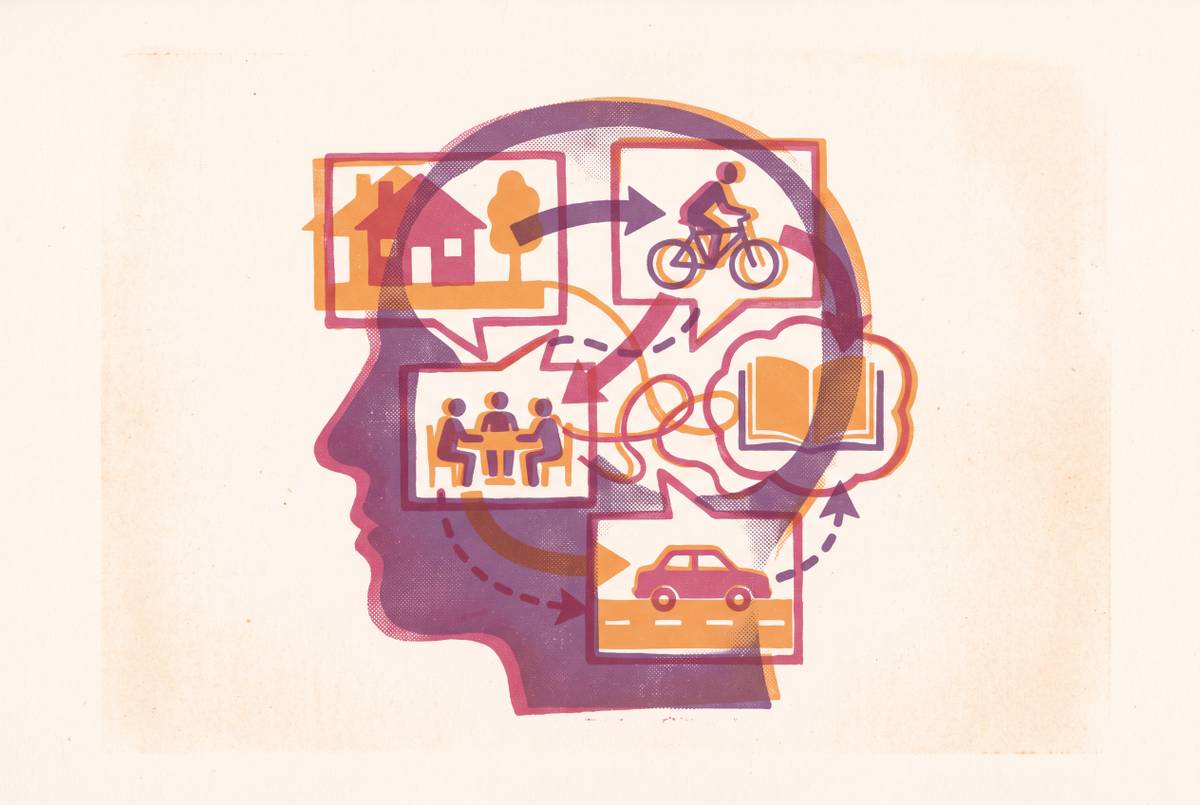
The self is something the mind builds, continuously, out of the raw material of what happens to a person and what that person decides it meant, rather than something dug up fully formed like a fossil buried under years of experience. This is the core claim of narrative identity, a concept developed by Dan McAdams and the researchers at Northwestern's Study of Lives Research Group: identity is an internalized, evolving life story that pulls together the past, the present, and the self a person expects to become, into something that holds together instead of falling apart under its own contradictions.
That story-building capacity does not arrive at birth. It appears in adolescence, once a person can finally step back from an experience and ask what it meant. From there, the story keeps getting revised across a lifetime through what researchers call autobiographical reasoning and temporal integration, the ongoing work of fitting new chapters onto old ones so the whole thing still reads as one life.
The brain does not function as a security camera here, passively logging footage for later review. It edits. It selects which details matter, decides what order they belong in, and interprets their significance before any of it gets filed away as memory. Two people can walk through the same divorce, the same layoff, the same diagnosis, and walk out with entirely different stories because the editing differed.
Once that is clear, something useful follows. If identity gets constructed rather than simply discovered, then whatever shapes the construction process shapes the identity itself. Journaling is exactly that kind of process, a deliberate intervention into the editing room where the self gets cut together. That is the premise the rest of this piece works from, before moving to the mechanics of why writing does something that thinking alone does not.
Thinking about experience versus writing about it
A thought feels complete the moment it occurs, but it rarely is. Thinking tends to loop, circle, and repeat itself in fragments, while writing demands that those fragments get arranged into something that can be read from beginning to end. That demand is where the psychological work actually happens.
James Pennebaker's expressive writing research, replicated across a large body of studies, found something counterintuitive about who benefits most from writing about a difficult experience. It was not the people who vented hardest or described their pain in the most vivid detail. It was the people whose writing moved, over the course of several sessions, from fragmented, disorganized description toward a coherent, structured narrative. The gain came from sense-making, from the act of building a story with a shape, not from the emotional release of getting feelings onto a page.
That reframes what expressive writing is actually doing. It gives a writer the chance to construct a meaningful personal narrative out of what happened, to place a single bad week or a single devastating year inside the context of an entire life rather than letting it sit there as an isolated wound. The neuroscience offers a small supporting clue: affect labeling, the act of putting feelings into words, reliably activates the right ventrolateral prefrontal cortex and reliably reduces activity in the amygdala, the brain's alarm system. Naming the thing changes how the brain responds to the thing.
This happens because a life story, by definition, is built from structure: sequence, cause, consequence, meaning. A pile of raw feelings is closer to a junk drawer than a narrative. Writing forces a sort.
The shape of a useful narrative: redemption, acceptance, and the arcs that matter
Writing about an experience is one thing. What a person writes, and what shape that writing takes, is another, and it turns out to matter just as much. Not every self-story built through journaling strengthens identity. Some reinforce exactly the stuckness the writer was hoping to escape.
A study from McAdams's group, published in the Journal of Personality and Social Psychology, found that people who framed their own life as a Hero's Journey reported greater meaning in life. The narrative frame itself, independent of the actual events being described, carried psychological weight. Two people with comparable hardships can walk away with very different senses of purpose depending on whether they understood their suffering as a chapter in an ongoing quest or as a senseless interruption.
But redemption is not the only frame that works, and later research from the same group complicates any assumption that journaling should always aim to turn hard events into triumphs. Studies on narrative self-transcendence in late midlife found that acceptance, settling into a story rather than rewriting it into a victory, also supports well-being. Sometimes the healthiest ending to a chapter is not "and that is how I overcame it" but "and that is what happened, and I have made peace with it." That is a meaningfully different kind of closure, and pretending redemption is the only valid arc risks pressuring people into stories that do not fit their actual experience.
A 2025 study by Segal, Pennebaker, McAdams, and colleagues compared turning-point writing against open-ended expressive writing and found differential effects across physical health, mental health, and well-being. The frame applied to a narrative, not just the act of writing it down, shapes what kind of outcome follows. One might argue this is the single most practically useful finding in the entire field: it is not enough to write; what matters is what kind of story the writing is building.
This has a direct consequence for anyone treating a journal as a running ledger of complaints. A journal that only catalogs grievances, or that tells the same story of injury again without ever reinterpreting it, risks calcifying a fixed self-narrative. The author of a life story has to be willing, occasionally, to revise the manuscript.
Matching the journaling method to what the self-story needs
If narrative arc matters this much, then format is not a matter of personal taste so much as a decision about which kind of narrative work a person actually needs done. Treating every journaling method as interchangeable, picking whichever one has the nicest-looking template, misses the point entirely. Each format exists to do a different job.
Expressive writing, the Pennebaker method, involves fifteen to twenty minutes of continuous writing about a person's deepest thoughts and feelings regarding a difficult experience, with no concern for grammar, spelling, or whether any of it would make sense to another reader. It is the right tool for trauma, grief, and any event whose meaning has not yet settled into something stable.
Gratitude journaling works through a different mechanism entirely: it retrains the brain's negativity bias by building new attentional habits, nudging a person to notice what went right. Research by Fekete and Deichert found that gratitude writing served as a better resource for managing stress and negative affect than traditional expressive writing under conditions of extreme stress, with the gratitude group showing reduced stress and negative affect a month later while the expressive writing group showed no change. That makes gratitude journaling a tool for sustaining a positive narrative thread already in progress, not a tool for processing an event whose meaning is still unresolved.
Morning Pages, the practice developed by Julia Cameron, calls for three handwritten pages first thing in the morning, before checking a phone or speaking to anyone else. The goal is clearing out the static that keeps honest thought from surfacing, which suits creatives, overthinkers, and anyone whose inner narrator will not stop talking over itself.
Five-minute journaling, built around a fixed morning-and-evening template, suits skeptics and people whose schedules leave no room for anything longer. Its real value lies less in the depth of any single entry than in building the habit that eventually makes deeper work possible.
Bullet journaling, created by Ryder Carroll, uses rapid logging with symbols and short entries to track tasks and plans. It serves structured thinkers well, but it is built for task management, not emotional processing. That distinction matters because bullet journaling gets mistaken for a simpler, lighter version of reflective journaling when it is actually solving an entirely different problem: organizing a life, not interpreting one.
Before opening any notebook or app, the question to ask is what narrative work this particular moment calls for. Processing an unsettled event calls for expressive writing. Sustaining momentum calls for gratitude or five-minute formats. Clearing mental static calls for Morning Pages. Choosing deliberately, rather than defaulting to whatever is trending, is itself a small act of authorship over the self-story.
The problem with the blank page
Is the person who keeps buying journals and never filling them lazy, or unmotivated? Probably not. The more common diagnosis is structural. A blank page gives no entry point, and without one, most people simply stall before the first sentence.
Prompts solve this, not as training wheels for people who cannot think for themselves, but as a legitimate narrative tool in their own right, because a prompt gives the story somewhere to begin. For emotional orientation, a prompt like "How am I feeling right now, and where do I feel it in my body?" starts in the body rather than in analysis, which tends to be easier to access when the mind feels foggy. For narrative reframing, "What would I tell my past self about today?" creates temporal distance and puts the writer in the position of a wiser future narrator looking back, which is a small act of identity construction in itself.
For avoidance work, a prompt asking what the writer has been avoiding, and what the real reason for avoiding it is, does something sneaky: resistance to answering it becomes data. does something sneaky: resistance to answering it becomes data. If a person stares at that question and feels a wall go up, the wall itself is the material to examine. For low-energy days, a structure built around one good thing, one challenge, and one thing to anticipate offers shape without demanding much. And for the deeper work, sitting with a single prompt for fifteen to twenty minutes and writing without censoring surfaces the most useful material precisely when the prompt feels uncomfortable to sit with.
None of this is incidental to narrative identity. A prompt directs attention, and attention determines what gets included in the story. Ask "what would I tell my past self," and the writer is quietly cast as a wiser, more capable narrator before a single word gets written. The prompt is doing identity work before the content even arrives.
Building a journaling habit that survives the gap between intention and practice
Understanding all of this does not guarantee anyone actually sits down and writes. The gap between knowing a practice helps and actually sustaining it is where most well-intentioned journaling habits go to die, usually sometime around day four. Consistency is part of the narrative itself, not a side issue to narrative identity.
The goal of the first two weeks of any journaling practice is establishing a simple self-concept: the sense of being a person who journals. Once that identity gets internalized, it becomes self-reinforcing, because a person tends to act in ways that confirm who they already believe themselves to be. That is a modest-sounding goal, but it is the actual engine behind most habits that survive past the first month.
Habit stacking helps get there faster. Pairing journaling with an existing anchor, writing right after the morning coffee gets poured, for instance, borrows an already-established neural pathway instead of asking a tired brain to generate a fresh decision about when to start. The habit runs on an existing trigger rather than waiting on motivation that may or may not show up.
On low-energy days, the minimum viable entry keeps the habit alive even without any depth. One sentence. One word describing mood. One bullet point. That is enough to keep the habit alive and prevent the all-or-nothing collapse that causes most people to quit entirely after missing a single day.
Paper versus digital formats each suit different needs, and neither one is objectively superior. Paper carries no notifications and offers a tactile relationship with the act of writing that some people find more grounding and less distracting. Digital formats win on accessibility, searchability, and the ability to capture a passing thought on a phone in the fifteen seconds before it evaporates. The right choice depends less on which format is objectively superior and more on where, in a person's actual day, the habit is most likely to survive contact with real life.
The narrative identity you build across time
A single journal entry is a snapshot. The value of keeping one over years comes from something a single entry cannot offer: the arc that becomes visible only in hindsight, the pattern that was invisible while it was being lived.
A nine-year longitudinal study by McAdams's group found that narrative identity predicts trajectories of depression and well-being over time. That finding reframes the whole practice. The story a person tells about themselves is functionally connected to how that life actually unfolds over the years that follow.
Reviewing old entries offers something hard to get in the moment: distance. Self-distancing, the ability to view one's own experience from slightly outside it rather than fully immersed inside it, becomes available in retrospect in a way it rarely is while an event is still raw. That distance is what makes revision possible. Research on narrative self-transcendence in late midlife, from the same research group, found decreased regret and increased acceptance over time, suggesting that the long practice of narrating a life changes not just what gets remembered but how a person relates to what happened.
The practical form this takes is straightforward: periodic re-reading, weekly, monthly, or annually, built around one question. What story is being told, and is it the one the writer wants to be telling? Asking that question on a schedule makes the role of author explicit. Digital tools, including AI-assisted journaling platforms, can help by surfacing patterns across dozens or hundreds of entries that no single session would reveal on its own, though that kind of pattern-finding only works if there is a real record behind it worth searching through in the first place.
Journaling does not hand anyone a finished self to hold onto. It keeps the story open and revisable, which is what a living identity actually requires, since a self-story that stops changing has stopped being true to a life that keeps moving. The person who sits down to write a few lines before bed is not transcribing who they already are. They are still deciding, one entry at a time, who they are in the process of becoming.