Autobiographical Memory Consolidation and Reconsolidation
Your memories change every time you recall them, rewriting themselves to match who you are now.
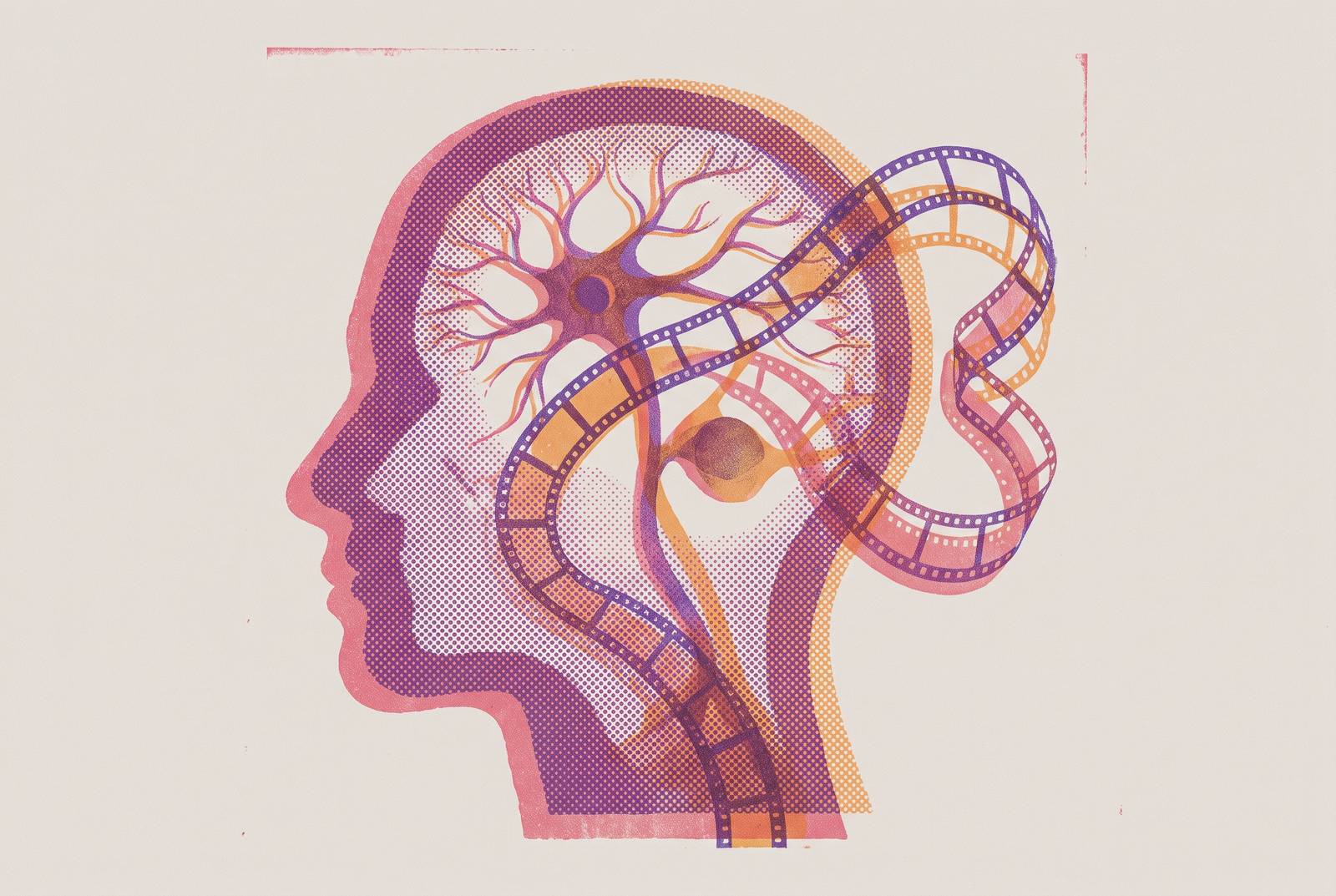
Autobiographical memory is not a video file sitting in cold storage. Every time you pull one up, you edit it, often without noticing, and the edited version is what gets saved back. That is the actual finding across the last few decades of memory science, and it changes what "reflecting on the past" means in some fairly practical ways.
How consolidation first turns an experience into a memory
Consolidation is the process that takes a fresh experience and turns it into something durable enough to survive the next thirty years. It does not happen at the moment of encoding. It happens afterward, in a window of time during which the memory is still soft, still being shaped, before it settles into whatever form it will hold onto for a while.
The hippocampus does the initial encoding work, binding together the where, when, and who of an episode into something coherent enough to count as a single memory. The amygdala runs alongside it, tagging experiences for emotional weight, and that tag determines how strongly the memory is consolidated: an emotionally flat Tuesday afternoon gets consolidated weakly if at all, while a fight with a sibling or a near-miss on the highway gets locked in hard. Meanwhile, the default mode network, running through the medial prefrontal cortex and posterior cingulate cortex, handles the self-referential side of things: how this event relates to you, what it says about who you are, where it might matter later.
A 2025 paper in Frontiers in Cognition describes autobiographical processing as recruiting a genuinely wide network: the amygdalae, hippocampal formations, visual pathways, the default mode network, thalamic networks, and multiple cortical and subcortical sensory interfaces, all lighting up more or less at once. That is not a memory getting filed. That is closer to a small committee meeting, deciding in real time what this experience meant and how much of it is worth keeping. And because that committee meets over hours, not milliseconds, the window between encoding and stabilization is itself porous. Things that happen during that window, what you think about afterward, who you talk to, what mood you're in, can shape the memory before it has even finished forming.
What happens in the brain when a memory is recalled
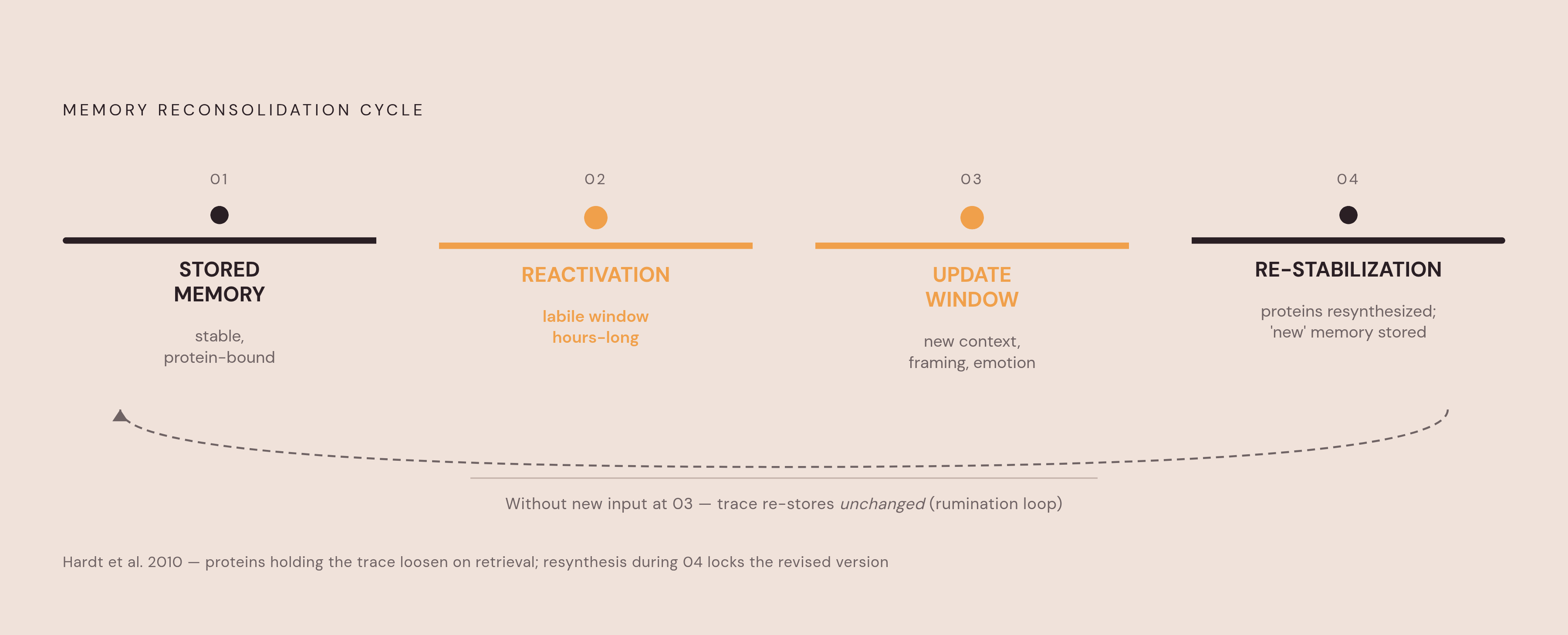
Here is the part that surprises most people: recalling a memory does not just retrieve it. It unlocks it.
The reconsolidation hypothesis holds that reactivating a stored memory makes it briefly unstable again, chemically speaking. The proteins holding that memory trace in place loosen up. Over the following hours, the brain resynthesizes those proteins and re-stabilizes the memory, a process detailed by Hardt and colleagues in 2010. But the memory that gets re-stored is not guaranteed to be identical to the one that got pulled up. If updating occurs during that labile window, as Hass-Cohen and Clay's 2025 review discusses, the version retrieved next time might be the revised one, not the original.
This is not the system breaking. This is neuroplasticity doing exactly what it evolved to do, which is update stored information against new context rather than preserve a static archive nobody consults. A 2025 Frontiers in Cognition paper by Hass-Cohen and Clay discusses mechanisms driving that update, among them predictive error: the friction between what you remembered and what you are experiencing now primes the old trace to absorb the new information. Another involves inhibiting repeated negative recall so that the memory becomes open to revision rather than simply being reinforced. The brain notices when the past and present don't match, and it uses that mismatch as an excuse to revise.
That window of instability is also, not incidentally, a window of opportunity. Later sections lean on this pretty heavily, so keep it in your back pocket.
How reactivations during the time between encoding and retrieval reshape what we remember
A study in Scientific Reports tested this directly, and the design shows the result is more specific than "memory changes over time."
Sixty participants wandered a naturalistic virtual city and incidentally encoded 30 events. Each event varied along two axes: emotional valence (positive, neutral, negative) and interaction type. The twist came at the retention interval, the gap between encoding and the final memory test. Some events got reactivated during that gap; others didn't.
For events with intermediate reactivations, new predictors of what got remembered kicked in, in ways that did not apply to events that went unreactivated. That result lines up with older frameworks, Multiple-Trace Theory and Trace-Transformation Theory, both of which argue consolidation is an ongoing process that responds to revisiting rather than a single event with a start and finish line. It's ongoing, and it responds to how and when a memory gets revisited.
Which raises an uncomfortable, useful question: if the conditions of recall shape what survives, what does that mean for someone who deliberately, repeatedly revisits a memory on purpose? Journaling, in other words, stops looking like passive reflection and starts looking like an active editing session, whether or not the person doing it realizes that's what's happening.
Why the memory system rewrites in service of identity, not accuracy
The memory system was never optimized for accuracy. It was optimized for coherence.
Work by Waters (2014), cited in Hass-Cohen and Clay's 2025 review, frames autobiographical narrative as a running comparison between past and current memory, built specifically to support decisions you're about to make, not to preserve a court transcript of what happened. Related frameworks go further, arguing that top-down control processes prioritize keeping the self-model internally consistent over keeping any single memory factually intact. Björkstrand and colleagues, cited in the same 2025 paper, frame memory reconsolidation as an evolutionary mechanism for managing ongoing threat: the system is built to keep revising old memories against new information about what's dangerous or safe now, not to leave them alone.
Practically, that means the "you" doing the remembering edits the memory to match who you currently are. Memories that clash with your current sense of self tend to fade, get reframed, or quietly drop details. Memories that confirm it tend to get reinforced and dredged up more often, which, per the reconsolidation mechanism, means they get revised more often too. None of this is lying, exactly. It's closer to a company updating its own internal wiki to match how the org actually operates today, rather than preserving an outdated org chart out of some misplaced loyalty to accuracy.
The corollary lands a little harder than it should: the memories you feel most confident about, the vivid ones, the ones you'd swear to under oath, may be the ones that have been rewritten the most. Confidence and accuracy are not the same currency, and the brain spends the first freely.
So if recall rewrites the memory anyway, can that rewriting be pointed somewhere useful on purpose? That's the question the rest of this piece tries to answer.
What expressive writing does to the rewriting process
James Pennebaker ran the experiment that started this whole line of research back in 1986. Healthy college students wrote for 15 minutes a day, four days running. One group wrote about trivial topics. The other groups wrote about the most traumatic or upsetting experience of their lives.
The mechanism, as later work unpacked it, is narrative construction. Turning raw emotional experience into sentences forces the brain to organize it, and that organizing act changes where and how the memory gets stored. More than 300 studies since 1986 have circled back to confirm some version of this. At the neural level, expressive writing engages the left inferior frontal gyrus (Broca's area) and the prefrontal cortex, the machinery that turns feeling into language. That engagement appears to alter how emotionally loaded memories are processed and stored, with amygdala activation dropping and prefrontal activity rising after expressive writing interventions in fMRI work.
Matthew Lieberman's UCLA fMRI research gave this effect a catchier name: affect labeling, or "name it to tame it." Simply putting a word to an emotion, in his studies, reduced amygdala activation. The act of naming was the intervention, not a side effect of it.
The clinical protocol most studied runs three to five sessions across four consecutive days, 15 to 20 minutes each. Structurally, that maps onto what reconsolidation research describes: reactivating a memory and engaging with it through language before it re-stabilizes.
What the evidence shows about the effects of structured memory rewriting
Pennebaker's original cohort didn't just report feeling better. Participants who wrote about trauma made up to 50% fewer doctor visits in the following months, and that physiological footprint extended across subsequent research as well. That's a fairly wide physiological footprint for 15 minutes a day over four days.
Across more than 100 follow-up studies, the pooled effect size is around Cohen's d of.16. That number is modest, and it should stay modest in how it gets talked about: this is not a cure-all, and the size of the benefit varies a lot by population and by how the writing task gets structured. But modest and real are different things, and an effect that reliably clears zero across a hundred-plus studies, spanning different populations and researchers, earns some trust.
A 2011 study by Ramirez and Beilock at the University of Chicago found that students who spent ten minutes writing about their anxiety before a high-stakes math exam performed measurably better than students who didn't. The proposed mechanism is working memory offloading, unloading the anxious thoughts onto the page frees up the cognitive resources those thoughts were otherwise occupying, resources the exam then gets to use instead.
Over repeated sessions, reflective writing appears to engage prefrontal and hippocampal circuits in ways that help reprocess and reframe difficult material. The throughline across all of it: these are not just people feeling temporarily lighter after venting. Something about how the memory is encoded and retrieved changes after the writing session, which is a structural claim, not a mood claim.
How arts therapies and creative practices trigger reconsolidation through non-verbal routes
Writing is not the only door into this process, and Hass-Cohen and Clay's 2025 review argues memory reconsolidation might be the mechanism shared by arts therapies generally, producing effects across whether the medium is visual art, music, dance, or drama.
The proposed pathway: an engrossing, rewarding creative experience pulls the limbic subcortical system, the autonomic nervous system, and central nervous system functions into synchronization. When that synchronization is orderly and coherent rather than scattered, it appears to support the same reconsolidation window that language-based reflection opens. Their framework, Art Therapy Relational Neuroscience (ATR-N), lays out a sequence: safely identify which experiences are keeping symptoms alive, juxtapose those experiences against novel evidence that contradicts or complicates them, and let that contradiction do the work of updating the memory, potentially for good.
One condition matters more than the others: the activity has to be genuinely engrossing and genuinely rewarding. A half-hearted coloring exercise, done on autopilot, is unlikely to crack open the reconsolidation window at all. Depth of engagement seems to be the active ingredient, not the specific medium, which means the choice between painting, dancing, or writing may matter less than how absorbed someone actually is while doing it.
Spoken reflection fits this same pattern, oddly enough. Thinking aloud, narrating an experience to another person or even to an empty room, is embodied and sequential in the same way brushwork or choreography is. It builds narrative structure through the act itself, in real time, rather than requiring the structure to exist first.
How to reflect on memories in ways that update them productively rather than reinforce them unchanged
Reactivating a memory is necessary for reconsolidation, but it's not sufficient. That distinction is where a lot of well-meaning reflection goes sideways.
Rumination is the failure mode. Replaying an argument in your head for the fortieth time, in the same emotional key, does not open an update window, it just grooves the existing trace deeper. What seems to determine whether recall updates a memory or just reinforces it is whether new context enters during the labile phase. No new context, no update. Just repetition.
A few conditions tend to support the productive version instead. Emotional safety matters: distress that runs too hot appears to close the reconsolidation window rather than open it, which suggests there's a real difference between processing a memory and simply re-traumatizing yourself with it. Novel framing helps too, approaching an old event from a different vantage point, a different relationship to it, or with genuine curiosity about what got missed the first time around. And narrative construction itself, the act of putting the experience into sequential sentences, forces an organizing structure onto something that was previously just raw feeling, and that gap between the feeling and the sentence is apparently where the actual updating happens.
Philip Zimbardo's time perspective therapy leans on a related idea, integrating past, present, and future orientations into one balanced narrative rather than getting stuck reliving a single frame. Structured prompts do concrete work in this same vein: not "what happened," which just replays the tape, but "what does this mean now," or "what didn't I notice at the time," or "what would I say to someone else going through this." Each of those questions supplies exactly the kind of novel context a labile memory needs in order to revise rather than just repeat.
Timing and frequency matter beyond any single session, too. The 2026 Scientific Reports study found that intermediate reactivations during the retention interval, plural, spaced out, not one big cathartic recall, were what shaped the final memory. That gives regular, spaced reflection a mechanistic basis rather than just a "good habit" justification. And voice, specifically, carries some practical advantages here: narrating a memory aloud is embodied and sequential the way writing is, but it lowers the activation energy a blank page tends to demand, which matters if the actual goal is sustaining engaged, emotionally present recall long enough for reconsolidation to do its work.
What it means to reflect on the past if every act of reflection rewrites it
Reflecting on the past is not reviewing a record. It's closer to co-authoring the next draft of a document that never actually goes to print.
That cuts two ways, and both deserve equal weight. Unreflective rumination, or reflection that stays locked in a distressed, unchallenged frame, can calcify a damaging read on events into something that feels permanent and objective, when it's neither. But intentional, structured reflection, the kind this piece has been describing, can genuinely change how an experience gets carried forward, not by rewriting what happened, but by changing how it sits inside the larger story of who you are.
Conway's 2019 framework makes the self doing the remembering both author and subject at once, which sounds like a philosophy seminar problem until you notice it's just a description of what happens every time someone journals about a hard year. The goal was never perfect accuracy. It's coherence: a self-narrative honest enough to trust and flexible enough to actually grow from.
Writing, speaking, drawing, narrating out loud, none of these are add-ons bolted onto memory from the outside. They're closer to memory's native operating mode, the way it actually functions when it's functioning well. Knowing that the past gets rewritten every time it's revisited doesn't make remembering less worthwhile. If anything, it raises the stakes on doing it deliberately, since every trip back to an old memory is, in some small way, a vote on who you're about to become.
Sources
- Memory reconsolidation: a proposed change mechanism for the arts therapies - PubMed
- Frontiers | Memory reconsolidation: a proposed change mechanism for the arts therapies
- Reconsolidation of Human Memory: Brain Mechanisms and Clinical Relevance | Request PDF
- The role of reactivations during consolidation in the structure and accessibility of episodic autobiographical memories | Scientific Reports
- The role of reactivations during consolidation in the structure and accessibility of episodic autobiographical memories