Precision of Emotion Labels and Downregulation Dose-Response
Precise emotion words boost downregulation more than vague ones, but only in the right context.

Someone says "I'm upset" and knows, even as the words leave the mouth, that the label doesn't quite fit. Upset is too blunt for what's actually happening, but nothing sharper surfaces in time, so the sentence stands as filed. That gap between the feeling and the word for it is not a minor communication glitch. It's the subject of a growing body of research on emotional granularity, and it turns out the precision of the label you pick changes what happens next in the brain and body, not just how well you explain yourself to someone else.
What emotional granularity is and why people differ in it
Emotional granularity is the capacity to tell emotional states apart with some resolution, rather than lumping them into a handful of generic buckets. Humiliated, embarrassed, and disappointed can all get flattened into "bad," but they are not the same experience, and treating them as interchangeable throws away information the brain could otherwise use.
People vary in this skill, and that variation is measurable. A 2024 integrative analysis by Fugate, Gendron, and Hoemann in Affective Science found that variation in granularity predicts variation in emotion regulation ability. Some of that comes down to one theory of emotion, which holds that the brain builds affective experience on the fly, using whatever emotion concepts are on hand as a kind of predictive scaffolding. Richer concepts make for sharper, more useful predictions. Thinner ones don't.
Low granularity looks like defaulting to "stressed" or "bad" for nearly everything uncomfortable, the emotional equivalent of owning three crayons when the situation calls for a whole box. This isn't fixed. Vocabulary can expand, and when it does, regulation capacity seems to move with it. That's the thread the rest of this piece follows.
The foundational affect labeling effect: what Lieberman's line of research established
The starting point is decades old and fairly settled at this stage. Matthew Lieberman and colleagues showed that putting a feeling into words tends to turn the volume down on the body's physiological and neural response to it. Later work with Torre in 2018 confirmed the pattern held up.
The mechanism runs through the prefrontal cortex. Labeling an emotion activates that region while dampening activity in the amygdala, essentially letting the brain's more deliberate processing put a hand on the shoulder of its alarm system. What's notable is that this doesn't feel like regulation while it's happening. Torre and Lieberman, writing in Emotion Review in 2018, describe affect labeling as implicit emotion regulation: it produces effects similar to effortful strategies like reappraisal, without the person doing anything that feels like effort.
Expressive writing research in this tradition, with over 200 replications documented in the literature, gives this a long-form proof of concept. People who write about emotionally loaded experiences show measurable physiological changes afterward. None of this is contested ground. It's the bedrock. The rest of this piece chases what happens to that effect once you start asking how precisely the label was chosen.
How labeling granularity modulates the size of the downregulation effect
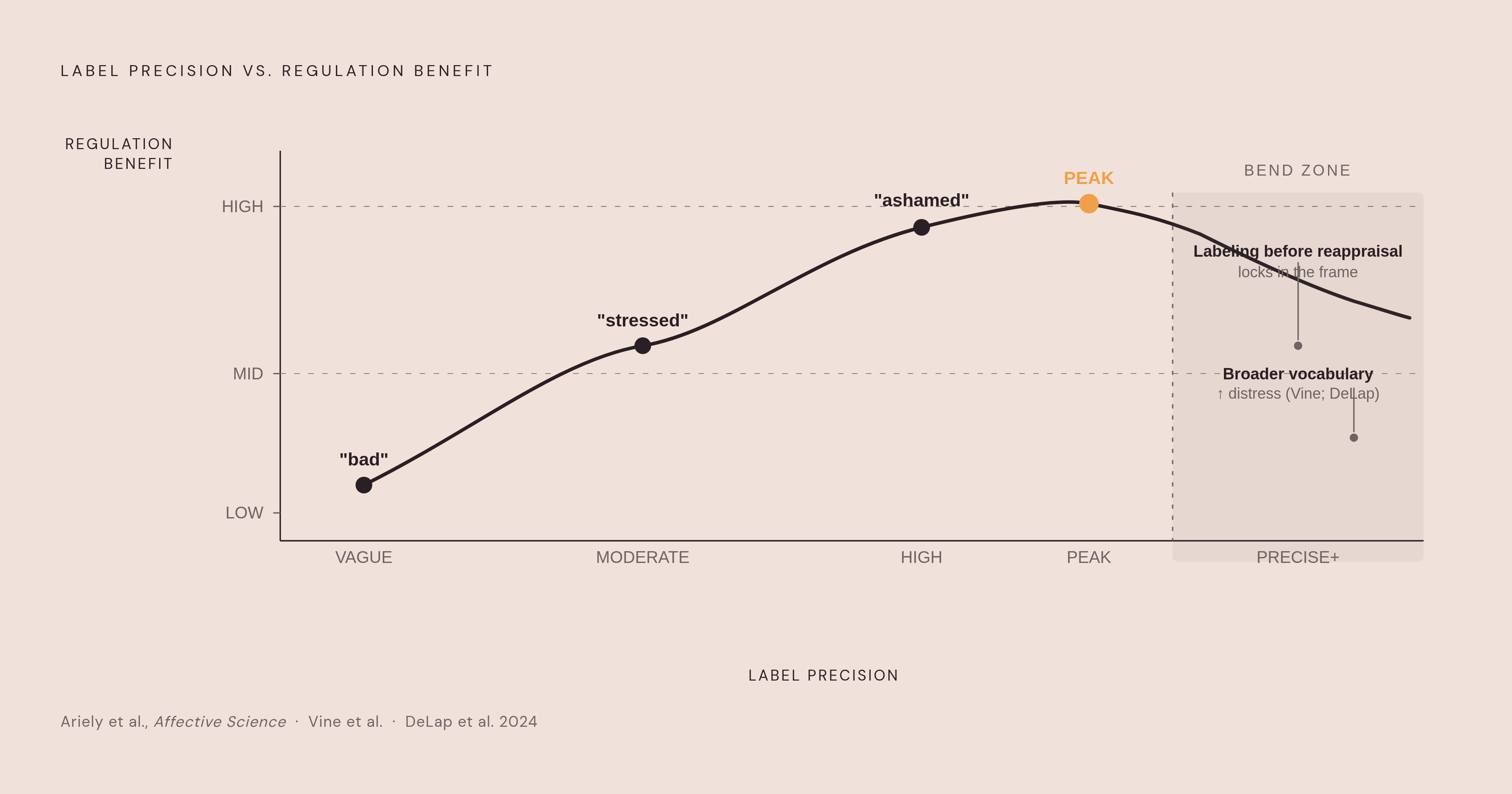
The story gets a dose-response shape. Research cited across the granularity literature has found that emotional granularity predicts regulation success, not just whether a person slaps a label on the feeling, but how fine that label is.
A field study by Nguyen and colleagues in the International Journal of Human-Computer Studies backs this up with a real intervention. Over 24 days, 33 participants used a conversational agent built around the Theory of Constructed Emotion to practice granular affect labeling, compared against a control chatbot offering generic emotional support. The granular-labeling group showed significantly better gains in emotion regulation ability, and the agent never explicitly taught a single regulation strategy. It just helped people find better words.
The mechanism the study points to: expanding someone's active emotion vocabulary broadens their emotion concepts, and broader concepts improve a person's understanding of what's actually causing the feeling, which in turn supports more reflective regulation. A 2024 integrative analysis lands on the same conclusion from a different angle, examining the granularity-dysregulation link and the role that emotion word knowledge plays in it. Vocabulary depth here is an operating variable. It's an operating variable.
Consider "I feel bad about what happened" versus "I feel ashamed, like I failed a standard I set for myself." The second sentence isn't more articulate for its own sake. It recruits a specific, actionable emotion concept the brain has more to work with, rather than a vague, undifferentiated flag.
Work published in Trends in Cognitive Sciences frames the whole thing as evidence accumulating toward competing candidate labels. Someone with "mortified," "humiliated," and "embarrassed" sitting as distinct, ready concepts runs a richer competition and lands on a more accurate answer. Someone with just "bad" doesn't have a competition. There's nothing to resolve.
Where the dose-response curve bends: the conditions under which more precise labeling does not help and may hinder
More precision sometimes makes things worse, or at least doesn't help. That's the honest complication, and it appears more than once in the literature.
Research published in Affective Science found that when participants labeled their own negative emotions, it did not reliably reduce negative affect. Worse, labeling before reappraisal actually hurt reappraisal's effectiveness. That's a strange result if labeling is supposed to be a straightforward good. It suggests that for strategies built on changing how someone represents a situation, naming the emotion first can lock in a frame that then resists being changed.
Vine and colleagues found that people with broader vocabularies for negative emotion reported higher psychological distress. DeLap and colleagues found a similar pattern in adolescents in 2024, which rules out the idea that this is some quirk of clinical populations or particularly rough adult samples.
Two readings exist, because the data doesn't settle which is right. One: precise labeling surfaces distress that vague labeling was quietly hiding, so it looks like labeling causes the distress when it's really just making visible what was already there. Two: some people use labeling as a launchpad for rumination rather than resolution, circling the same sharp word instead of moving through it. The research itself cautions against treating emotion labeling as a one-size-fits-all tool across every context and culture. The dose-response curve bends rather than rising in a straight line, and where it bends depends on what regulation goal someone's actually chasing. It just isn't a straight line going up and to the right forever. It bends, and where it bends depends on what regulation goal someone's actually chasing.
Why labeling and reappraisal are not interchangeable
Labeling and reappraisal are different tools. They're different tools, and mixing up the order can matter.
Neuroimaging work shows that combining affect labeling with reappraisal changes activity in the dorsolateral and ventral prefrontal cortex. But the Ariely and colleagues in Affective Science found that combining labeling with reappraisal did not straightforwardly improve on either strategy used alone. Labeling, in their framing, is implicit and automatic. Reappraisal is explicit and takes effort. Slot labeling in first, and it may pin the person to one representation of the situation, one that reappraisal then has to fight to loosen.
That raises a real question the field hasn't nailed down yet: does granular labeling do more good on its own, or as a step toward meaning-making, rather than as a prelude to reappraisal specifically? Nobody has a clean answer. What's more defensible is a narrower claim: labeling earns its value by identifying the emotion accurately enough that a person can pick the right next move. It's a diagnostic step.
Gao and colleagues also point to the ventromedial prefrontal cortex as a site of implicit regulation, meaning some of the benefit of a precise label might do its work below conscious awareness, no deliberate reappraisal step required at all.
The emerging "Narrative Safety" framework and its embodied specificity
A 2026 paper in New Ideas in Psychology proposes something called Narrative Safety, a hypothesis still finding its feet, not a settled result. The claim: a precise utterance can trigger measurable autonomic and affective regulation within ten seconds or less, tracked through physiological measures of autonomic arousal.
The specific mechanism proposed is semantic-somatic congruence. When the language someone uses actually matches the felt, physical texture of what's happening in their body right now, it reduces what the framework calls interoceptive prediction error, aligning the symbolic word with the bodily sensation through pathways on the right side of the brain tied to interoception.
That's a different route than standard affect labeling, which the framework describes as running through left-lateralized categorical work, naming which bucket the feeling belongs to. Narrative Safety suggests a second, separate channel: precision has to match not just the right emotional category but the actual bodily sensation producing it. If that holds up under further testing, it implies the dose-response relationship traced through this piece might actually be two curves stacked on top of each other: one for how sharp the concept is, another for how well the words match what the body is doing. Both need their own kind of granularity, and they're not the same skill.
What the language itself must do: from emotion vocabulary as knowledge to emotion vocabulary as skill
The granularity research points to a distinction that matters more than it sounds like it should: knowing a word exists is not the same as being able to use it. The links between granularity and regulation appear to trace to how a word gets actively used and understood, not merely to whether it sits somewhere in a person's passive vocabulary.
A word recognized on a list is a word that stays put during a moment of real arousal. A word used regularly, out loud or on the page, becomes available under load, which is exactly when it's needed. Passive and active vocabulary differ, and it's not a subtle difference.
The process-model framing of competing labels applies directly here. Someone with "mortified," "humiliated," and "embarrassed" as three distinct, ready concepts runs a genuine competition among candidates and comes out the other side with something specific. Someone stuck with "bad" doesn't have a competition to run. This is why emotional vocabulary counts as a trainable skill and not just a stock of semantic trivia: training it changes which concepts are on offer when the brain goes looking for one, which changes what actually gets built in the moment a feeling occurs. The Nguyen et al. field study is the clearest evidence that the training itself works, and notably, it worked through conversation and guided prompts.
How journaling practice creates the conditions for granular labeling to accumulate over time
Journaling earns its place in this story for a specific, almost boring reason: it happens after the emotional peak has passed, in a lower-arousal window, and timing changes how well affect labeling actually works. Precision is easier to reach for when the nervous system isn't already at full volume.
Tracking labels across entries over time does something a single labeling moment can't: it separates a passing state from a pattern. Noticing "I label this shame every time I get unsolicited advice" is a more useful sentence than any one instance of feeling ashamed, because it points at a trigger instead of just naming a mood.
Research on emotion and reflexivity has examined reflective diary-writing practices in working adults, studying the connection between granularity and what some researchers call critical reflexivity, which gives the practice some empirical footing rather than leaving it as a self-help talking point. But structure matters. Free writing without direction tends to produce catharsis in general terms, while prompts built to push toward specificity, something like "what exactly feels different about this discomfort compared to yesterday's," scaffold the granularity that the research keeps identifying as the actual mechanism at work.
Research on expressive writing has found that physiological markers, including heart rate and autonomic measures tied to emotion regulation, shift in response to structured writing, with the specific form of the writing shaping the size of the effect. The structure of the writing, not just the act of writing, shapes what the body gets out of it.
Voice journaling deserves a mention too. Spoken reflection, guided by the same kind of prompts, produces the same labeling events without requiring comfort with written language. It strips out a friction point while keeping the actual cognitive task, naming things precisely, fully intact.
Practical techniques for building labeling precision into a journaling habit
Distinguishing within a category matters more than distinguishing between categories. Don't stop at "angry." Ask whether the feeling is closer to indignant, which carries a sense of unfairness, resentful, which carries accumulated grievance, or contemptuous, which carries a judgment about status. Each of those implies a different cause, and each points toward a different next move.
Logging where the feeling appears in the body alongside the word lines up with the somatic-precision idea from the Narrative Safety framework. Tightening the match between the symbolic word and the physical sensation may be part of what speeds up the regulation effect, assuming that framework holds up under more testing.
The label should function as a decision point. Once a state is named precisely, that name should point toward a next step, whether that's meaning-making, self-compassion, problem-solving, or plain acceptance, rather than defaulting to the same generic coping move regardless of what the label actually says.
And active vocabulary has to be built on purpose. Reading precise emotion words or hearing them in conversation is not the same as using them. The research is specific on this point: it's the act of using a word, in writing or out loud, to describe one's own state that appears to move it from passive recognition into something usable in the moment it's needed.
Sources
- Affect Labeling and Reappraisal as an Emotion Regulation Strategy - PMC
- Links Between Emotion Word, Usage, Understanding, Accuracy, and Emotion Dysregulation: An Integrative Analysis - PMC
- Beyond happy and sad: Exploring granular affect labeling to enhance emotion regulation ability - ScienceDirect
- Putting Feelings Into Words: Affect Labeling as Implicit Emotion Regulation | Request PDF
- The process of affect labeling: Trends in Cognitive Sciences
- Affect labeling: The role of timing and intensity - PMC
- Diminished negative emotion regulation through affect labeling and reappraisal: insights from functional near infrared spectroscopy on lateral prefrontal cortex activation | BMC Psychology | Springer Nature Link
- pmc.ncbi.nlm.nih.gov