Source Monitoring Errors in Personal Memory
Confident memories can be completely wrong about where they came from.
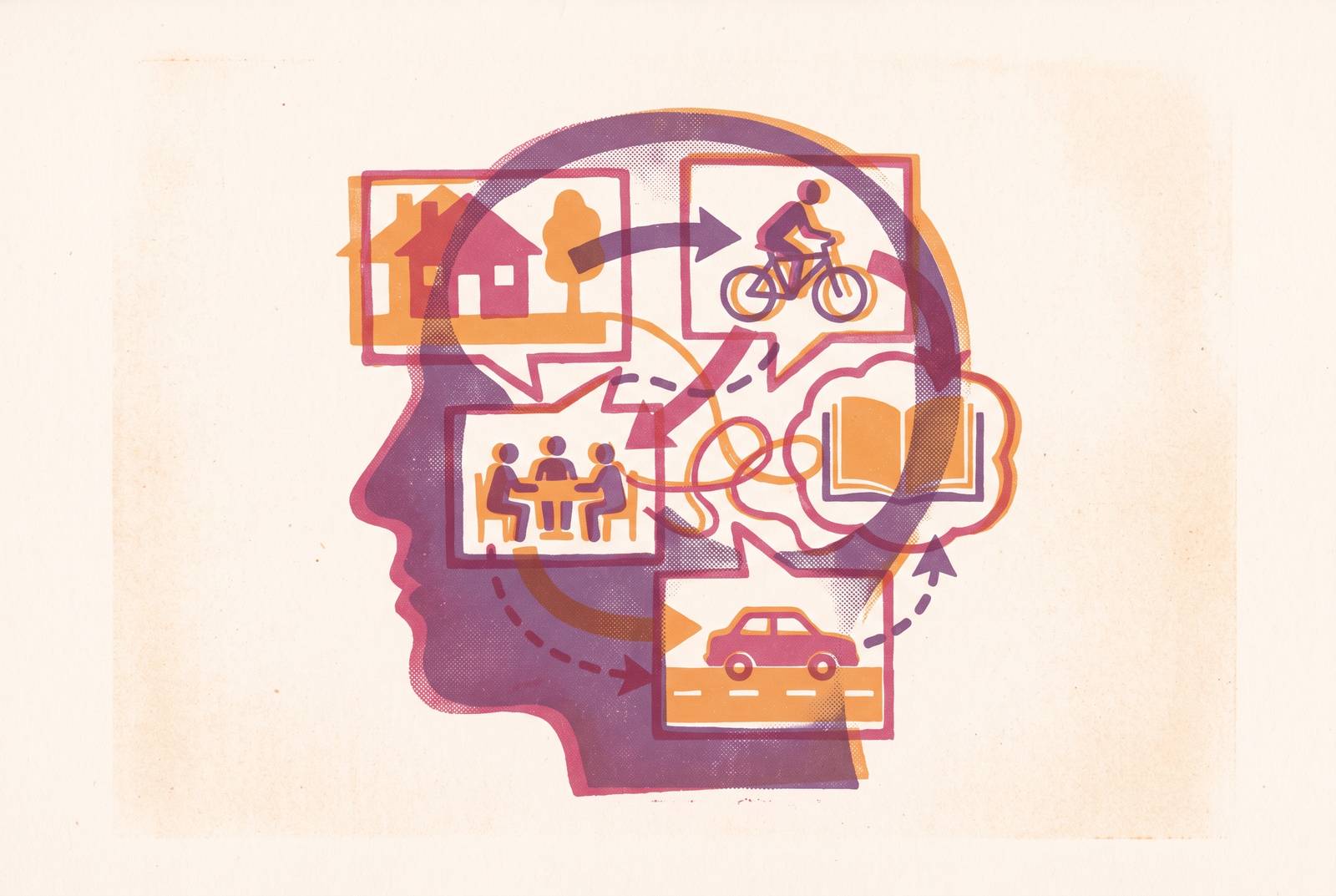
You can be completely certain about a memory and completely wrong about where it came from. That is the central discovery behind source monitoring research: confident recollection can be certain and carry the wrong origin story. This article examines how that gap between content and source opens up, where it costs the most, and whether anything can close it.
What source monitoring errors are and why they feel nothing like ordinary forgetting
A friend tells you a story at dinner. Months later you describe the scene as if you were there, and you are surprised to learn you were not. The disorienting part is not the missing memory. It is the confidence. You can see the room, the expressions, the sequence of events. None of it feels borrowed.
This is a source monitoring error, and it is a distinct category of memory failure. The content of the memory survives intact while its origin tag is wrong or missing entirely. You can remember a fact, an image, a phrase, or an event with full conviction and still be completely wrong about how it got into your head. A headline you read once, then see repeated on social media, comes to feel like something you learned in class. A vivid dream gets filed as a real childhood event. The information itself is present and accessible. The error lives in the label attached to it, not in what was stored.
That is why the experience feels nothing like ordinary forgetting. Forgetting is a deficit, an absence where something used to be. A source monitoring error is a substitution. The memory arrives with all the texture of a genuine experience, and the wrong origin story rides along unnoticed.
How memory constructs a source rather than retrieving one
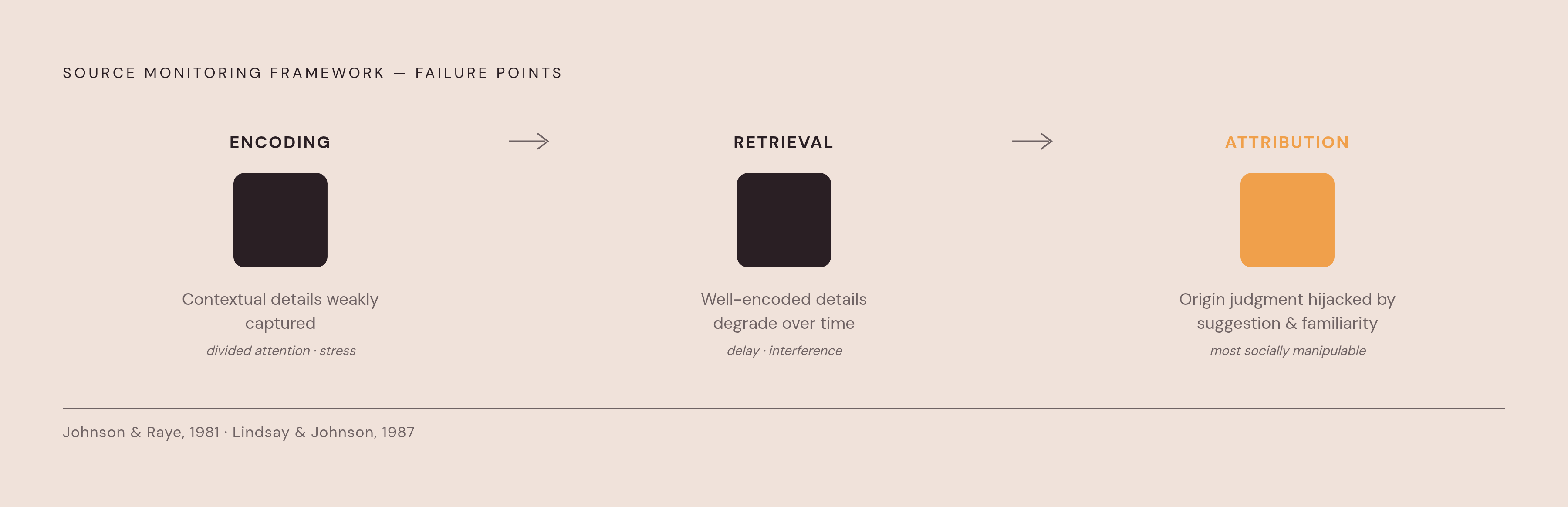
The reason this happens is that the brain never stores a source label alongside a memory. The Source Monitoring Framework, the dominant account in cognitive psychology, holds that memory is reconstructive, not archival. No tag specifying origin gets filed away with each detail. Instead, at retrieval, the brain infers where a memory came from by working with whatever contextual traces survived encoding.
That inference can go wrong at three distinct points. At encoding, contextual details that hint at source may be weakly captured or not captured at all, especially under divided attention or stress. At retrieval, even well-encoded source details may have degraded by the time the memory is accessed. And at attribution, the explicit judgment about where something came from is susceptible to external suggestion, to familiarity cues, to whatever prior expectations happen to be active.
The consequence is that familiarity feels like accuracy. Because the brain rebuilds a memory rather than replays it, the act of recollection can produce a sense of certainty that has little to do with whether the source judgment is correct. The memory feels real, so the label feels right.
This heuristic approach is usually efficient. Nobody needs to track the origin of every piece of information they encounter. But the efficiency carries a systematic vulnerability: when sources are similar, ambiguous, or repeated, the inference system starts guessing, and it often guesses wrong. The misinformation effect is one product of this mechanism. Post-event information enters memory through normal channels, but its source label, the small flag that says "I was told this afterward," gets lost. The content then folds itself into the original event, and the person remembers seeing what they only heard about.
What the brain is physically doing when source monitoring goes wrong
Source monitoring depends on prefrontal systems, and those systems are disproportionately fragile. A 2026 fMRI study in Neuropsychologia found that false memory activity, regardless of memory domain, was associated with overlapping activity in the medial prefrontal cortex and inferior parietal cortex. Those are not peripheral structures. They sit at the center of what the brain does when it binds features together.
The prefrontal-hippocampal circuit is what enables that binding, tying together what happened, when, where, and how you came to know it. When the circuit is damaged or underactivated, content survives but contextual tags are stripped away. The what remains. The where and how do not.
This neural picture matters for what follows. Once you know that source monitoring runs through prefrontal systems, the distribution of source errors stops looking random. Wherever prefrontal function is compromised or overwhelmed, the errors cluster. That principle organizes the next section almost on its own.
Who is most vulnerable and why vulnerability is not random
Vulnerability follows a logic. Amnesic patients and people with organic brain disease involving frontal lobe damage show elevated rates of source monitoring errors across the research literature. That is the direct demonstration: damage the prefrontal systems, and content survives while source attribution collapses.
Depression and high stress produce a similar result, but through a different route. Both disrupt the judgment processes that source monitoring relies on, degrading attribution at the point of retrieval. The brain has the content. It cannot reliably recover where the content came from.
Social anxiety offers a useful counterpoint, because it shows that heightened vigilance does not fix the problem. Research published in Cognitive, Affective, & Behavioral Neuroscience found that higher social anxiety symptoms were associated with enhanced memory for faces encountered during error trials, but not for non-social objects. For socially anxious individuals, emotional arousal during errors selectively strengthens encoding of social content. That can skew what gets remembered and how confidently, without improving the source tag at all. The anxious person pays more attention, and what that attention produces is a more vivid memory with the same broken label.
Children are vulnerable for developmental reasons: source-tracking skills are still under construction, so suggested information enters memory and loses its external-source tag with particular ease. Trauma survivors face a compounding problem. Traumatic events are frequently rehearsed through police statements, media exposure, and conversations with family or therapists. Each rehearsal is an opportunity for misleading details to enter and lose their label. Schizophrenia involves two independent deficits identified in the research: a failure to encode the source of self-generated items, and a tendency to attribute new items to a previously presented source. Together they bias the person toward attributing puzzling stimuli to an external origin.
Where source monitoring errors carry the highest real-world cost
The underlying error is always the same: content intact, source tag wrong. What changes is the setting in which the memory gets acted on, and that setting determines whether the cost is trivial or irreversible. Eyewitness testimony sits at the high-cost end. A witness may accurately remember a face, a detail, or an event while confusing whether it was seen directly, heard from someone else, or inferred from later media exposure. That source confusion can determine legal outcomes. The problem compounds through trauma rehearsal: victims who make police statements, encounter media coverage, and discuss events with family and therapists face repeated opportunities for misleading details to be introduced and later misattributed to direct experience.
Clinical reality monitoring failures carry their own weight. The cognitive psychology literature connects impaired reality monitoring to anomalous perceptions, false beliefs, and symptoms across multiple conditions. The inability to distinguish self-generated from externally generated content has consequences beyond memory alone.
At the everyday end, the same mechanism produces low-stakes embarrassments. You tell a joke to the person you heard it from. You repeat as your own idea something a colleague raised in a meeting. Ubiquitous, minor, and structurally identical to the catastrophic cases. At that other end is someone mistaking a memory of a dream about being abused for a memory of a real childhood event. Same cognitive process, completely different consequences.
Why false memories formed through implantation are especially resistant to correction
The most practically alarming finding is that once a richly formed false memory exists, correction tends to fail. Bücken and colleagues tested this directly, in a study published in Memory, using a blind implantation method. Participants confirmed events that included one false childhood event, then received explicit source sensitization training designed to help them identify and retract false memories.
The training did not reduce false reports. False beliefs and false memories actually increased from session two to session three in both the trained and control groups. The paradigm was methodologically conservative: participants were told they had confirmed five events, one of which was false, and were asked to rate their memory and belief. The implanted event was never overtly suggested, just confirmed. Even under those careful conditions, the false memory proved resistant to correction.
The authors concluded that false memories elicited through blind implantation may be particularly resistant to correction, posing a serious challenge for therapeutic and forensic contexts. For the broader argument, the implication is directional: intervention must happen at or before encoding, not after consolidation. By the time a memory has lost its external-source tag and is being experienced as personal, telling someone to check their sources is like asking them to unremember something they have already lived.
How AI-generated content and conversational AI have created a new class of source confusion
AI-generated media introduces a source confusion problem the brain was not built to handle: content that looks and sounds like perception but was never experienced, delivered through channels that feel like conversation. Research published on arXiv found that AI-edited visuals significantly increased false recollections. AI-generated videos of AI-edited images produced the strongest effect, roughly double the false recollection rate compared to control, and confidence in false memories was also elevated for that condition. The mechanism follows from everything already established. The brain uses perceptual vividness as a heuristic for "this was experienced." AI-generated images and video satisfy that heuristic but correspond to no real event. The content feels sourced in experience when it is not.
The dialogue medium makes it worse. Conversational AI is not a passive information source but an interactive one. It mimics the structure of trusted interpersonal exchange, the kind of context that reliably encodes with a credible-source tag. Combine perceptual realism from generated images and video with conversational trust from AI dialogue, and the conditions for source misattribution become especially favorable. And the Bücken finding about resistance to correction becomes especially alarming, because the false memories being formed in ambient, everyday exposure are precisely the kind that resist later unmaking.
Whether source monitoring can be strengthened before errors are made
The research supports cautious optimism. Source monitoring can be improved, but only if the intervention reaches people before or during encoding, not after the memory has formed. The Bücken study establishes the ceiling: post-encoding correction largely fails. The work that shows promise operates at retrieval practice or at encoding itself.
Retrieval practice strengthens accurate memories and indirectly protects them. A fact that has been actively recalled and rehearsed is harder to overwrite with misinformation than one that was only passively encountered. The metacognition connection runs through the same channel. Source monitoring is a form of metacognition about memory, the habit of asking "did I actually experience this, or did I hear about it?" That habit can be practiced.
The practical principle follows from the mechanism. Any habit that builds richer, more contextually tagged memory traces at encoding, noting when, where, and how you learned something, works with the Source Monitoring Framework rather than against it. It gives the attribution system more material to work with at retrieval. But the honest limit remains. Whether metacognitive training scales from controlled lab conditions to real-world, high-stakes source environments, clinical testimony, daily AI-mediated conversation, remains contested. The ecological validity of these interventions is the most important unresolved question in the field. The tools exist, the lab evidence is real, and whether they hold under everyday conditions is still open.
Sources
- Error-related memory biases are specific to social stimuli for socially anxious individuals - PubMed
- Full article: Trained but still tricked: source sensitisation training fails to reduce false memory reports
- External Source Monitoring and Reality Monitoring: Meta‐Analysis of fMRI Studies - PMC
- Clinical and Neurocognitive Aspects of Source Monitoring Errors in Schizophrenia
- 5.14: Source Monitoring - Social Sci LibreTexts
- Synthetic Human Memories: AI-Edited Images and Videos Can Implant False Memories and Distort Recollection