Redemptive Versus Contamination Narratives in Personal Writing
The stories we tell ourselves about hardship shape identity more than the hardship itself.

Personal writing is shaped less by what actually happened than by the arc a writer imposes on it afterward, and two structural patterns, redemption and contamination, account for much of the difference in how that writing turns out. The framework comes from Dan P. A redemption sequence moves from a bad, emotionally negative scene to a good one that follows it: suffering gives way to wisdom, a loss opens into growth the person didn't ask for but eventually uses. A contamination sequence runs the other direction. A good scene turns dramatically bad, and the negative affect overwhelms the positive, erasing the good as if it had never been real.
The distinction that matters most here is interpretive. Two people can live through the same layoff, the same divorce, the same diagnosis, and walk away having built entirely different structures out of it, because the raw material of an experience doesn't come pre-labeled as redemptive or contaminating. Someone has to do the labeling. That's the whole argument this piece is built on: the event supplies the content, but the writer supplies the shape, and the shape is where identity actually gets made.
None of this should be confused with mood. A contamination narrative is not simple pessimism, and treating it that way misses what McAdams is actually describing, which is pain that has hardened into identity. A redemption narrative, in the same way, is not a rebrand of toxic positivity. The strongest redemptive accounts don't skip past cruelty or bad luck. One pattern metabolizes pain. The other preserves it in amber.
How these narrative patterns embed themselves in identity over time
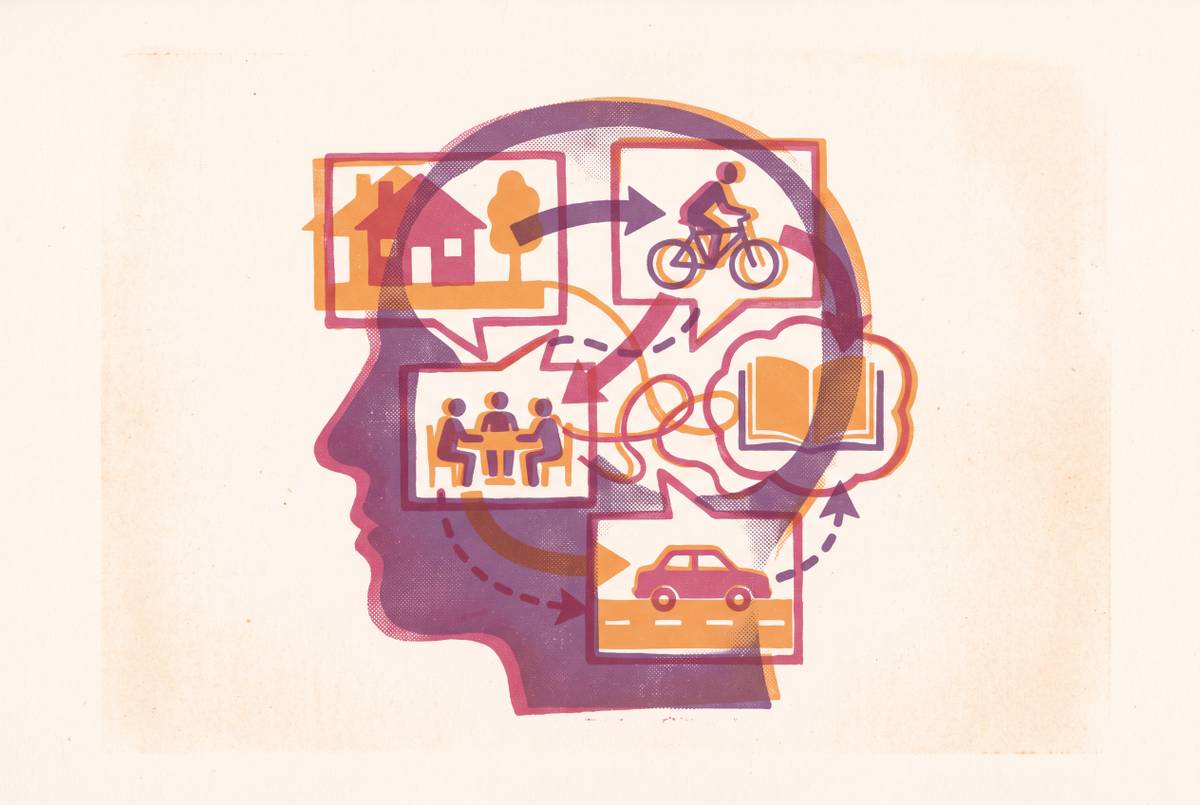
Narrative identity isn't a fixed transcript of a life. McAdams describes it as an ongoing, authored story the self keeps revising. The cumulative pattern of redemptive or contaminated scenes doesn't just describe someone's past, it shapes what they believe their trajectory is capable of. Every time a person writes about something that happened to them, they are casting a vote for one interpretation over another, whether or not they notice they're doing it.
McAdams frames psychological development as a shift from social actor, to motivated agent, to author, with authoring as the stage where a person picks up the pen on their own story. This matters directly for anyone doing personal writing, because the act isn't neutral record-keeping. Sitting down to write about a hard year is already an act of authorship, and the only open question is what kind of author shows up.
Four structural markers separate sturdier life stories from more fragile ones: coherence versus episodic structure, redemption versus contamination, agency versus passivity, and communion versus isolation. Contamination narratives tend to produce the opposite: rumination, shame, and a diffuse sense of self that never quite resolves, because the story itself never resolves. The specific sequence of events someone lived through matters less than which lens they're using to read it, and that lens is what decides whether the accumulated material becomes a coherent story or a pile of unfinished ones.
What the research says about how each pattern affects well-being, generativity, and self-esteem
The link between narrative type and well-being is more precise than "positive thinking helps. Research across midlife adults and students found redemption sequences positively associated with psychological well-being, contamination sequences predicting the opposite, and redemption scores outperforming the overall emotional tone of a narrative as a predictor of well-being. It's not simply that happier stories produce happier people. A story can include real devastation and still function as redemptive, and it's that structural arc, not the sentiment, carrying the predictive weight.
The effect reaches past mood into generativity, which McAdams defines as the capacity to care for and contribute to people and causes beyond the self. Adults who scored high on generativity also showed significantly more redemption and less contamination running through their life stories. A redemptive narrating style isn't purely self-soothing. It appears tied to the outward-facing capacity to invest in other people, which raises a question about what exactly a contamination narrative costs beyond the person telling it.
Self-esteem follows a similar gradient. People whose key autobiographical scenes run redemptive tend to show higher self-esteem, while contaminated stories track with lower self-esteem. None of this holds up as culture-neutral, though, and the exceptions matter as much as the pattern. A 2026 cross-cultural validation study in the European Journal of Psychological Assessment found that redemptive and contaminated elements of narrative identity can differ significantly between people even when their lived circumstances look similar from the outside. Research on Israeli and Palestinian youth found Israeli youths telling predominantly redemptive stories while Palestinian youths told stories weighted toward contamination and tragedy, a mismatch that may itself make common ground harder to find between the two groups. For people whose circumstances are ongoing and structurally unjust, a cheerful instruction to "just reframe it" isn't just unhelpful, it may be unavailable to begin with. The more honest claim is that authorial agency over meaning, even in small, partial moves within a genuinely difficult story, is a different posture than the passivity contamination tends to produce, and that difference is available to more people than full-blown redemption is.
Why the brain responds differently to each narrative type during writing
Writing recruits a circuit spanning the prefrontal cortex, the hippocampus, and the brain's language centers, organizing scattered thoughts into something structured enough to read back later. Redemptive framing specifically exercises the regulatory half of that circuit, and that's a large part of why the arc a person builds while writing matters as much as what they choose to write about.
The foundational experimental work on this comes from James Pennebaker, who ran his expressive writing studies at the University of Texas at Austin. Affect labeling is the mechanism underneath those results: putting a feeling into words activates prefrontal regions in a way that shifts processing away from raw limbic reactivity and toward something more regulated. Simply describing an event doesn't do this on its own.
Redemptive framing asks more of the brain than contamination framing does, and that extra demand is the point. Building a redemptive arc means holding the negative and the emergent positive in mind at the same time, which is exactly the integration work the prefrontal circuit exists to do. Contamination framing ends on the negative note and never asks for that integration, so the limbic activation that writing stirred up in the first place may never fully resolve. But the mechanism explains the benefit. Narrative type is the exercise at the center of the neuroscience of expressive writing.
How contamination narratives form and persist
Contamination narratives rarely start as errors in judgment. They're often the most honest reading someone has available to them at the moment the experience first gets processed. The real problem isn't that the narrative exists, it's that it calcifies into identity and stops functioning as a description of one bad stretch and starts functioning as a verdict on the person.
Carol Dweck's research on fixed versus growth mindsets explains a good deal of that calcification. The inner critic many people describe, the voice insisting they're not good enough no matter what they accomplish, is the contamination narrative, speaking in the present tense as if it were simply who the person is.
The pandemic offers a useful case study in how stubborn this can be. "Bad things keep happening" absorbs the good moments, reframing them as temporary relief rather than real progress, once it becomes the lens the whole account gets read through. Simply noticing the pattern isn't enough to break it. What the practice needs is structural intervention, not better intentions.
Concrete writing practices that shift a contamination arc toward redemption
Shifting a contamination arc toward redemption rarely happens through a single insight or a well-timed pep talk. It tends to require a structured re-encounter with the same material, approached from different angles across multiple sessions, and that multi-session architecture is what separates the techniques that actually work from the ones that just feel productive in the moment.
Pennebaker's expressive writing protocol is still the clearest anchor here: write about a specific emotional experience for 15 to 20 minutes, across four consecutive days. Returning to the same event on successive days is what creates the conditions for meaning-making, because the writer isn't under pressure to resolve everything in one sitting. Instead, interpretive structure builds incrementally, one session layering onto the last. The instruction to write about "deepest thoughts and feelings" rather than a simple recap of what happened is what activates the affect-labeling and prefrontal integration described earlier. Recounting events in order doesn't do this. Examining what they meant does.
A complementary four-step approach gives that examination some shape: attend to the concrete details of the story, examine what those details actually signify, consider how they may have positioned the writer for growth that wouldn't otherwise exist, and treat the present moment as halftime. That last reframe carries particular weight for personal writers, because it asks for no pretending. The bad thing stays bad. The only shift required is refusing to treat the current chapter as the ending, which is a much smaller ask than demanding optimism and a much larger one than it sounds.
Questions like "What did this experience make possible that wouldn't have been possible otherwise?" or "What did I learn about myself that I couldn't have learned any other way?" are structural demands that send the writer out searching for redemptive material rather than waiting passively for it to surface on its own. CBT thought records serve a similar function from another angle, giving the contamination narrative a visible shape on the page that can then actually be examined and challenged. A painful chapter nearly always sits beside relationships and skills it has temporarily overshadowed. Writing finds them again.
How the medium and format of personal writing interact with narrative arc-building
The medium a person writes in matters only to the extent that it supports honest, emotionally engaged writing, the kind that actually activates the regulatory mechanisms described earlier. A beautiful notebook does nothing on its own. What it can do is lower the friction between a person and their own difficult material, which is a real and separate function.
In a period where AI tools are absorbing more and more of people's written thinking, choosing to write something by hand has become, for a fair number of people, a deliberately unmediated act. The quality of attention that choice signals to the writer, about taking something seriously enough to slow down for it, is part of what makes the practice work, independent of whether a pen or a keyboard is involved.
For people who think more clearly out loud than on a page, voice removes a barrier that handwriting or typing can actually introduce. That shift, from passive recounting to active back-and-forth, maps closely onto the authoring posture McAdams describes, where someone stops narrating events that happened to them and starts shaping what those events mean. And because every conversation gets transcribed and stored automatically, searchable later, the format supports exactly the kind of multi-session re-encounter Pennebaker's research identifies as central to shifting a narrative, without requiring the writer to manually revisit old notebook pages to do it.
Using narrative framing as an ongoing lens rather than a one-time exercise
The distinction between redemption and contamination is most useful not as a label applied after the fact but as a question brought to each writing session while it's happening: not "what happened," but "where does this sit in the arc of my story." Treated that way, the framework becomes less a diagnostic tool and more a habit of attention.
Identity isn't a finished document. Life stories get written and rewritten continuously as a person accumulates more experience and more perspective on what came before. The contamination framing someone is carrying today is a current draft, not a permanent verdict on who they are. The authoring stance McAdams describes, the shift from passive actor to agentic author, is the posture a consistent writing practice can actually build over time, one session at a time. Claiming agency and meaning even inside the worst circumstances is the defining move of redemptive narrating, and it has nothing to do with whether the resulting story is a happy one. It has to do with who holds the pen.
A short, regular practice that keeps a writer in ongoing contact with their own evolving story will generally do more than occasional long sessions that treat each hard event as an isolated crisis to be solved once and filed away, regardless of length or polish. Whatever keeps someone returning to the page or the microphone, whether that's a streak, a reminder, or just a standing time of day, is in service of the same thing: enough repeated contact with the material to let the interpretive work actually happen. The lens itself is simple enough to carry forward from here. Every session is another chance to ask which arc is being written, and, more usefully, whether it has to stay that way.