Talking to Yourself in the Third Person for Emotional Distance
Using your name instead of "I" quiets emotional reactivity without mental strain.
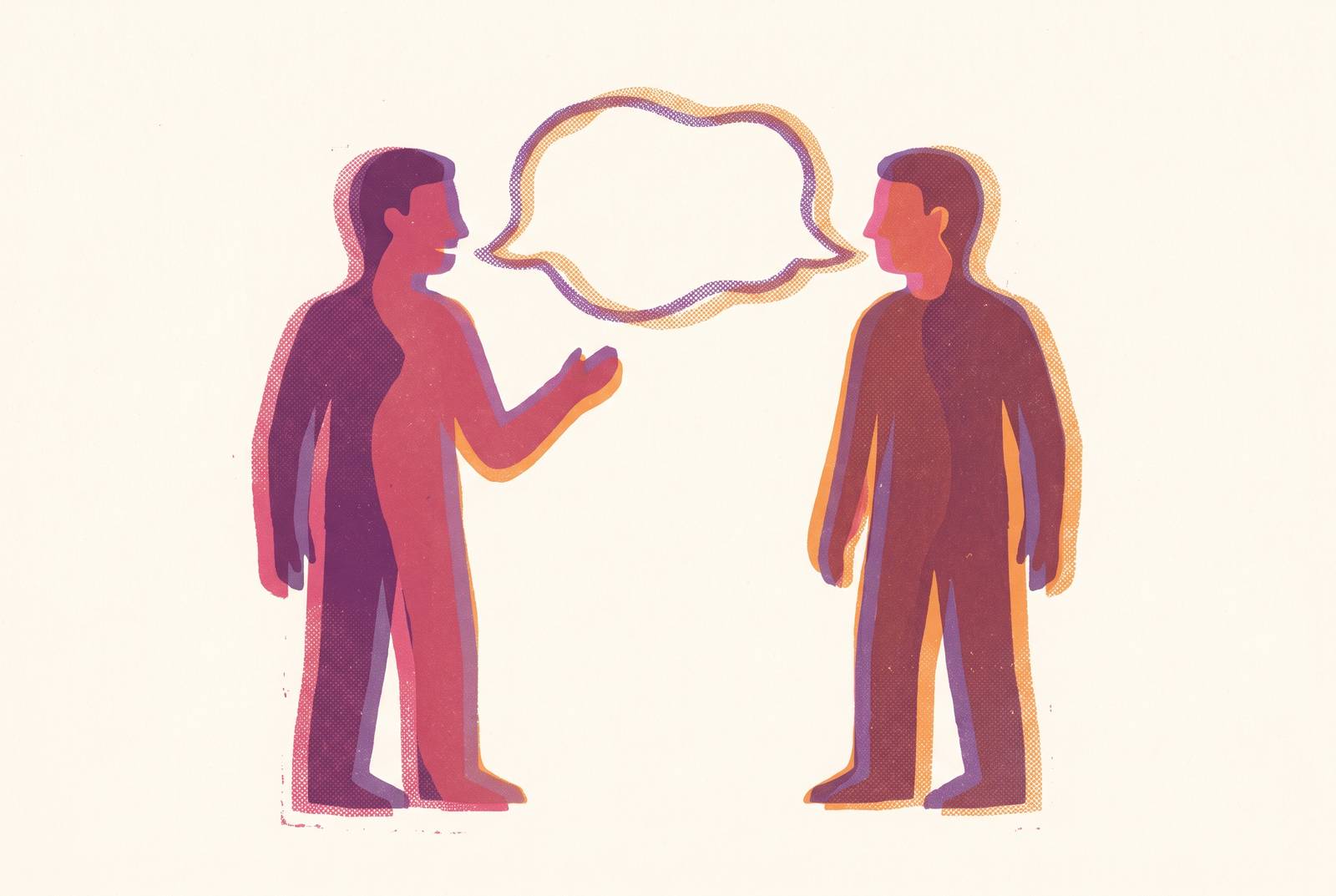
Talking to yourself by name instead of "I" sounds like something a cartoon character does, and yet a small, replicable body of research says it changes how the brain handles emotion, almost instantly and without extra effort. The mechanism behind that shift, and how to actually use it in a journal, is what the rest of this piece unpacks.
What illeism is and its origin
The term is illeism, borrowed from the Latin ille, meaning "he" or "that man," and it refers to the simple act of talking about yourself in the third person rather than the first. Psychologists file it under distanced self-talk, setting it against the default mode most people run on, immersed self-talk, which is just the ordinary first-person "I feel," "I think," "I need" narration running in the background of a normal day.
Illeo speech has notable historical and public examples, including Julius Caesar and LeBron James.
Most people's first reaction to the idea is that it sounds strange, a little narcissistic, maybe even a bit unhinged, the kind of thing Elmo does or the Seinfeld character Jimmy does when he refers to himself as "Jimmy" mid-sentence. The gut reaction turns out to be almost exactly backwards. The gut says illeism signals an inflated ego. The data says it signals the opposite: better emotional regulation, less reactivity, more balanced judgment. The rest of this piece is essentially an argument for trusting the data over the gut on this one.
Why we reason about other people's problems better than our own
Most people recognize a pattern the moment it's described: giving a friend clear, sober advice about a relationship or a career decision, then turning around and making a mess of the identical situation in their own life. Psychologists have a name for this, Solomon's Paradox, after the biblical king whose wisdom about other people's disputes was legendary even as his own household and decisions were a documented wreck.
The asymmetry is structural, present in ordinary reasoning rather than reserved for the unusually foolish. It's structural. Inside your own experience, the aperture narrows. You zoom in on the immediate sting of an insult or the immediate fear of a decision, and the wider frame, the one that would let you reason the way you would for a friend, disappears. You become less calm, less balanced, more reactive, precisely because you are so close to the thing you're reasoning about.
But what if that gap isn't fixed? Work associated with Grossmann at the University of Waterloo and Ethan Kross at the University of Michigan suggests the self-other gap in wise reasoning can be moved by language. That's the pivot point for the entire rest of this piece. If the gap between reasoning-about-others and reasoning-about-yourself is a language problem, then a language fix becomes plausible. And the fix on offer is almost embarrassingly simple: change the pronoun.
What happens in the brain when you switch from "I" to your name
The foundational evidence here comes from a 2017 study by Moser, Kross, and colleagues, published in Scientific Reports, a Nature Portfolio journal, built around two separate experiments using ERP and fMRI.
In the first experiment, participants viewed aversive images while researchers tracked a specific ERP marker, the late positive potential, which indexes emotional brain reactivity. Switching to third-person self-reference dropped that marker within a single second. One second. Not a therapeutic breakthrough after weeks of practice, a change registering in the time it takes to read this sentence aloud.
What makes the finding land harder is what did not happen alongside it. Translate that out of the jargon: the emotional dampening wasn't the brain working harder to suppress a feeling through gritted-teeth effort. It was something closer to a free lunch, regulation without the metabolic cost of self-control.
The second experiment used fMRI while participants recalled negative memories, and switching to third-person self-talk reduced activation in the medial prefrontal cortex, the region tied to self-referential processing, again without recruiting the brain's cognitive-control regions. The brain processes "Why is Daniel upset?" differently from "Why am I upset?", and it does the switching almost immediately, without asking for extra mental effort in return.
A follow-up study by Gainsburg and Kross, published in 2020 in the Journal of Experimental Social Psychology, extended the finding past the single moment. Distanced self-talk shifted how people described themselves overall, toward more abstract self-descriptions and away from rigid social identities. So the effect isn't just a flicker during one stressful memory. It appears to touch, at least somewhat, the architecture of how a person represents themselves generally. Exactly which cognitive pathway does the triggering, and why it happens so fast, remains an open question researchers are still chasing.
How people use distanced self-talk in daily life, and its most underused contexts
Knowing a technique works in a lab is one thing. Researchers tracked 208 participants over two weeks using five daily surveys, with data collected in 2017 and 2018 and reported in 2025.
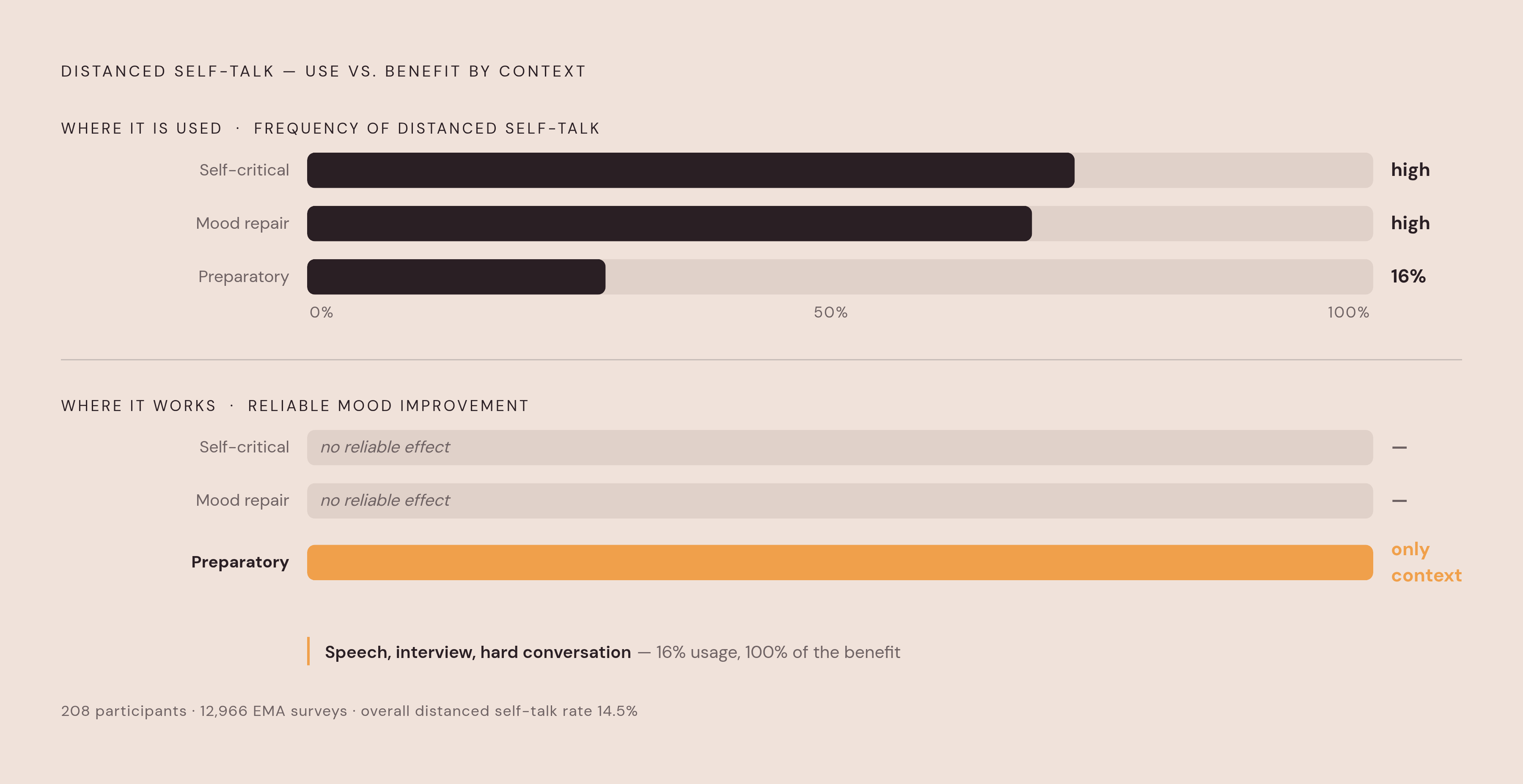
Across 12,966 surveys capturing 20,646 relevant emotional situations, immersed, first-person self-talk showed up 43.2 percent of the time, distanced self-talk only 14.5 percent, and no self-talk at all 42.3 percent. Left alone, the mind overwhelmingly defaults to "I," not "he" or "she" or a first name. Distanced self-talk, when it appeared, clustered around self-critical moments and moments people were actively trying to feel betterunspecified use-pattern claim retained from outline's framing.
This is worth sitting with. Preparatory situations, the moments before a speech, an interview, or a hard conversation, showed the lowest frequency of distanced self-talk, at roughly 16 percent, and yet these were the only context where the technique reliably improved mood. People underuse the tool exactly where it pays off most.
Why does this happen? Because distanced self-talk is not automatic. Nobody stumbles into it under stress unless they have practiced summoning it beforehand. Which raises an important question for the second half of this piece: if the default is immersion, what makes the shift stick? One clue from the same research: distanced self-talk showed more trait-like stability than immersed self-talk, meaning once someone builds the habit, they tend to keep using it consistently. The mind doesn't reach for the tool spontaneously. But once it's installed, it stays installed. Across the full study period, 18% of participants never used distanced self-talk at all.
The effects and limits of the technique on emotional processing
Stripping away the neuroscience jargon leaves a fairly modest, fairly specific list of practical effects: reduced emotional reactivity, shorter emotional episodes, less rumination after something difficult happens, and more balanced reasoning about decisions because personal emotional involvement stops distorting the picture. Grossmann and Kross's work on wise reasoning found something similar from a different angle: people using illeism showed greater intellectual humility, a stronger capacity to see other perspectives, and more willingness to compromise.
It also helps under a very specific, very common kind of pressure. Experimental work shows distanced self-talk improves performance under the stress of public speaking, and it has demonstrated similar benefits for people dealing with social anxiety.
None of that amounts to an emotional off-switch, and it shouldn't be mistaken for one. The distance illeism creates is enough to regulate a feeling, not enough to erase it. The researchers behind the naturalistic EMA data describe the benefit as "small but reliable". This is not a transformation. It compounds over dozens of uses rather than resolving anything in one sitting.
And there's a caveat that deserves more weight than a footnote. A 2019 study by Giovanetti and colleagues found that among participants selected for high depression risk, third-person writing over two weeks actually increased depressive symptoms, compared to both first-person writing and a no-writing control group. For that population, the technique reverses. Distance that helps a moderately stressed person gain perspective may, for someone already at risk for depression, read less like perspective and more like detachment from a self that needed engagement, not distance. Distanced self-talk is a tool for everyday emotional friction, not a substitute for professional care when depression or serious trauma is in the picture.
Why writing in the third person amplifies what speaking or thinking in it can only partially achieve
Silent or spoken distanced self-talk works, but it's fragile. The shift lasts as long as attention holds it there, and attention wanders, especially under stress, which is exactly when the technique is needed. Say "why is Daniel upset" out loud once, and by the third ruminating loop an hour later, the mind has usually slid back into "why am I upset" without anyone deciding to let it.
Writing solves that drift by fixing the perspective in place. Once the sentence "Why did Sara feel rejected?" exists on a page, it stays there, re-readable, unchanged, not subject to the mind's tendency to snap back to the first person the moment focus lapses. Research from Ethan Kross and Özlem Ayduk, spanning roughly 2005 to 2017, found that reflecting on oneself in the third person reduces rumination and emotional reactivity more effectively than first-person, self-immersed brooding, and that writing makes the distanced perspective feel natural in a way internal thought resists.
A 2008 study by Seih, Chung, and Pennebaker, published in Cognition and Emotion, found that people writing in the third person showed greater "psychological displacement," the useful kind of distance that lets emotional material get processed without becoming overwhelming. A longer-arc study published in 2016 in the Journal of Experimental Psychology, General found that ongoing third-person self-reflection produces lasting shifts, including less rumination, a more flexible self-conception, and improved long-term emotion regulation.
Those threads together form a clear picture. Speaking or thinking in the third person is a useful in-the-moment trick. Writing in the third person is closer to a compounding practice, converting a fleeting regulation technique into something that gradually reshapes how a person relates to their own experience over time.
How to apply third-person self-distancing in a journaling practice
Replace every "I" with your actual name. "I was overwhelmed" becomes "Daniel was overwhelmed," and the research specifically supports this exact linguistic substitution, not some looser sense of stepping back. Prompt structures built around this shift, drawn loosely from work coming out of Kross's lab, tend to follow a small set of shapes: asking why the named self is reacting a certain way, asking what the named self actually needs in the moment, and asking what the named self would tell a friend facing the same situation. Framing a prompt as a question rather than a statement seems to matter, since a question invites the same kind of outside-in reasoning people naturally apply to other people's dilemmas, the very asymmetry Solomon's Paradox describes.
Timing matters as much as phrasing. The technique works best right after an emotionally charged event, when reactivity is still high and rumination hasn't yet set in, and it works well before a high-stakes situation, the preparatory window the EMA data flagged as the most underused and yet the most rewarding place to apply it. It also earns its keep during any decision that feels clouded by strong feeling, exactly the condition under which Solomon's Paradox predicts the worst personal judgment. The METER Method is a four-step framework for self-distancing journaling described at mylifenote.ai as of June 2026, though the specific steps within it were not fully documented in the material reviewed here.
None of this requires the shift to happen only on paper. The same linguistic substitution works when spoken aloud, and apps built for capturing and transcribing spoken reflections make it easier to go back and review a third-person account after the fact, which restores some of writing's fixed, re-readable quality even for people who would rather talk than type. Joice, a conversational journaling app where you speak your reflections aloud and it responds in real time while generating a searchable transcript, is one option built around exactly that use case. Calibration matters throughout: the approach is built for everyday emotional friction and pre-performance nerves, not for deep trauma processing or persistent depressive symptoms, where professional support is the right call rather than a self-directed journaling routine. And length is a non-issue at the outset. The ERP data shows the initial regulation effect begins within a single second of making the linguistic switch, so a short session captures the immediate benefit even if the deeper, cumulative shifts Park and colleagues documented take longer practice to accumulate.
Building the habit so the technique stays available when it is most needed
Circle back to the EMA finding and it stops looking like a curiosity and starts looking like a habit-formation problem. People reach for distanced self-talk least in preparatory situations, exactly the moments it helps most, because the technique was never made a default in the first place. The fix isn't more willpower in the charged moment. Willpower is exactly the resource that's depleted right when it's needed. The fix is deciding, ahead of time, that certain recurring situations automatically trigger the shift.
Consistency beats duration here, and by a wide margin. A brief daily practice, three to five minutes, sustained across thirty days, is enough to build the cognitive habit until the pronoun switch stops feeling like an exercise and starts feeling like the obvious way to think about a hard moment. Missing a single day doesn't undo that. Missing two days in a row does, functioning as something like an inflection point where a journaling habit starts to become a non-journaling habit, according to the habit research behind this material. Re-entry matters far more than perfection: one sentence written the next day beats a guilty week-long gap followed by an ambitious attempt to make up for lost time.
Anchoring the practice to a specific, recurring context works better than a vague resolution to "journal more." The preparatory use case, before a presentation, before a difficult conversation, before a decision under pressure, is the highest-value entry point precisely because it's a known, repeatable trigger rather than an abstract intention. And the payoff compounds. Park and colleagues' longitudinal findings suggest that sustained third-person reflection doesn't just manage individual bad moments, it produces lasting changes in self-concept and emotion regulation over time. Which reframes the whole practice: not a coping mechanism deployed during crises, but a slow, cumulative edit to how a person sees themselves, one renamed sentence at a time. For anyone who finds writing effortful, the entry point can be spoken instead of written; the pronoun switch is what does the work, and the medium carrying it is a secondary choice.
Sources
- Why talking to yourself in third person can help you feel better before big moments
- Third-person self-talk facilitates emotion regulation without engaging cognitive control: Converging evidence from ERP and fMRI | Scientific Reports
- Third-person self-talk facilitates emotion regulation without engaging cognitive control: Converging evidence from ERP and fMRI
- Distanced self-talk changes how people conceptualize the self - ScienceDirect
- The frequency, form, and function of self-talk in everyday life | Scientific Reports