Cultural Variation in Emotion Categories and Their Regulation Effects
Cultural values shape which emotion regulation strategies actually work for you.
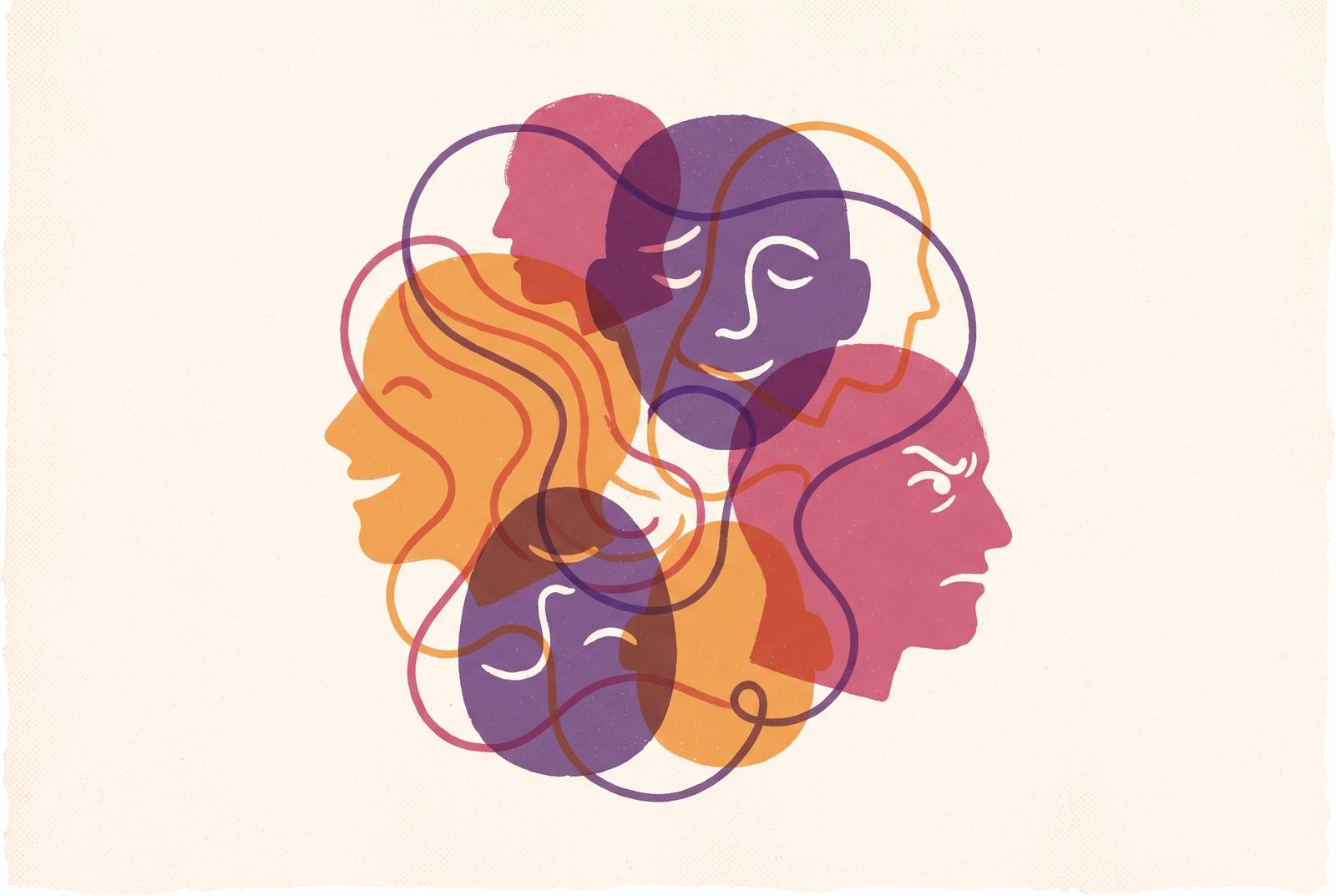
Fear, sadness, anger: these feel like things that happen to you, the way weather happens to a picnic. Lisa Feldman Barrett's Theory of Constructed Emotion argues something close to the opposite: emotions are built, in the moment, out of raw bodily sensation, past experience, and the conceptual categories a culture hands you. When the learned category is stripped away, what's left is a racing heart, tight chest, and no story to attach it to. It's just a racing heart, tight chest, and no story to attach it to. That distinction turns out to matter a lot for anyone trying to regulate their emotions using advice built for a self that may not be theirs.
How cultures carve up emotional experience differently
Barrett's framework has a strange corollary for cultural psychology: the whole vocabulary of "cognition," "emotion," and "motivation" as separate mental buckets is itself a folk theory. Hazel Markus and a collaborator laid the groundwork for seeing why this varies by culture back in their work on self-construal, arguing that Western cultures tend to build an independent model of self (distinct, expressive, defined by internal traits) while many East Asian cultures build an interdependent one (relational, role-based, tuned to the group around you).
That's not just a difference in how emotions get shown. It changes which emotions a person is even trying to feel. Take happiness. When someone raised in that first cultural context is asked what a good day feels like, the answer usually orbits achievement: a promotion, a personal best, something earned alone. When someone raised in a Japanese cultural context is asked the same question, the answer more often orbits harmony, involving a smooth interaction, a group that functioned well, and a sense of fitting rather than standing out. Same dictionary entry for the word, translated the same way, but structurally two different experiences built from two different blueprints of what a self is for.
The standard regulation toolkit was built for one kind of culture
Most of what gets taught as emotion regulation, in therapy rooms, in self-help books, in the productivity-app version of mental health, comes out of research conducted primarily in Western, individualist settings. A 2026 systematic review covering 54 articles across East Asian and Western contexts makes clear that much of this research has been built on a narrow participant pool and then generalized outward.
Two strategies anchor almost all of it. Cognitive reappraisal means consciously reinterpreting a situation to change how it feels, turning pre-exam nausea into "I'm excited," for instance, rather than "I'm scared." Expressive suppression means the opposite move: the feeling already fired, and the job is to keep it off your face and out of your voice. The standard verdict, repeated across decades of clinical literature, is that reappraisal is adaptive and suppression is maladaptive. It's a full stop, textbook answer, the kind that shows up on a licensing exam.
But look at what that verdict actually rewards. Reappraisal prizes the ability to generate your own private reinterpretation and act on it, which is exactly the muscle an independent self is built to flex. Suppression, meanwhile, gets penalized because it blocks a person from expressing what's internally true, and expressing what's internally true is the whole point of an independent self-model. The verdict isn't wrong so much as it's a value judgment dressed up as a clinical finding, and the value judgment happens to match one cultural blueprint almost perfectly.
Where reappraisal works less and suppression works more than the textbook says
A 2025 meta-analysis in Nature Human Behaviour went looking for where the standard verdict breaks, and it broke in specific, measurable places rather than along a single cultural-region divide.
In cultures scoring high on long-term orientation, reappraisal's usual link to lower psychopathology weakens. The strategy still helps, just less than the textbook predicts. Flip to cultures more tolerant of uncertainty, China, one large Western nation, and India, and reappraisal's benefit gets stronger, likely because alternative interpretations of a stressful event feel more available and more socially acceptable to reach for. Suppression shows its own split. In more indulgent cultures, suppression costs more in terms of psychopathology. In more restrained, competitive cultures, that same suppression carries a smaller penalty.
What's notable is the method behind these findings: the researchers used Hofstede's cultural dimensions rather than a blunt East/West label, which is how the analysis catches something like the gap between China and Japan on ambiguity tolerance, two countries that get lumped into "East Asian" constantly despite pulling in different directions on this specific measure. A 2024 review in the Journal of Cross-Cultural Psychology adds a behavioral data point on top: East Asian individuals showed more use of both suppression (d = -0.29) and avoidance (d = -0.57) compared to Western samples, small-to-moderate effects, but consistent ones.
The physiological evidence is where this stops being an abstraction. An EEG study out of Japan measured the late positive potential, a brain signal tied to emotional response, while participants were instructed to suppress. Among participants who scored high on interdependent self-construal, suppression produced a real drop in that neural signal: their brains were actually down-regulating the emotion, not just hiding it behind a straight face. Among participants low in interdependence, the effect was negligible; the instruction to suppress did basically nothing to their neural response. Same instruction, same brain region, opposite outcome depending on a personality variable that has nothing to do with passport or ethnicity.
Why individual cultural values matter more than national category membership
That EEG finding is the whole argument in miniature. The suppression benefit tracked individual interdependence scores, not nationality. Two people born in the same city can sit at opposite ends of that scale, and the one lower in interdependence gets none of the neural benefit the textbook's cultural-region footnote would predict for them.
Research in this area increasingly points toward a methodological lesson: measuring how strongly someone personally holds a given cultural value may predict their regulatory outcomes better than asking where they grew up or what their heritage is. Country of origin is a proxy, and a leaky one. It's a shortcut for the actual variable researchers care about, which is what model of self a given person is running.
That has an obvious, slightly inconvenient implication for anyone trying to apply this research to their own life: someone raised in an interdependent household who spent a decade in an individualist workplace culture might not fit either playbook cleanly. Neither the Western clinical consensus nor its cultural-dimension corrective was built with a bicultural, code-switching nervous system in mind. Which raises a fair question: if neither template fits, what's actually left to work with? Something closer to a personal audit than a downloaded framework, is the short answer, and that's what the last two sections try to build toward.
How writing and reflective practice sit differently across cultural contexts
The evidence behind expressive writing, structured writing about a stressful event improving mood, sleep, and immune markers, comes from a research lineage built almost entirely in Western, individualist labs. The benefits are well documented. What's less settled is whether they're universal or whether they're partly a byproduct of the independent self-model's comfort with narrating private feelings out loud on a page.
That's a live question. Research examining cultural differences in motivations during expressive writing is still working through it rather than closing the book on it. Externalizing an internal state onto paper assumes the internal state is the thing to examine, and that assumption varies by self-model.
Form varies too, maybe more than function does. A 2025 systematic review of writing-based interventions in cognitive rehabilitation for MCI and dementia, documented by Frontiers research, catalogued journaling, poetry, Chinese calligraphy, and memory notebooks all doing similar reflective work through very different physical practices. Calligraphy is slow, deliberate, and attentive to form in a way that a stream-of-consciousness journal entry simply isn't. Same underlying function, different container, which is a useful reminder before assuming the specific format of "sit down and write about your feelings" is the only vehicle that gets someone to the destination.
Designing a reflection practice that fits your cultural self-model
None of the above is an argument for throwing out journaling or reappraisal. It's an argument for matching the tool to the self-model actually doing the work, instead of defaulting to whatever showed up first in a research sample drawn from wealthy, industrialized, democratic societies with high levels of formal schooling. That sample is where most of this research started and where its blind spots come from.
For someone whose self-model runs independent, comfortable externalizing thoughts and prioritizing personal insight, the standard toolkit is a reasonably good fit already. Reappraisal-focused prompts work well here: "What's another way to read what just happened?" or "What would I tell a friend in this exact spot?" Structured expressive writing, narrate the event first, then explicitly reframe it, gives that reappraisal muscle something to push against. Third-person self-distancing, writing about the day's events as "she" or "he" rather than "I," has shown up in the literature as a way to cut emotional reactivity without suppressing anything. Open-ended morning pages fit the same profile: low structure, high tolerance for surfacing whatever's there.
For someone running a more interdependent self-model, relational, context-attuned, tuned toward harmony over individual standout, a different set of prompts fits better. Ask how the situation affected the people around you. Ask what maintaining harmony in that moment would have looked like. Observation-focused writing, describing a scene from a wider vantage point rather than parked inside a first-person emotional close-up, tends to sit more naturally here too. So does gratitude writing aimed at relationships and roles rather than personal wins, and structured reflection on social responsibilities rather than an isolated inventory of feelings.
Bicultural or acculturated readers get the least satisfying answer, and probably the most honest one: try both, log what actually changes something, and treat cultural fit as a question to investigate rather than a label to assume based on where a passport was issued. The self-model producing the emotion is the one that has to sit with the regulation strategy afterward, and that's not always a fact anyone can guess from the outside, including the person doing the guessing.
Sources
- culture-emotion-lab.stanford.edu
- Is Emotional Regulation Effective Everywhere?
- The impact of culture on emotion suppression: Insights from an electrophysiological study of emotion regulation in Japan
- Differences and Similarities in the Use of Nine Emotion Regulation Strategies in Western and East-Asian Cultures: Systematic Review and Meta-Analysis - Hongru Song, Jason S. Chan, Christian Ryan, 2024
- affective-science.org
- journals.sagepub.com
- pubmed.ncbi.nlm.nih.gov
- MetaAnalysisIdealAffect.InPress.102925