Inhibition Theory of Why Suppressing Disclosure Costs Health
Suppressing trauma costs the body measurable physiological damage.
Holding back a thought, a feeling, or a memory of something painful takes active physiological work. That reframing, laid out across research using a protocol of 3–4 days of writing, 15–20 minutes per session, is the subject of this piece: what inhibition costs the body, what discloses it, and why so few people bother to spend the time that might balance the ledger Emotional Inhibition and Health | Request PDF blog.mylifenote.ai.
What Pennebaker's inhibition theory claims
The psychosomatic premise is blunt: long-term inhibition is linked to stress and disease, not as a vague correlation but as the theory's central, testable proposition. Smyth (Guilford Publications, 2016).
It helps to be precise about what the theory claims. The theory does not say that staying quiet about a hard experience feels bad, which is obvious enough that it hardly needs a psychology department to confirm it. Suppression imposes a measurable biological load that raises blood pressure, weakens immune markers, and increases doctor's visits. So the real question the rest of this piece works through is mechanical: if suppression spends something, what exactly gets spent, and what pays it back?
The evidence that not disclosing trauma damages health over time
That correlation needed a way to measure who confides and who doesn't, which is what the Self-Concealment Scale was built for. It captures individual differences in willingness to disclose distressing personal information, and self-concealment on that scale predicts anxiety, depression, and physical symptoms on its own, independent of the trauma itself.
The clearest test case comes from a study of 62 gay men living under social constraints on self-expression. Those who wrote about their gay-related thoughts and feelings showed less avoidance behavior and fewer somatic symptoms than men in the control condition, which is about as direct a link between social suppression and bodily cost as the literature offers. Cole and colleagues found something similar in 1996: elevated health risk specifically among gay men who concealed their identity, a finding Pennebaker cited the following year as corroboration of the inhibition-disease link. Traue's 2001 entry in the International Encyclopedia of the Social & Behavioral Sciences widened the frame further, tying emotional inhibition to higher probability of hypertension, heart disease, and psychosomatic symptoms through three separate pathways: neurobiological, social-behavioral, and cognitive 30 Journaling Prompts for Mental Health (Research-Backed).
What ties these studies together is whether people talked about what happened to them. It's whether they talked about it. Severity is the variable most people assume matters most, and these findings keep pointing somewhere else. What none of this settles, though, is mechanism: is the damage coming from the effort of concealment itself, or from some other feature of trauma that just happens to travel alongside silence? That question is exactly what the 1986 experiment was built to isolate.
What the 1986 experiment revealed about short-term pain and long-term gain
The protocol was almost embarrassingly simple. No therapist, no discussion group, just a room, a notebook, and a clock.
In the short term, the trauma-writing group came out worse for it. Blood pressure ran higher and moods dipped right after the sessions where participants wrote about both the facts and the emotions of what happened to them.
That is a genuinely strange result if you expect health interventions to feel good while they're working. The design also varied what people were asked to write, cognitive facts only, emotional content only, or both combined, and the combined condition is what drove the effect. Writing the facts without the feelings, or the feelings without the facts, did less. Something about forcing language to hold both the event and its emotional weight, at the same time, appears to interrupt whatever the body had been quietly maintaining. In the 6 months following the experiment, participants showed a long-term payoff of fewer health center visits, a concrete, behavioral health outcome, not just self-report.
Three competing explanations for why writing works (and what each gets right)
Pennebaker himself complicated his own theory in a 1997 paper in Psychological Science. Relief from inhibition might play a role, he wrote, but changes in basic cognitive and linguistic processes during writing turned out to predict improved health outcomes better than inhibition relief alone did. Pennebaker and Chung later summed up the field's state with a shrug that reads almost like an admission of defeat: a daunting number of explanations have been proposed, and many of them have turned out to be partially correct. Not one correct explanation. Many partially correct ones.
Three mechanisms tend to appear in that pile. The first is inhibition relief itself: suppression is active labor, so writing simply ends the labor and lets the body recover whatever it had been spending on containment. The second is cognitive restructuring, the idea that writing imposes narrative structure on an experience that had been sitting in fragments, with Pennebaker and Chung describing the shift as translating an "analog" emotional experience into a "digital" linguistic one. The third comes out of neuroscience rather than psychology proper: affect labeling, the finding that naming an emotion reduces its intensity, summed up by UCLA's Matthew Lieberman as "if you can name it, you can tame it," with unlabeled emotion instead trapping the body in a kind of low-grade, chronic arousal. Later work adds a physiological data point: heart rate dropped in both reappraisal and self-compassion expressive-writing groups, a measurable signal downstream of whichever mechanism gets credit.
None of these three explanations really competes with the others so much as each grabs a different slice of the same event. Relief accounts for why suppression is costly in the first place. Restructuring accounts for why the writing has to have some coherence to it, not just be a word-dump. Labeling accounts for why naming things, specifically, does something distinct from just thinking about them. Catharsis was never the mechanism. It might just be a side effect that occurs sometimes and not others.
Why the format of disclosure matters less than the act of it
Esterling and colleagues, in a 1994 study cited in Pennebaker (1997), found that emotional disclosure through either writing or speaking modulated immune markers, which tells you the medium was never the load-bearing variable. Pennebaker and Chung name the actual mechanism directly: "transforming feelings and thoughts about personally upsetting experiences into language." Language is the ingredient. Paper is just one container it happens to fit in.
That has an obvious modern test case. A 2025 clinical trial published in PMC found expressive writing still reduced depressive symptoms when delivered entirely online, and its simplicity is exactly what makes it portable to digital formats, reaching people who face real barriers to sitting in an in-person therapist's office blog.mylifenote.ai. Zoom out further and a 2026 scoping review counted close to 200 controlled trials on digital interventions for depression and anxiety, and the field's question has shifted 30 Journaling Prompts for Mental Health (Research-Backed). It's no longer "does this work," it's "why," with reflection, cognitive reappraisal, and sustained engagement functioning as the strongest predictors of actual improvement over time 30 Journaling Prompts for Mental Health (Research-Backed).
If linguistic translation is the operative mechanism rather than the physical motion of a pen, then talking through an experience out loud, in a structured and reflective way, ought to produce roughly the same relief as writing it down. The obstacle here was never technological. It's motivational and habitual. A notebook, a keyboard, or a recorded conversation all lower the friction of starting, and of continuing, and so all fit the theory just fine.
Self-concealment as a personality dimension, not just a situational response
Pennebaker draws a distinction that's easy to miss on a first read. Some non-disclosure is circumstantial, driven by stigma or by a genuine lack of anyone safe to tell. Some of it is dispositional, a stable trait some people carry into every relationship regardless of circumstance. The Self-Concealment Scale measures the second kind directly, and scores on it predict anxiety, depression, and physical symptoms even after controlling for other factors that might otherwise explain the overlap.
That range matters because it means some of these patterns are so habitual they don't register to the person doing them as suppression at all. It just feels like personality. Nobody thinks of themselves as "actively containing something" when containing it is all they've ever done.
The gay men study gestures at a related cost that's easy to underweight: sustained concealment appears to occupy working memory, so the ongoing effort of tracking what not to say functions as a low-grade tax on attention that runs in the background all day. Which raises an uncomfortable possibility for anyone reading this who doesn't think of themselves as someone who suppresses anything. Health anxieties nobody's mentioned, tension with a partner that gets managed rather than discussed, grief that got filed away because there was never a convenient moment to unpack it, all of that can add up to the same physiological tax, invisible to the person carrying it, which is arguably what makes it dangerous in the first place. Traue's 2001 taxonomy of emotional inhibition types identifies genetic inhibition, repressive inhibition, suppressive inhibition, and deceptive inhibition, with emotional implosion as an extreme form, pointing to the fact that some inhibition patterns are deeply habitual and may not feel like active suppression to the person doing it 30 Journaling Prompts for Mental Health (Research-Backed).
What structured expressive disclosure looks like in practice
The protocol that survives from this research asks 46 introductory psychology students to write about either personally traumatic events or trivial topics on 4 consecutive days. That combination, facts plus feelings, is essential to the effect. That combination did the work in the original experiment; either half alone produced a weaker effect.
This is different from journaling as most people picture it, the daily log of what happened at work, what got eaten for lunch, whether the gym happened. Expressive writing under this protocol has no interest in accuracy or good prose. The goal is translating experience into language under conditions low-stakes enough that nobody's grading the sentences. Structured prompts help precisely because they solve the hardest part of the exercise, which is knowing where to start, by pointing attention at the factual and emotional dimensions of an experience without requiring the person to invent a starting point from nothing.
The spoken version carries the same weight. Structured reflection out loud, especially prompted rather than freeform, appears to trigger the same linguistic translation process that writing does. People with higher alexithymia, who have more difficulty identifying their own emotions, showed higher positive affect after expressive writing than control participants did, in a 2025 study published in a SAGE journal blog.mylifenote.ai. That's almost the opposite of what you'd predict. The people who struggle most to name what they feel appear to gain the most from an exercise that forces the naming. Unstructured venting, just spilling emotion with no organizing thread, does not produce the same benefits. Structure, meaning narrative coherence, some sense of cause and effect, some ordering in time, is what turns raw feeling into something processed rather than just repeated. The core protocol from Pennebaker's research asks people to write or speak about a personally upsetting experience for 15–20 minutes on 3–4 consecutive days, covering both the facts and the emotions surrounding it.
The adoption gap and the cost of starting
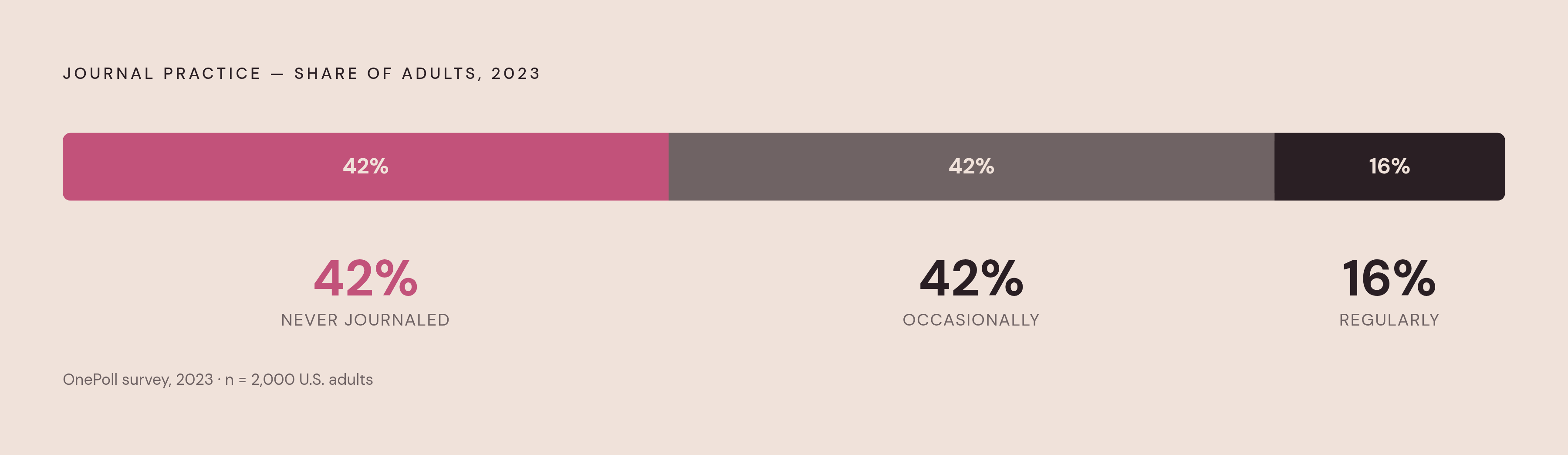
This should sting a little. A 2023 OnePoll survey found 42% of people have never journaled at all, and only 16% do it regularly, which means most people are carrying whatever inhibition load they have with zero structured outlet for it. It's not a knowledge problem. This research has been public and reasonably well-publicized since 1986, so the gap is motivation and habit, not ignorance. It's motivation and habit, which are harder problems than ignorance because you can't fix them by handing someone a pamphlet.
Even a low bar still runs into the blank page: traditional writing asks someone to generate content, structure, and motivation all at once, and the friction is worst at the exact moment inhibition is strongest, which is right at the start, before a single word has landed on the page.
If the theory holds, and 42% of people have no structured outlet at all, then a sizable chunk of the population is quietly running a physiological deficit they're never paying down. That is a significant stake. It's a public health footnote that never quite gets the alarm it probably deserves. Conversational, prompt-driven disclosure sidesteps the blank page directly, since responding to a question is a fundamentally easier act than generating a narrative from nothing, and a response is still, mechanically, the same linguistic translation the theory says is doing the work. Joice, a voice journaling app where you speak your thoughts aloud and it responds in real time with prompts, is one tool built around exactly that substitution. The format is negotiable. The translation from feeling into language is not. Pennebaker's own design insight held that the protocol of 15–20 minutes over 3–4 days is deliberately minimal, as the research was designed around what people would actually do Emotional Inhibition and Health | Request PDF blog.mylifenote.ai.
Sources
- Writing About Emotional Experiences as a Therapeutic Process - James W. Pennebaker, 1997
- Pennebaker, J. W., & Chung, C. K. (in press). Expressive
- Effects of Reappraisal and Self-Compassion Expressive Writing on Emotion Regulation - Teresa Jacques, Rui A. Alves, 2025
- Confronting a Traumatic Event. Toward an Understanding of Inhibition and Disease — the Research Networking System
- Disclosure of traumas and psychosomatic processes - PubMed
- Self-concealment: Integrative review and working model