Physiological Effects of Spoken Emotional Disclosure
Writing about emotions produces measurable physical changes your body registers in real time.
Talking about a bad day and writing about it are not the same event for the body. Both count as "emotional disclosure," but the research on what each one does physiologically is different in ways that matter if you're trying to figure out whether venting actually does anything besides make you feel heard. Written emotional disclosure in particular has been linked to measurable physiological change, not just a mood bump, and the evidence for that claim is stronger than most people assume, though shakier than it is often stated.
The physical effects of emotional disclosure
The folk theory goes like this: talking about something hard feels better afterward, so it must be doing something good. That's true as far as it goes, but it's also the kind of explanation that stops at the first plausible-sounding answer instead of asking what "doing something good" actually means in the body. Does it mean cortisol drops? Does blood pressure change? Does an immune cell count shift?
James Pennebaker's original work in the earlier era of expressive-writing research pushed past the subjective-relief explanation and into something with harder edges. He had people write about traumatic experiences for 15 to 20 minutes across several sessions and then tracked what happened to their health afterward, not just their mood. The finding that made people pay attention wasn't that participants felt better. It was that their health outcomes improved in ways that went beyond self-reported mood. That's a claim about biology, not about catharsis.
Most of this evidence base comes from written disclosure, not spoken. Spoken emotional disclosure, the kind that happens in therapy rooms, voice memos, or conversations with a friend, has been studied, but the literature is thinner and newer. Anyone drawing conclusions about talking specifically should hold that gap in mind, because a lot of what's "known" about disclosure is really known about writing, then assumed to transfer.
The Pennebaker paradigm and the body's response to emotional expression
The paradigm itself is almost absurdly simple. Participants write about their "deepest thoughts and feelings" regarding a stressful or traumatic experience, typically for 15 to 20 minutes a day across multiple sessions. No therapist in the room, no feedback, no editing. Just paper (or a keyboard) and a prompt that basically says: don't hold back.
Across decades of replication, outcomes across physical health, psychological well-being, and physiological functioning appeared with some consistency. Specific findings from that literature include improved lung function in asthma patients, and other health-service-related outcomes, though findings vary considerably across studies.
The immune finding deserves a beat of its own, because it's the hardest to wave away as placebo. Some studies have reported objectively measurable biological changes following expressive writing, the kind of outcome that shows up in a lab result, not just in somebody reporting they felt more resilient.
The physiological signals that move during and after disclosure
Heart rate is the most consistently measured variable in this space, and it moves in a direction that makes sense: down. The broader expressive writing literature has documented physiological shifts during and after writing sessions, a pattern researchers including Jacques and Alves have continued to investigate.
Heart rate variability tells a more nuanced story. Jacques and Alves tracked HRV in real time during writing and found that self-immersed expressive writing increased the LF/HF ratio while decreasing expressive suppression, a pattern that suggests the body is shifting its autonomic balance, not just calming down uniformly.
Blood pressure is where things get messy. Written emotional disclosure produced short-lived increases in ambulatory blood pressure that faded by the medium term, and brooding tendency moderated the effect in a counterintuitive way: high brooders in the disclosure condition actually showed the lowest ambulatory blood pressure readings within that group. So the people you'd expect to ruminate their way into higher blood pressure sometimes got the opposite result. That's the kind of finding that should make anyone cautious about oversimplifying "disclosure lowers blood pressure" into a blanket rule.
Electrodermal activity adds a skin-level layer to the picture. Wu and Roche paired EDA measurement with acoustic analysis of speech and found that low-immersion speakers, meaning people who engaged less fully with the emotional content while speaking, showed patterns of physiological arousal during speech that differed from higher-immersion speakers. The pattern was even more pronounced in participants' first language, Chinese in that study, and varied depending on which language was being spoken. Skin conductance, in other words, picked up something that self-report alone would have missed entirely.
The physiological footprint of spoken versus written disclosure
Here's the honest gap in the field: several studies have looked at verbal emotional disclosure and blood pressure specifically, and the results have been mixed, not clean. Nobody's found a tidy, replicable "talking lowers blood pressure by X points" result the way you might hope for.
But how does this change the picture from written disclosure? Voice carries information text cannot. Wu and Roche's work on pitch, intensity, and duration variation in speech treats prosody, the rhythm and melody of speech, as a physiological correlate of emotion rather than a stylistic flourish layered on top of words. That's a meaningfully different claim than "writing about feelings helps." It says the sound of the voice itself is doing biological work.
Speakers with low emotional immersion, who spoke about difficult material in flatter, more restrained vocal patterns, showed physiological arousal patterns that differed from those of more expressive speakers, though the relationship varied with language context. That's almost backwards from what intuition suggests. It implies that suppressing the voice doesn't protect the body from stress; it may actually cost the body more. Fluent, expressive vocalization looks like it lowers autonomic load rather than raising it, the opposite of the "stay composed" instinct most people default to under emotional pressure.
Research published in the Journal of Social and Clinical Psychology compared face-to-face disclosure against instant messaging, looking at outcomes across the two modes. That comparison is genuinely useful groundwork for anyone asking whether typing a message to a friend produces the same bodily response as calling them, even if the field hasn't settled the question.
Why the evidence is contested
None of this should be read as settled science, and the field's own critics have been loud about that. A systematic review with meta-analyses covering 61 trials found that most of those trials had fewer than 100 participants, and the median methodological quality score (Jadad score) across them was zero, about as low as that scale goes. The review's conclusion was blunt: no clear improvement for emotional disclosure compared with control conditions on objectively measured physical health, and no clear improvement on most other outcomes either. The authors said the assumption this intervention is beneficial "needs to be reassessed."
That's a serious counterweight to the Pennebaker findings, and it deserves to sit right next to them rather than get buried in a footnote. One review has even described the paradigm as having "yielded impressive mental health outcomes and holds great promise as a cost-effective intervention," while adding in the same breath that "results have been difficult to replicate and it is unclear what conditions are necessary for observing the effect." That's a remarkably candid thing for a field to say about its own flagship finding.
Part of the trouble is that the effect isn't uniform. It shifts depending on who's being studied (college students dominate the sample pool, which limits how far conclusions generalize), gender, how long the writing sessions run, whether the study got published at all (a chronic problem in psychology, where null results tend to vanish into file drawers), and the exact wording of the writing instructions. Layer all of that together and the small effect sizes reported in the literature, r =.075 and d =.19 in some analyses, start to look less like a footnote and more like the honest size of the thing. Real, but modest. Anyone expecting emotional disclosure to function like a pharmaceutical with a clean dose-response curve is going to be disappointed.
Factors determining a body-level benefit from disclosure
Structure affects outcomes more than the format of disclosure does. The broader literature suggests that the format of disclosure counts for less than whether it has structure at all. Unstructured venting, the kind that just replays the stressor on a loop, is not functionally the same as guided disclosure that pushes toward some kind of resolution.
There's a small, almost funny finding buried in this literature that makes the point vividly. Kanaya and Kawai found that anger triggered by provocation was eliminated by the physical act of disposing of a piece of paper the anger had been written on. Not just writing it down, throwing it away. The paper becomes a stand-in for the feeling, and getting rid of the object seems to close something out in the nervous system that writing alone didn't finish. Completion matters, not just expression.
Cognitive reappraisal is probably the main engine driving this effect. Putting a feeling into words forces a kind of reframing, a rerouting of raw emotional material through language, and that process likely runs through the prefrontal cortex, the part of the brain responsible for planning, decision-making, and reining in emotional reactivity. Naming a feeling is not the same as having it; naming requires the brain to step back and organize what's happening, and that stepping-back is where a lot of the benefit probably lives.
Alexithymia, the difficulty identifying and describing one's own emotions, turns out to be a meaningful moderator. Participants who scored higher on alexithymia before doing expressive writing showed greater increases in positive affect afterward compared to those who didn't struggle with emotional labeling. The people who are worst at naming their feelings might have the most room to gain from being forced to try.
The voice channel's activation of the body's emotional processing system
Embodied cognition offers the clearest lens for why speaking might do something writing doesn't. Under that framework, the voice is part of the processing itself, not a delivery pipe for feelings that are already fully formed somewhere upstream in the brain. It's part of the processing itself. The cognitive and emotional work shapes the vocal expression in real time, which means talking about something and thinking about something aren't cleanly separable acts.
Wu and Roche's prosody findings are the concrete evidence for this. High-immersion speakers, people fully engaged with the emotional content of what they were saying, showed greater variation in pitch, intensity, and duration when producing emotionally charged words. Low-immersion speakers showed flatter, more constrained vocal patterns and, as noted earlier, significantly higher physiological arousal. Put those two facts together and a mechanism starts to take shape: constraint in the voice tracks with stress in the body, and letting the voice do its full expressive work may be part of what lowers that stress.
Reading a script aloud in a monotone is not the same act, physiologically, as actually voicing what's felt. The mechanism seems to require the voice to do real expressive labor, modulating pitch, letting intensity rise and fall, for the body to register the shift.
On the neural side, expressive writing research has found enhanced processing in brain regions tied to cognitive control and memory. Speaking almost certainly recruits overlapping systems (auditory feedback loops, the motor planning involved in producing speech, real-time adjustment of prosody) though the research base comparing these pathways directly is still thin. That's a place where the honest answer is "plausible but under-tested," not "confirmed."
Implications of these findings for emotional expression as a deliberate practice
Pull the threads together and a rough set of guardrails emerges, none of them dramatic, all of them grounded in what the data actually shows. Structure beats free-form venting. Repetition across multiple sessions beats a single one-off outpouring. Orienting the disclosure toward making sense of an experience, rather than replaying it on repeat, beats simple recounting.
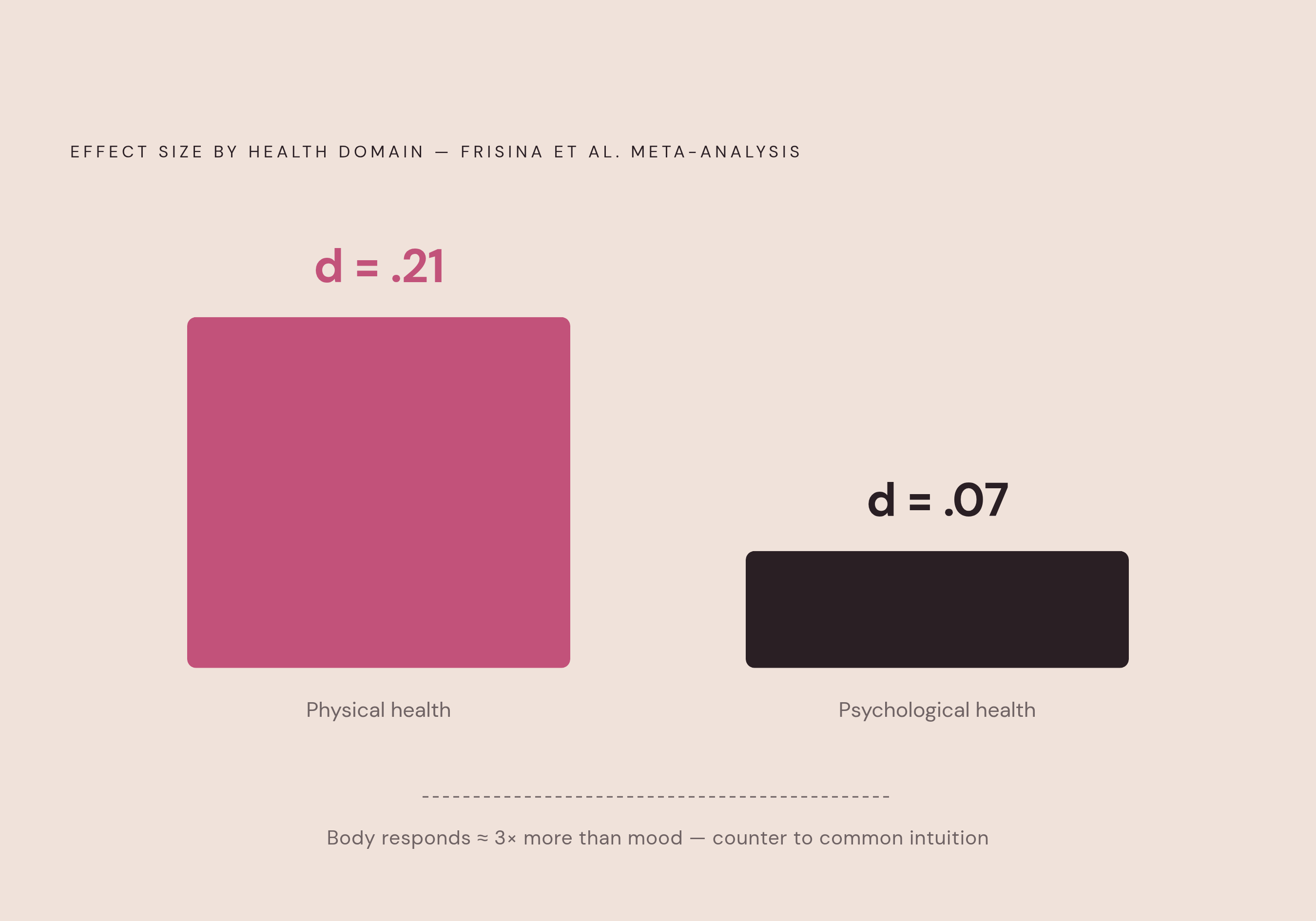
Modality affects outcomes less than prosody and structure do. A meta-analysis by Frisina and colleagues found physical health effects at d =.21, distinct from psychological health effects at d =.07, so the body-level benefit and the mood-level benefit aren't the same size and don't necessarily travel together. Spoken disclosure adds the prosody pathway described above, but it also introduces social friction that a private notebook or an empty document doesn't: worry about being overheard, judged, or misread by whoever's listening. Neither channel wins outright. They trade one set of frictions for another.
The effects appear most reliably in people with alexithymia, people processing an acute stressor rather than general background stress, and people prone to expressive suppression, the habit of clamping down on emotional display. In healthy, low-stress populations, the effect gets smaller and considerably less consistent, which tracks with the systematic review's skepticism above.
As for format, Pennebaker's original structure (15 to 20 minutes, three to four sessions) remains the most rigorously tested version of this practice. Shorter formats haven't been studied nearly as thoroughly, though field research using mobile check-ins over 15-day and 23-day windows has found that brief, regular engagement still produces measurable stress relief. Not the same evidence base as the lab-controlled sessions, but a signal in the same direction. Whether that signal holds up under the kind of scrutiny the meta-analysis above applied to the older literature is, fittingly, still an open question. Which might be the most honest place to leave it.
Sources
- (PDF) A Meta-Analysis of the Effects of Written Emotional Disclosure on the Health Outcomes of Clinical Populations
- Examining Input Modalities and Visual Feedback Designs in Mobile Expressive Writing
- Emotion, proficiency, and arousal: exploring speech and physiological responses in Chinese ESL learners
- Real-Time Psychophysiological and Writing Correlates of Expressive Writing | Experimental Psychology
- Does emotional disclosure have any effects? A systematic review of the literature with meta-analyses | International Journal of Technology Assessment in Health Care | Cambridge Core
- Effects of Reappraisal and Self-Compassion Expressive Writing on Emotion Regulation - Teresa Jacques, Rui A. Alves, 2026
- academia.edu
- journals.sagepub.com