The 21-Day Habit Formation Claim Against the Evidence
Most habits take two to five months to form, not the widely cited 21 days.
Maxwell Maltz wrote that it takes "a minimum of about 21 days" for a mental image to change, and somewhere between his notebook and the self-help shelf, both qualifiers vanished. What survives is a number repeated so often it sounds like a controlled finding, when the actual evidence on habit formation, including a 2024 systematic review covering 2,601 participants, describes something slower, messier, and more useful to know in advance.
How Maxwell Maltz's hedged observation became an unhedged rule
Maltz, a plastic surgeon, published Psycho-Cybernetics in 1960 after noticing something consistent in his rhinoplasty patients: they took roughly three weeks to stop being startled by their own reflections. Amputees, he noted, reported phantom-limb sensations for a similar stretch. From these clinical observations he drew a cautious conclusion, writing that it requires "a minimum of about 21 days for an old mental image to dissolve and a new one to jell." Two words in that sentence carry the whole argument. "Minimum" sets a floor, not a ceiling, and "about" hedges even the floor. The popular version dropped both, swapped Maltz's actual subject, the adjustment of a mental self-image, for an entirely different process, behavioral habit formation, and in doing so turned a surgeon's field note into something people now cite like a clinical trial result. Part of why it stuck is practical: a finding framed as "2 to 5 months, with significant individual variability" doesn't fit on a calendar app's onboarding screen, while 21 days does, feeling demanding enough to seem credible and short enough to seem doable.
What the brain does when a habit forms
A new behavior begins under the control of the prefrontal cortex, the region responsible for deliberate, effortful decisions, where every repetition takes conscious attention and feels like work. As the behavior solidifies, control migrates toward the basal ganglia, where execution becomes closer to automatic. That migration is what neuroplasticity means in this context: not a metaphor for change, but an actual shift in which brain structures run the show. Building that shift requires repetition sustained over time, since neural pathways strengthen with consistent use and weaken without it, and no fixed calendar date determines when the handoff from deliberate to automatic completes. Maltz wasn't wrong that mental images can shift in about three weeks. He was describing a different neurological process than behavioral automaticity, one with its own timescale that happens not to be the timescale everyone borrowed his number for. How much the structure of a behavior matters becomes clear once you compare two examples. Drinking a glass of water at a fixed time each morning asks very little of the brain: the context is stable, the motor routine is simple, and the reward (thirst relief) arrives immediately. A full workout routine asks for much more: the context varies with weather and schedule and energy level, the motor sequence is complex, and the physiological payoff is delayed. The brain simply has more to encode in one case than the other, and encoding more takes longer regardless of how badly someone wants it done.
What the controlled evidence shows about how long habit formation takes
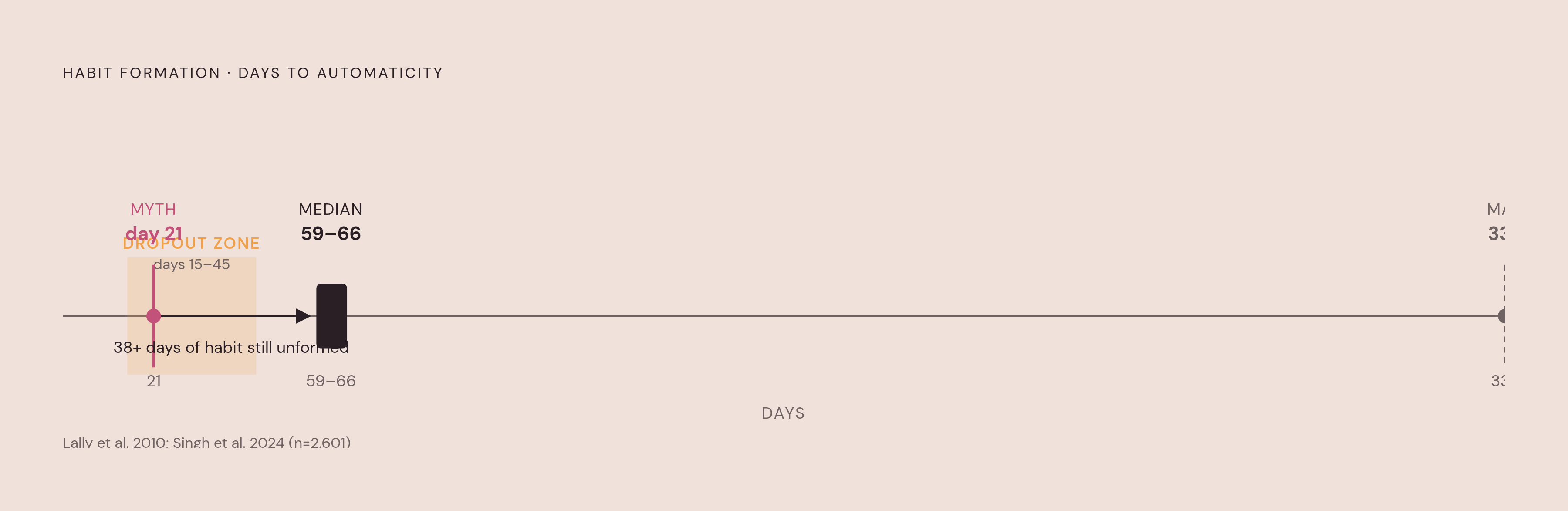
If the mechanism explains why 21 days was always a stretch, the measured outcomes are what confirm it. Phillippa Lally and colleagues, in a study published in the European Journal of Social Psychology, tracked habit formation in real-world conditions and found it ranged from 18 to 254 days, averaging 66. It's the first large controlled study to replace a guess with a distribution, and even its fastest cases cleared three weeks by nearly a month. Simple behaviors, like drinking a glass of water with a meal, settled into automaticity sooner; complex behaviors, like performing 50 sit-ups daily, took much longer to stop feeling like effort. Lally's study cracked the myth open. A 2024 systematic review and meta-analysis published in Healthcare, led by Ben Singh and colleagues Murphy, Maher, and Smith at the University of South Australia, buried it. Their analysis pooled 20 studies and 2,601 participants, the first attempt to aggregate the evidence across multiple studies rather than lean on one. The result: health-related habits typically take 2 to 5 months to develop, with a median between 59 and 66 days, and some cases stretching to 335 days. Where earlier rebuttals of the 21-day claim rested on a single data set, Singh et al. turned that rebuttal into a consolidated empirical floor, a qualitatively different kind of evidence than one study alone could offer. Singh's own summary of the finding, reported by ScienceDaily, is direct: habit formation begins within about two months but can take up to 335 days, and people should not give up at the three-week mark.
The Worst Moment to Stop
Day 21 isn't just an inaccurate finish line. It sits inside the exact window where habits are most likely to collapse. Behavioral researchers describe days 15 through 45 as a plateau zone: the novelty that made the first two weeks feel exciting has worn off, the behavior still requires conscious effort to perform, and nothing yet feels automatic. Why would anyone quit precisely there, at a point that still demands work and offers no new excitement to offset it? Because they were told the work was supposed to be finished. Someone who believes a habit is "complete" at day 21 stops at the exact moment the brain most needs continued repetition, not at the end of the formation process but at its most fragile midpoint, where the neural pathway is still only partially consolidated. Quitting there is a rational response to a false signal: if the process was advertised as finished, stopping reads as a decision rather than a defeat. Streak-based tracking tools often compound the problem through what behavioral researchers call the what-the-hell effect, where one missed day gets registered as a broken streak, a broken streak reads as proof of failure, and that failure narrative triggers an abandonment disproportionate to a single skipped entry. Lally's own data undercuts this directly: missing a single day showed no measurable effect on whether a habit ultimately formed. Streak design buries that finding every time it treats one missed day as catastrophic rather than irrelevant.
The case for streaks
None of this means streaks are a bad idea in principle. People do measurably push harder to protect an active streak than to continue a behavior with no streak attached, and gamified tracking does increase engagement in controlled studies of habit-tracking apps. The streak mechanism works; what matters is what the streak gets anchored to. A 21-day target sets the plateau zone, the highest-risk dropout window, up as the finish line, so that by the time someone arrives there, already told they're done, the motivational structure holding them together collapses at precisely the moment it needs to hold firm. One might argue that any motivation beats none, that a flawed deadline still gets people moving. But that argument treats the false timeline as a neutral exaggeration rather than what it is: a specific wrong expectation that produces a specific, predictable failure at a specific point. Lally's data also did not find that habit formation was predicted by participants' self-control capacity. That non-finding matters, because it means framing a stalled habit as a willpower failure misidentifies the cause and sends people looking for the wrong fix. The factors that actually predicted success were more mundane and more useful: morning timing, since self-regulatory resources run higher earlier in the day, and personal enjoyment, since a chosen, liked behavior consolidates faster than one assigned from outside.
What this means for journaling
Journaling absorbs an unusually direct version of the 21-day myth, because the every-day streak format the myth encourages runs against how the field's own foundational research was actually built. James Pennebaker's expressive writing protocol, the most cited research design in the field, never asked participants to write daily. The original study ran participants through three to five sessions, typically four consecutive days, and still produced significant, measurable benefits. That alone should recalibrate what beginners think they owe the practice. Part of why short, irregular sessions still work traces back to cognitive offloading: writing a thought down moves it out of working memory and into an external record, freeing up cognitive resources the moment it's written, with no streak or threshold required for the benefit to register. Brain imaging and expressive writing research both point the same direction, showing that writing activates multiple neural networks at once and that putting a feeling into words can quiet the amygdala's stress response, neither of which depends on hitting 21 consecutive days. Lally's single-missed-day finding has a particularly concrete translation for journaling: a target of three entries a week tends to be more durable than a daily target, and, counterintuitively, produces more total writing over the long run than a daily goal that collapses the moment day 18 gets missed. Ryder Carroll's Bullet Journal method offers a quiet illustration of evidence-aligned design already in practical use. Its migration practice, a regular review where the writer actively decides what gets carried forward, builds consistency through re-commitment rather than unbroken attendance, closer to how the brain actually consolidates a habit than any unbroken-chain approach gets. Journaling doesn't have to clear a 21-day hurdle to count as working, functioning instead as the instrument for watching any other habit form, a record of how a new behavior is actually going, which makes it less like one more item on a streak tracker and more like the tool that makes the tracker unnecessary.
What accurate expectations look like in practice
Treating two months as a starting point rather than a stretch goal changes what "on track" looks like for anyone building a health-related habit. Someone at day 25 who expected 21 days might feel like a failure; someone at day 25 who expected a median of 59 to 66 days, as Singh et al. found, is exactly on schedule. That's not a small reframe. A missed day on day 30 reads as proof the habit failed, or as an unremarkable blip inside a process that Lally's data show tolerates missed days without consequence, depending on what expectations someone started with. The honest version of this story is also the more useful one, because the complexity is where the actual guidance lives: expect months, not weeks; expect the hardest stretch to arrive after the excitement fades, not before; expect a missed day to cost nothing if the overall trajectory holds. None of that sells as cleanly as a three-week challenge. It does, however, match what happens in an actual nervous system building an actual pathway, and it leaves the plateau zone looking like what it is: not the finish line, but the part of the course where most of the real work still has to happen.
Sources
- Time to Form a Habit: A Systematic Review and Meta-Analysis of Health Behaviour Habit Formation and Its Determinants - PMC
- The New Psycho-Cybernetics and the 21-day Myth
- The 21-Day Habit Myth: Lally's Real Answer Is 66 Days
- The formation of habits in the neocortex under the implicit supervision of the basal ganglia