Power Posing Research After the Replication Crisis
The hormonal claims collapsed, but evidence for psychological effects remains contested.
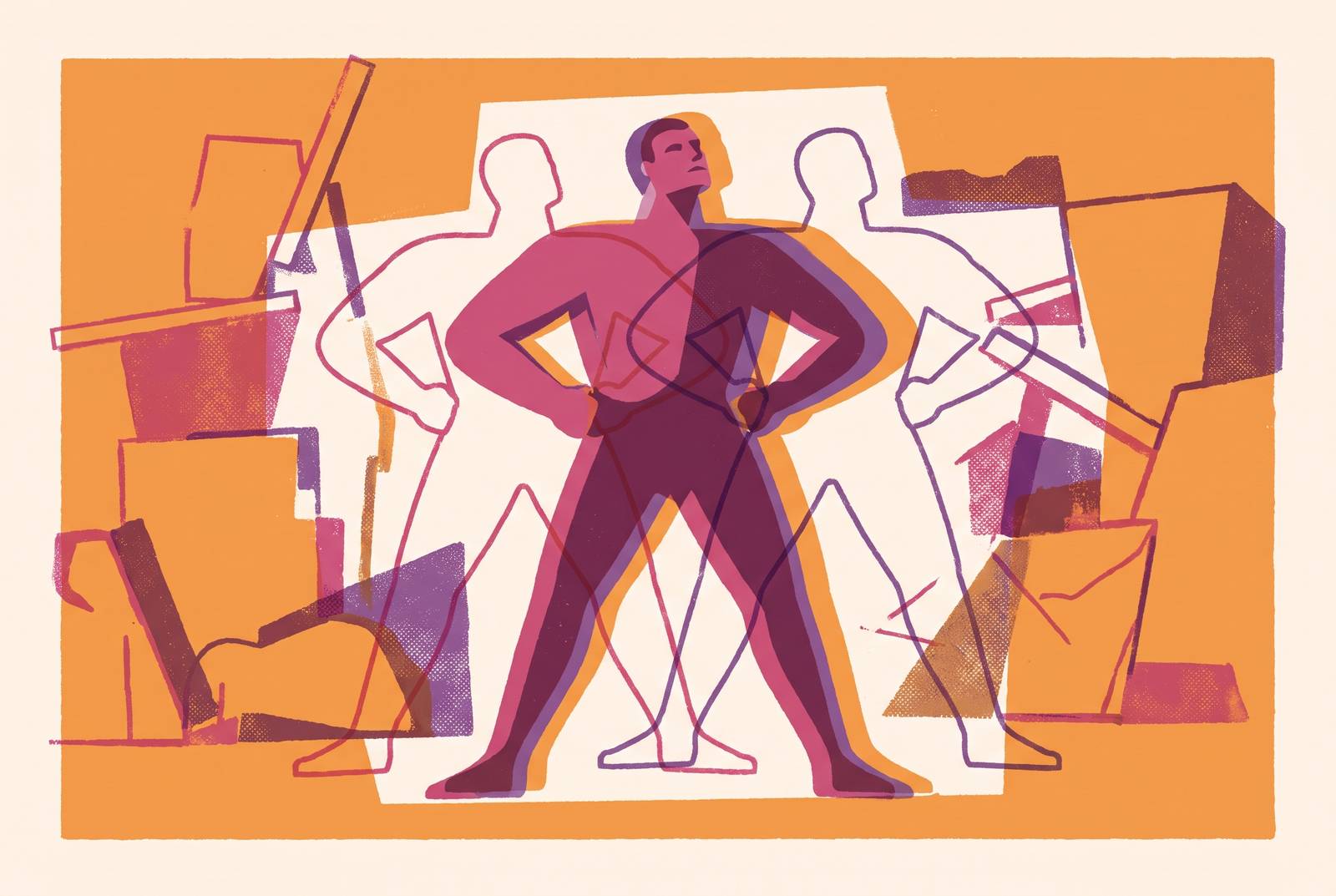
Power posing research after the replication crisis tells a more precise story than either a breakthrough or a debunking. The original hormonal claims largely collapsed, while evidence for subtler psychological effects persisted and remains contested. The debate shows how psychological science separates a defensible finding from the effects of small samples, flexible analysis, and imprecise questions.
Why the original power posing study became so consequential so fast
Dana Carney, Amy Cuddy, and Andy Yap’s 2010 study proposed that two minutes of expansive posture could raise testosterone, lower cortisol, increase felt power, and lift risk tolerance. This was not merely a claim about confidence. It bundled hormonal, psychological, and behavioral changes into a brief physical intervention, suggesting that a change in posture could alter both experience and biology. The experiment had 42 college students, but tens of millions later heard about the finding through Cuddy’s TED talk.
That sample was small by modern power standards. For its era, however, it was unremarkable, in a field where convenience samples of roughly 20 participants per group were routine. Researchers often chose sample sizes based on what was usual rather than working out how many people they needed to detect an effect reliably. The striking result therefore emerged from an ordinary research arrangement. Its public reach vastly exceeded the scale of its evidence, creating the height from which the later replication failure would fall.
The structural conditions that made inflated findings likely across all of psychology
Journals rewarded new findings and positive results, while attempts at replication got far less credit. Researchers faced career pressure to produce something striking. With those pressures, small studies with significant findings were more likely to be published than studies that found little or nothing. This left a body of research with too many positive results, inflated effect sizes, and null findings that went unpublished.
Small samples were only part of the problem. Researchers also had latitude over exclusion rules, when to stop collecting data, how to define outcomes, and which statistical models to use. These choices are known as researcher degrees of freedom. When choices remain flexible during analysis, they can provide several routes to statistical significance even when the underlying evidence is weak. A published paper can then look like a clean test of one hypothesis when the analysis allowed many possible paths.
Publication bias compounded that flexibility by filtering which results became visible. A literature rich in significant findings could look persuasive without showing all the unsuccessful attempts behind it. The distinction is between a convincing collection and a selectively stocked display. Power posing became a prominent casualty partly because it was already famous. Its failure belonged to a field-wide pattern, which makes the replication evidence more informative than a story about any one researcher.
What the Ranehill replication tested and what it found
Eva Ranehill and colleagues’ 2015 pre-registered replication used roughly five times the original sample size to test the claims again. Its results split power posing’s bundle of claims into hormonal, behavioral, and subjective outcomes, each to be judged on its own. In the larger study, the change in testosterone did not differ between high-power and low-power posers. Cortisol did not change differentially either. Risk-taking behavior also did not differ between the groups, leaving the original physiological and behavioral claims unsupported by this replication.
The subjective measure produced a different result. Participants who adopted expansive postures reported feeling more powerful than those who adopted contractive postures. That finding did not rescue the hormonal claims, because feeling powerful and showing a hormonal change are distinct outcomes. The hormonal null results still left the reported difference in feeling to account for. The replication exposed a division that later evidence would refine.
The procedures were not identical to the original. Participants held poses for six minutes rather than two, a difference Cuddy later raised when responding to the replication debate. Such differences create a legitimate question about what a replication tests, but they do not themselves establish why results diverge. The original authors came to disagree over how much faith to put in the subjective effect that remained.
Dana Carney's public disavowal and what it revealed about the original study's methods
Dana Carney’s 2016 statement made that disagreement unusually concrete. The original study’s first author publicly withdrew her confidence in its finding and described methodological problems behind it. She identified the very small sample and decisions involving the exclusion of certain conditions and participants from analysis. In hindsight, she characterized aspects of the process as data dredging.
She stated that she no longer conducted research in the area or taught power posing in her classes, and she discouraged other researchers from pursuing what she regarded as a dead end. Cuddy responded by reaffirming confidence in the subjective effect. She pointed to procedural differences, including pose duration, and maintained that independent laboratories had replicated a real psychological effect on felt confidence.
The disagreement concerned what remained worth investigating. Two scientists who had conducted the same study drew different conclusions from the subsequent evidence. Their rupture shows why correction is a process of interpretation as well as disclosure. It also unfolded on an unequal public stage. The TED talk reached tens of millions, while Carney’s reversal reached only a tiny fraction of that audience, leaving the original finding and its correction with very different levels of visibility.
What the meta-analytic literature says actually survived scrutiny
Körner and colleagues’ 2022 synthesis, involving thousands of participants, found effects on self-reported psychological states but no reliable effects on physiological outcomes. Behavioral effects were likely inflated by publication bias. Evidence that posture influenced reported feelings could no longer stand in for evidence that it altered hormones or behavior. The narrower claim required its own assessment.
A full review of 128 body-posture studies took in both published and unpublished papers. It found reliable effects on thoughts and feelings, including positive mood, self-esteem, and feelings of dominance. It found no effects on physiological measures, including hormone levels, blood pressure, and skin conductance. Including unpublished work helped address the selective visibility of positive findings. Even so, an aggregate difference between expansive and contractive postures left an important question unanswered.
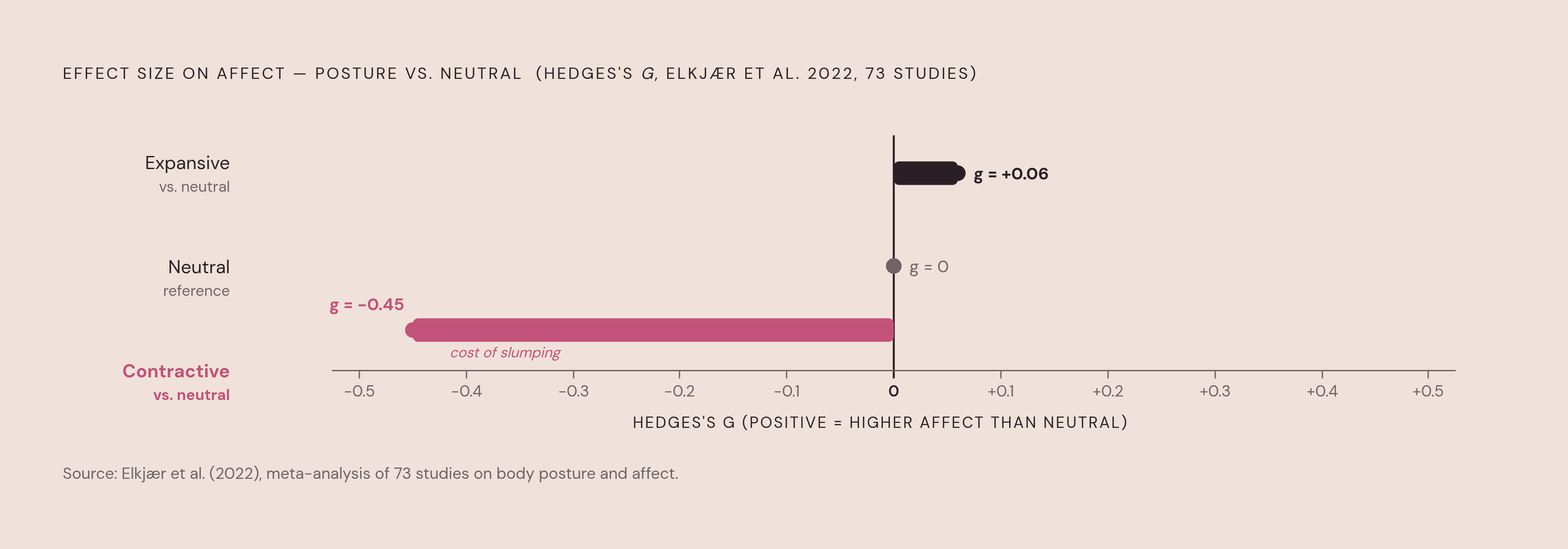
Which side of the comparison was doing the work? Elkjær and colleagues’ 2022 review of 73 studies looked at that question by including neutral conditions. Contractive postures relative to neutral showed a meaningful effect, with Hedges’s g = 0.45. Expansive postures relative to neutral showed almost no effect, with g = 0.06. These are effect sizes, and the contrast changes the interpretation of the evidence.
An expansive-versus-contractive comparison cannot, by itself, distinguish a benefit of expansion from a cost of contraction. The neutral condition provides the missing reference point. Elkjær’s findings suggest that what became known as the benefit of power posing may largely have been the cost of slumping. That is a narrower conclusion than the original promise, but it is also a more exact account of what the comparison may have measured.
Why the surviving subjective effect is still under legitimate scientific dispute
The remaining subjective finding faces a challenge that physiological measurements do not face in quite the same way. Participants can infer what an experimenter expects and adjust their reported feelings accordingly. These are demand characteristics, and they complicate the interpretation of self-report. A person’s answer may reflect the expected response to a pose rather than a psychological change caused by holding it.
The same 128-study review found that power-pose effects tended to be stronger when studies had no cover stories. When the study’s purpose was less concealed, the apparent effect was larger. That pattern is consistent with demand-driven responding. It gives the objection empirical weight rather than leaving it as a hypothetical flaw that could be raised against any self-report study. However, the association alone does not establish that every reported effect arose from expectations.
Cuddy and others see replications by independent laboratories as support for a real subjective effect, while critics ask whether those findings separate postural feedback from what participants think the task is testing. Both positions turn on how the results were produced. If expectations account for the whole difference, the residual case for power posing would collapse. If posture changes feelings beyond those expectations, a small psychological effect could remain even without the original hormonal and behavioral claims.
The dominance-versus-prestige reframing and where the research is heading
The research frontier increasingly concerns what a posture represents, rather than whether “power posing” deserves one final yes or no. Dominance poses are expansive displays that take up space and are linked to power over others. Prestige postures are upright, composed displays linked to status and admiration that a person has earned. These are different social signals with different social consequences. Grouping them under one label may have obscured the effects of each.
That distinction changes the question under investigation. A test of a dominance display need not answer the same question as a test of an upright prestige posture, even if both once fitted the broad category of power poses. More precise constructs allow more precise hypotheses. This is not a rehabilitation of the original hormonal claim, nor does a better vocabulary establish a new effect. It clarifies what would need to be tested before a broader theory of embodied cognition could draw support from posture research.
Elkjær’s neutral-condition findings point toward the same conceptual repair. Distinguishing expansion from the absence of contraction is as important as distinguishing dominance from prestige. In both cases, the original category may have combined comparisons that answer different questions. The field’s next step is therefore not simply to repeat the old contest with a larger sample. It is to test for a narrower phenomenon with the posture, comparison, and outcome defined more carefully.
What one decade of reform has actually changed in psychological science
Bogdan’s 2025 analysis tracked p-values across a very large corpus of psychology articles from 2004 to 2024. It found that the overall share of significant p-values in the fragile range had declined, a change likely driven by increases in statistical power. This suggests that the field has begun to change how it works as well as to learn where it went wrong. The reward pattern had shifted as well. Articles reporting strong p-values were more likely to appear in top journals and receive more citations.
The improvement was uneven, and its limits deserve attention. Researchers at the highest-ranked universities still tended to publish articles with the weakest p-values. One explanation was those institutions’ preference for laborious, expensive, and subtle research topics that are inherently harder to replicate cleanly. More broadly, better statistical signals do not mean that all the incentives behind fragile findings have disappeared.
Public attention does not revise itself when a scientific record changes, and a modest self-report effect can remain difficult to separate from expectations or a misleading comparison. Reform must contend with interpretation as well as reliability. A field makes progress when it can replace an arresting promise with a smaller, better-defined question, even while the promise is still drawing an audience.
Sources
- One Decade Into the Replication Crisis, How Have Psychological Results Changed? - Paul C. Bogdan, 2025
- Systemic forces in the replication crisis
- The effects of power posing on neuroendocrine levels and risk-taking
- A decade of power posing: where do we stand?
- Full article: Power poses
- 'Power Poses' Co-Author: 'I Do Not Believe The Effects Are Real' : NPR
- Power pose effects on approach and avoidance decisions in response to social threat - PMC
- Winners, losers, and posers: The effect of power poses on testosterone and risk-taking following competition - ScienceDirect