Left Brain Right Brain Creativity Lateralization Myth
Brain networks across both hemispheres drive creativity, not a fixed right-side trait.
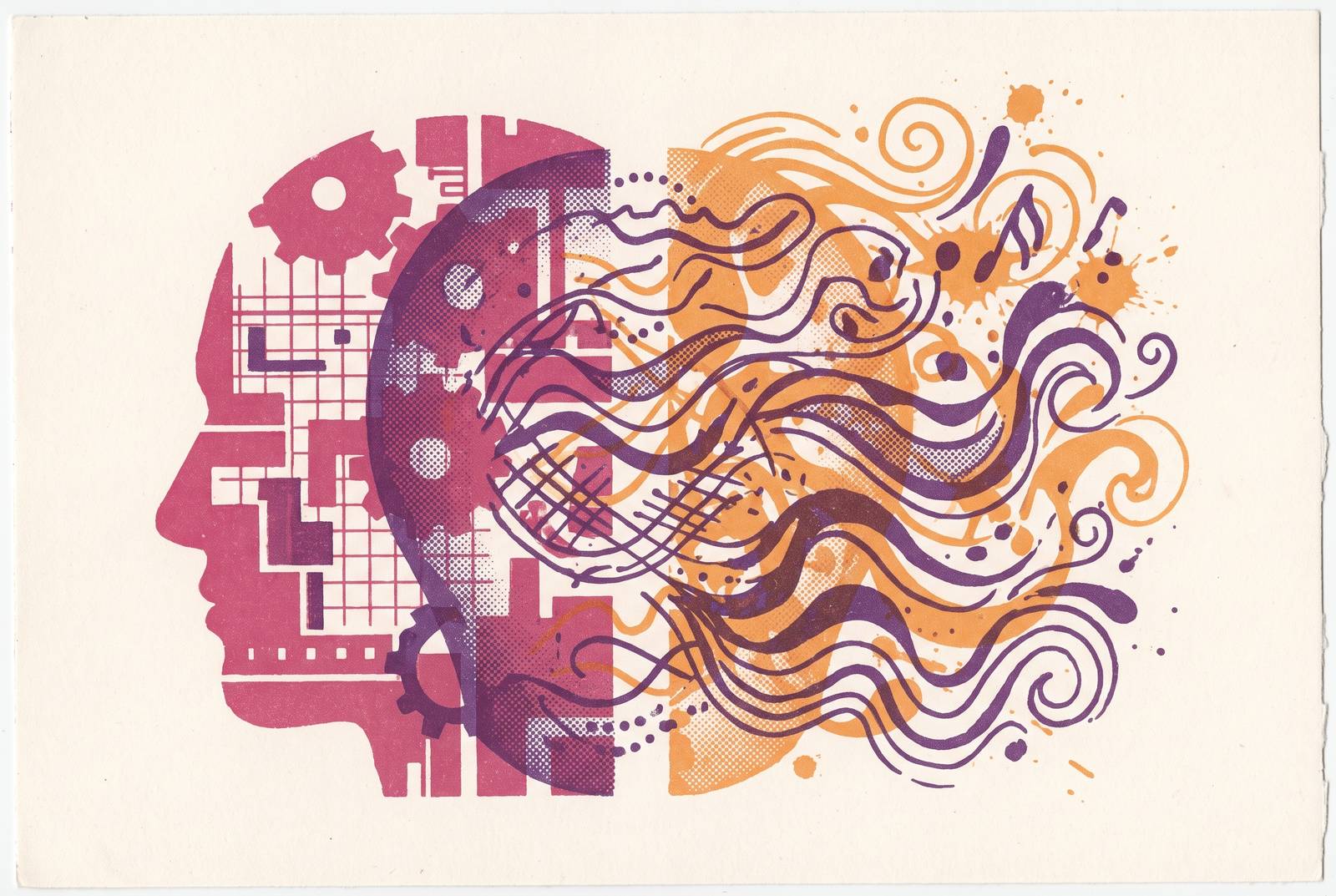
The left-brain/right-brain split is a myth with a legitimate scientific birth certificate, and that is why it has survived so long. Creativity does not live in the right hemisphere any more than logic lives exclusively in the left; both emerge from networks that span the whole brain, working together. This piece traces how that idea got started, what the science actually supports, and why the distinction matters for anyone who has ever written themselves off as "not a creative person."
Where the left-brain/right-brain idea came from
The story starts with real patients and real damage. In the 19th century, clinicians named Broca and Wernicke independently noticed that injuries to specific areas on the left side of the brain disrupted language in very particular ways, a finding that was, for its time, genuinely groundbreaking. One patient could understand speech but not produce it; another could speak fluently but produce sentences that made no sense. The left hemisphere, it seemed, had something special going on with language, and nobody had demonstrated that so clearly before.
Roger W. Sperry pushed the picture further in the 1960s, in research that eventually won him a major scientific award. That was a real and important discovery. It also described something narrow and unusual: a surgically disconnected brain, tested under laboratory conditions, unlike the intact, constantly cross-talking brain that everyone walks around with every day.
What happened next was a kind of cultural game of telephone. "Some functions lean more heavily on one hemisphere" quietly became "you are a left-brained person" or "you are a right-brained person," a personality typology that the original research never claimed and never tested. Early brain imaging studies didn't help matters: when a scan showed increased activation in one hemisphere during a particular task, headlines and textbooks often reported that fact without mentioning that the other hemisphere was active too, just to a different degree. From there, the idea found its way into personality quizzes, classroom posters, learning-style seminars, and corporate training decks, and each retelling sanded off a little more nuance until what was left was a tidy, confident claim that modern neuroscience never actually made.
None of this makes the people who learned it credulous. It makes them recipients of a chain of oversimplifications that started with careful 19th-century clinicians and ended, a century and a half later, on a motivational poster in a break room.
What lateralization means (and what it doesn't)
Lateralization of specific functions is real and well-documented; lateralization of entire personalities is not.
Take language. In the large majority of people, Broca's area governs the production of speech and Wernicke's area governs comprehension, and both regions sit on the left side of the brain. That is about as settled a finding as cognitive neuroscience has to offer. Spatial reasoning and face recognition, by contrast, tend to lean on right-hemisphere resources more heavily in many people. These asymmetries are not myths; they are measurable, replicable, and clinically useful, which is part of why the story built on top of them felt so believable.
But "left-dominant for most people" is not the same as "left-dominant for everyone, always, in a fixed and simple way." Vascular neurologist Constance Katsafanas notes that in some individuals, the language center sits on the right side of the brain instead, a reminder that even the most reliable lateralization findings describe tendencies across populations, not laws carved into every individual skull. Lateralization also shifts with context. Which hemisphere dominates a given response can depend on what has been learned and reinforced over time, and reward processing research shows that food, erotic, and monetary rewards each engage left and right basal ganglia structures to different degrees rather than sorting cleanly into one side or the other.
What happens when researchers try to take the next step and sort whole people, by personality and temperament, into "left-brained" and "right-brained" categories? Scans of more than 1,000 people found no evidence of a globally dominant hemisphere that could be used to categorize individuals this way, Simply Psychology reports. The asymmetries are real at the level of specific tasks. They do not add up to a dominant hemisphere running the show, which is the quiet, deflating answer to a question the pop psychology version of this idea never actually asked carefully in the first place.
The error, in other words, is one of category. Task-specific asymmetries got promoted into a whole-person identity label, and the promotion never had the data to support it.
What brain imaging shows creativity is
If creativity isn't a right-hemisphere specialty, what is it? A 2025 study published in JAMA Network Open analyzed neuroimages from 857 participants across dozens of studies examining creative tasks such as drawing, writing, and composing music, and found that creativity arises from a whole-brain circuit, not a single hemisphere. Co-senior author Michael D. Fox said: "We found that many complex human behaviors such as creativity don't map to a specific brain region but do map to specific brain circuits."
Three networks do most of the work. The default mode network handles generative, associative thinking, the kind of loose mental wandering that produces unexpected connections. The executive control network evaluates those connections against goals, filtering for what's actually useful. None of these three networks belongs to one hemisphere. They draw on regions across both sides of the brain, and how well they coordinate with each other is now treated as a meaningful marker of individual differences in creative capacity.
That coordination isn't just correlated with creativity, it can be shown to cause changes in it. Luchini and colleagues, in a study published in Cerebral Cortex, used covert neurofeedback to train participants to increase coupling between the default mode and executive control networks, and the following day, those participants produced measurably more original ideas. That's a rare thing in this field: a causal result, not just an association.
One of the more surprising findings from the Kutsche study involves the right frontal pole, a prefrontal region tied to self-monitoring. Damage to that area was sometimes associated with increased creative output, suggesting that quieting the inner critic is a measurable neurological event, not simply a matter of willpower or mindset. William James noticed something like this back in 1911, describing creative insight as a matter of "unclamping" ordinary mental machinery rather than adding some special creative ingredient. More than a century later, that intuition holds up reasonably well against the imaging data. And throughout all of this, functional MRI keeps showing both hemispheres active during complex tasks of every kind, analytical or creative. As Katsafanas puts it, "they talk to each other all the time."
Why the myth is actively harmful, not just inaccurate
Getting the neuroscience wrong would not be a forgivable, mildly embarrassing error that stayed in the realm of trivia. The left-brain/right-brain myth treats creativity as a fixed trait, something concentrated in a hemisphere that a person either has plenty of or doesn't.
The network model replaces that fixed picture with a dynamic one. Creative capacity, on this account, is distributed across regions and trainable. It responds to conditions rather than being locked in at birth. The Luchini neurofeedback result shows this directly: strengthening the coupling between the default mode and executive control networks produced more original ideas within a day, a result that only makes sense if that coupling can move. The inner-critic finding carries a similarly practical sting. If excessive self-monitoring suppresses the very network coupling that generates original ideas, then the habit of harsh self-evaluation isn't just an unpleasant personality quirk, it carries a measurable neural cost.
Neuroplasticity, the brain's capacity to reorganize and build new connections across the lifespan, cuts against the fixed-type story from another angle. Nobody is born creative or analytical in some permanent sense; the relevant networks develop along paths shaped by practice and environment. That has consequences beyond individual self-talk. Education and workplace programs that sort people into "creative" or "analytical" tracks based on hemisphere-dominance tests are standing on a foundation the research doesn't actually support. The myth's practical costs follow directly from its scientific errors: get the mechanism wrong, and the sorting systems built on top of it inherit that error.
How writing and journaling engage the whole-brain network
Writing offers one of the clearest everyday demonstrations that the brain operates as an integrated system rather than a set of separately staffed departments. Putting words on a page, even in something as unglamorous as a daily journal entry, recruits language circuits, memory, motor control, emotional processing, and executive function more or less simultaneously.
Journaling engages the prefrontal cortex, which handles rational thinking and decision-making, and the limbic system, which handles emotion regulation, at the same time, which makes the activity analytically and emotionally active in the same stretch of writing. Labeling emotions in words activates the right ventrolateral prefrontal cortex, which in turn downregulates activity in the amygdala, the brain's alarm system, a documented mechanism behind the calming effect many people report from writing about difficult experiences. James Pennebaker's research on expressive writing found that even short sessions could lower cortisol and sharpen cognitive clarity, benefits that don't respect any hemisphere boundary. A 2025 systematic review in Frontiers in Neurology goes further, identifying writing-based interventions, including journaling, poetry, Chinese calligraphy, and memory notebooks, as effective tools for cognitive, emotional, and social rehabilitation, even for people with mild cognitive impairment and dementia.
Handwriting in particular recruits an even broader network, layering movement and sensory processing on top of memory encoding. A 2025 study found that writing by hand strengthens connectivity between brain regions involved in memory and learning in ways that typing on a keyboard does not replicate. That's a detail worth a sentence, not a whole campaign against keyboards, since the larger point here isn't handwriting versus typing but the sheer breadth of what writing, in any form, asks the brain to do at once.
Put together, these findings suggest a specific, almost ironic trap. Someone convinced they are "left-brained" and therefore not creative may be avoiding the exact practice, reflective writing, that would directly exercise the default mode and executive control coupling creativity depends on. The myth doesn't just mischaracterize the brain. It can talk people out of the activity best suited to developing the very capacity they believe they lack.
Practical consequences: how to think about developing creative and reflective capacity
Once the hemisphere label is off the table, the interesting questions change shape. Instead of asking which side of the brain someone favors, the more useful question is: what conditions let the relevant whole-brain networks do their best work?
The inner-critic research points toward one clear answer: reduce the pressure of self-monitoring. That's a plausible reason why loose, low-stakes formats work as well as they do, things like unstructured, stream-of-consciousness writing in the tradition of Julia Cameron's Morning Pages from The Artist's Way, which seem to function by structurally limiting the frontal-pole interference the research has identified. Prompt-based journaling works on similar terms. A prompt removes the blank-page paralysis that tends to activate self-monitoring and stall the default mode network, doing some of the cognitive work on the writer's behalf before a single word gets written.
Flow states fit into this picture too. They're marked by tight integration between the default mode and executive control networks alongside reduced amygdala activity, which lines up with what the research associates with peak creative and focused performance. Regular reflective practice doesn't manufacture flow on demand, but it builds familiarity with the network state that makes flow possible, the way repeated practice with any skill lowers the threshold for entering it.
It's also true that people differ in how they best access these states. Some think out loud, some think while moving, some think only once a pen is in hand. None of this variation traces back to hemisphere dominance. It reflects ordinary individual variation in how networks get built and trained over a lifetime, the same kind of variation that appears in how people learn languages or pick up instruments.
That reframes the real question. Not "am I a creative person," which assumes a fixed trait the evidence doesn't support, but "what conditions help my whole-brain network do its best work," which assumes something closer to what the imaging data actually shows: a system that responds to practice, context, and the amount of room it's given to operate without interference. Sperry's split-brain patients and Fox's whole-brain circuits are separated by decades and a great deal of imaging technology, but they agree on one thing. The brain was never divided into a creative half and a logical half. It was coordinating across both all along.
Sources
- Where Creativity Actually Happens in the Brain
- Left Brain vs. Right Brain: Hemisphere Function
- Is Left Brain vs. Right Brain a Myth? A Neurologist Explains
- Can Journaling Rewire Your Brain? Neuroscientists Explain
- Writing as cognitive rehabilitation in MCI and dementia: a systematic review of therapeutic benefits and applications