Flashbulb Memory Accuracy and the Confidence Illusion
Vivid memories feel accurate, but research shows confidence and truth diverge sharply.
Flashbulb memory accuracy and the confidence illusion are the same subject viewed from two directions: the first describes a vivid, seemingly permanent recollection of where you were when something shocking happened, and the second describes why that vividness has almost nothing to do with whether the memory is correct. Decades of research now converge on a single, slightly unsettling pattern: the memories people trust most are, on average, about as accurate as the memories they barely trust.
What flashbulb memories are
A flashbulb memory is a specific kind of autobiographical memory, one defined less by its content than by its texture: vivid, long-lasting, dense with sensory detail, and anchored to the moment someone learned about a shocking, consequential public event. Livingston's "Now Print!" hypothesis, which proposed that events crossing certain thresholds of surprise and consequentiality trigger a dedicated neural mechanism. That mechanism, in the original telling, stamps a permanent, photograph-like record of the scene onto memory, fixed at the moment of encoding and preserved more or less intact from then on.
The name itself does a lot of rhetorical work. A flashbulb implies a burst of light, an instant, a frozen frame, something closer to a camera than a mind. When a memory arrives wrapped in strong emotion and sharp detail, it simply doesn't feel like it could be wrong, and that is why the photographic model felt so intuitively correct in 1977 and still does to most people today. That intuitive mismatch between how a memory feels and what it actually is turns out to be the entire story.
Why the brain produces a feeling of photographic precision
The sense of photographic precision isn't an illusion conjured from nothing. Researchers describe this as the hippocampus shifting into a distinct encoding mode under neurohormonal arousal, one that produces memories that are long-lasting and fragmented.
That distinction means vividness of encoding guarantees nothing about fidelity of storage or retrieval. A record can be strong, detailed, and wrong at the same time, which is a stranger combination than it sounds, given that most people equate strength of feeling with strength of fact.
Several competing models have tried to explain how flashbulb memories form and persist. The emotional-integrative model matters most for the larger argument here, because it says a flashbulb memory doesn't stay alive in a sealed neurological vault. It's an ongoing social and narrative process. The memory is being rebuilt every time it's told, not simply pulled off a shelf.
How confidence gets attached to a flashbulb memory
A memory feels most certain precisely because it was most emotional, not because it was most accurately recorded, and the same surge of arousal that makes an event memorable also inflates the sense of certainty attached to it, so intensity and trustworthiness end up fused in experience even though they are, mechanically, two separate things.
Research bears this out directly. Confidence, in other words, is a downstream product of arousal, not a readout of memorial fidelity. Work on what predicts confidence in flashbulb memories finds that both emotional factors, like intensity and perceived importance, and social factors, like rehearsal and media exposure, push confidence upward over time, while accuracy follows no such rising curve.
A study by Windsor, Dering, and Donaldson in the Journal of Cognition sharpened this picture considerably. The researchers found that remembering moderated the relationship between recognition accuracy and confidence judgments, and it did so asymmetrically: it shaped confidence far more than it shaped accuracy itself. Their conclusion was blunt. Highly vivid memories, confidently recollected, may not always be factually accurate. Confidence, on this account, is metacognitive and inferential. People read it off cues like how quickly an answer surfaces, how easy the task feels, and how rich the recollective experience seems, and none of those cues are direct measurements of whether the underlying details are true.
An objection needs airtime here, because the science itself doesn't make the picture one-sided. Some controlled research finds that confidence, vividness, and detail count are all, on average, higher in true memories than in fabricated ones, which looks at first glance like vindication for confidence as a signal worth trusting. It does not hold up for any single memory in front of you, as the Battista et al. 2025 findings make clear, a point the article returns to in the section on legal testimony.
Challenger and 9/11 Studies on Accuracy Over Time
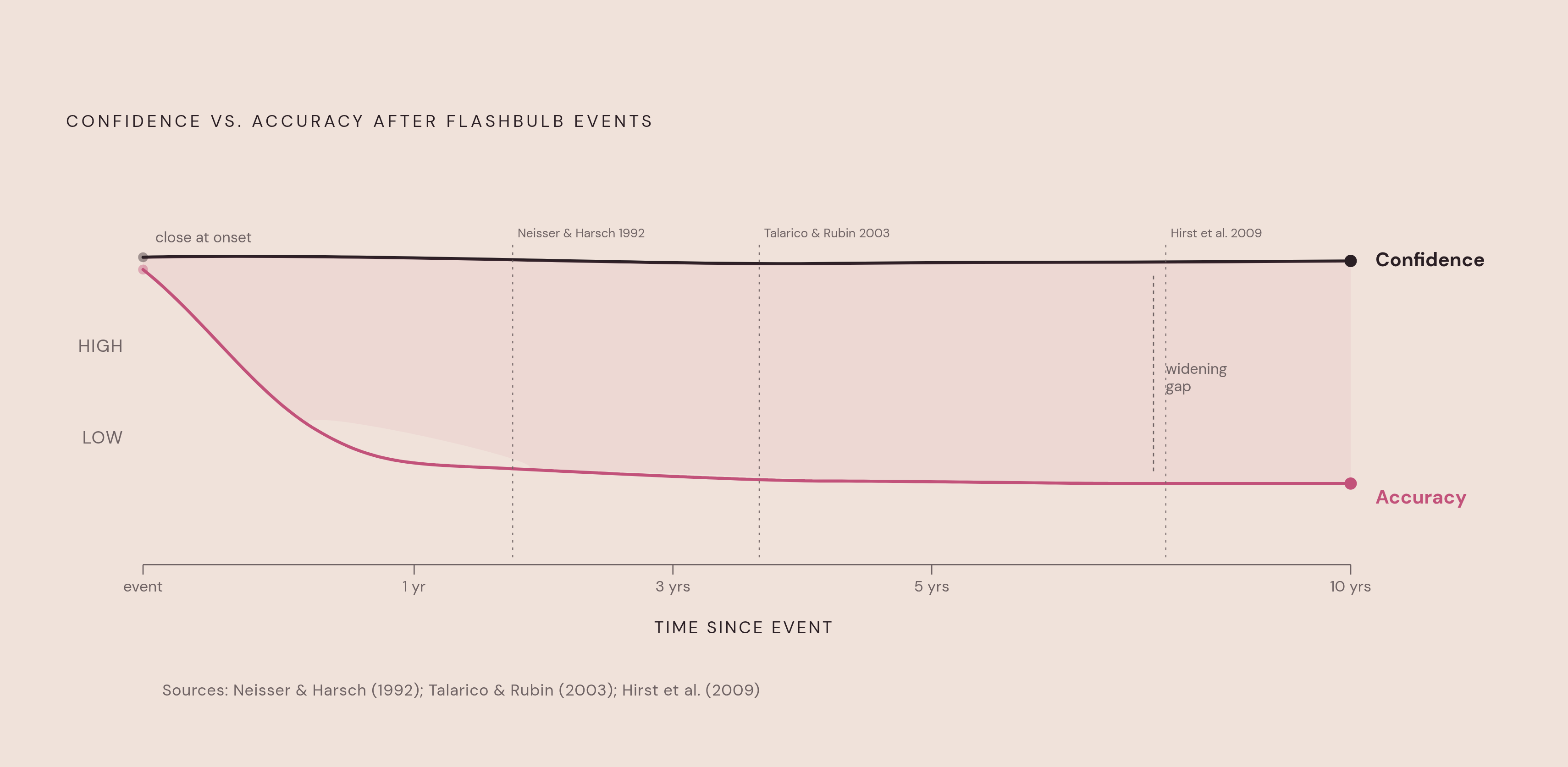
Two landmark studies turned this argument from a neurological hypothesis into documented fact: accuracy drops, often sharply, while confidence holds steady or even climbs.
Neisser and Harsch ran the first of these in 1992. And yet those same zero-scoring participants remained highly confident that their revised, now-contradictory accounts were accurate. They weren't lying. They genuinely believed the second version with the same conviction they'd once held for the first.
Talarico and Rubin followed in 2003 with a study of 54 Duke University students tested in the aftermath of the September 11 attacks. Retrieval accuracy for their flashbulb memories declined over time at the same rate as accuracy for their ordinary, everyday memories, tracked as a comparison. What distinguished the flashbulb memory wasn't how well it held up. It was how confidently people continued to describe it.
Hirst et al. extended the timeline in 2009, when they followed 9/11 memories for a full decade. Forgetting happened fast in the first year and then leveled off, settling into a stable, if degraded, version of events. Confidence, meanwhile, stayed high across all ten years, unbothered by the forgetting that occurred underneath it. One structural detail from that decade of data stands out: inconsistent flashbulb memories were more likely to be repeated across retellings than corrected, while errors in ordinary event memories were more likely to get fixed along the way. The confidence attached to a flashbulb memory seems to block the kind of self-correction that ordinary memory errors go through as a matter of course.
How COVID-19 memories extended the pattern beyond sudden-shock events
If the Challenger and 9/11 findings could be dismissed as artifacts of sudden trauma, the COVID-19 research closes that door. The pandemic didn't arrive as a single jolt; it built slowly, over weeks, which makes it a poor fit for the classic flashbulb trigger built around sudden surprise. The confidence illusion appeared even without a sudden jolt to trigger it.
A 2025 study by Sanz, Seco, and Unibaso-Markaida, published in Psychological Research, examined memories of the COVID-19 alarm state using the Bohannon and Symons framework, which scores memories on specificity (how many details someone recalls) and confidence (how sure they are those details are right). Participants held memories that were richly detailed and confidently reported, even though the triggering event built slowly and never arrived as a sudden jolt.
A separate cross-national study by Lanciano, Curci, and colleagues, published in Memory in 2024, looked across multiple countries and found that memory specificity was predicted negatively by age and by how severe someone judged the pandemic to be personally, and positively by how often the memory had been rehearsed socially. The cross-national scope matters here: it rules out the possibility that this pattern is some quirk of one culture's storytelling habits. Rehearsal, not the raw intensity of the initial moment, is doing a large share of the work in determining what gets encoded as vivid and certain.
Taken together, these findings widen the frame considerably. The conditions that produce the confidence illusion are not restricted to assassinations, plane crashes, or terrorist attacks. If an event feels personally significant and people keep talking about it afterward, it can produce the same gap between how sure someone feels and how right they actually are.
Why the confidence illusion is especially resistant to self-correction
A flashbulb memory error doesn't sit around waiting patiently to be fixed. The confidence wrapped around it works against the normal processes that would otherwise let a faulty memory get corrected over time.
The longitudinal data already points this way: inconsistent flashbulb memories tend to get repeated rather than revised, so each retelling cements the confident, inaccurate version. Alberini and LeDoux's work on memory reconsolidation supplies a plausible mechanism for why. Amygdala-dependent memories, the kind formed under intense fear or threat, may be more vulnerable to disruption and alteration during reconsolidation, not less vulnerable, as the permanence intuition would suggest. Every act of retrieving an emotionally intense memory is also an opportunity to unknowingly rewrite it.
Social sharing adds another layer to the problem. The result is a lopsided system: ordinary memories forget in ways that create natural openings for correction, while flashbulb memories sit behind a confidence floor so high that nobody feels motivated to go check.
What happens when legal systems treat flashbulb-style confidence as evidence of truth
The qualities that make a witness sound believable in a courtroom, consistency, confidence, and a wealth of detail, are the exact qualities the flashbulb literature shows are decoupled from whether the account is actually true.
Judges and jurors, lacking external evidence to check against, fall back on intuitions about what a truthful memory sounds like, and those intuitions track the canonical flashbulb profile almost exactly: steady, confident, rich in sensory specifics. The scientific literature gives you no reason to treat those features as reliable markers of accuracy. Battista, Lanciano, Curci, and colleagues tested this question head-on in a study published in Scientific Reports, using the Flashbulb Memory Checklist to see whether it could separate true autobiographical memories of negative events from fabricated ones. The checklist's scores, including confidence, the single most informative measure on offer, could not properly tell the two apart. The memories could be informative in a general sense. The checklist's scores could not reliably separate truthful accounts from fabricated ones for investigators.
The Windsor et al. Neuroimaging hints at a possible future fix, but it hasn't delivered one yet. Slotnick and Schacter's fMRI work found greater activation in early visual processing regions during true recognition than false recognition, and that is a genuine neural correlate worth tracking. As of 2025, though, this line of research can't reliably sort true from fabricated emotional memories at the level of one specific person telling one specific story, which is exactly the level a courtroom needs.
Researchers reach no consensus that confidence, consistency, or detail quantity reliably signal accuracy, but legal systems in multiple countries still lean on exactly those criteria to weigh whether a witness should be believed.
Where the scientific debate still sits
The field has not reached unanimous agreement, and that disagreement is itself informative. The central fault line runs between Brown and Kulik's original claim that flashbulb memories require a special neural mechanism, and the now-dominant view that they're ordinary memories subject to ordinary forgetting and distortion, just dressed up in unusually high confidence. Most current reviews favor the second position.
A minority view goes further: flashbulb memories might be less accurate than ordinary memories because amygdala-dependent reconsolidation can make emotionally charged memories more susceptible to change than resistant to it. Sharot et al. raised a separate complication in 2007: a distinctive neural signature for flashbulb memory formation appears reliably only in people who personally experienced an event, not in people who merely heard about it secondhand. So that finding complicates any claim about shared, collective memory of historical events, because a population studied together can include very different underlying processes depending on how close each person was to what happened.
The qualified objection raised earlier deserves one more look here. Wachendörfer and Oeberst's review of the literature found that, in aggregate and under controlled conditions, confidence, vividness, and detail count do run higher in true memories than in fabricated ones. That's a real pattern. But it doesn't scale down to individual cases, as the Battista et al. 2025 study confirmed when it tried and failed to use those same markers to sort true memories from invented ones. Even accounting for every one of these live disagreements, one finding holds up across nearly every study design, every event type, and every population examined: the gap between confidence and accuracy. That consistency, oddly enough, is the most stable result in the entire literature.
Why writing your memories down matters
Everything above points toward one practical consequence. Flashbulb memories are rebuilt each time they're recalled rather than simply replayed, and high confidence removes the motivation to question that rebuilding, so an external record made close to the event is the closest thing to a check that an individual actually has available.
The research pattern is consistent on timing: rapid forgetting happens within the first year after an event, while confidence stays elevated regardless of how much has already been lost. Writing a memory down, in the moment or soon after, externalizes it in a way the brain's internal version can't match: the written account becomes a dated artifact that later recollection cannot quietly edit, giving future recall something fixed to check itself against.
Writing produces a stable record immune to the reconsolidation and social-rehearsal pressures that gradually reshape the version living in memory, not an accurate memory on its own. No journaling habit, voice memo, or notebook entry will manufacture accuracy that wasn't there to begin with. What an early record offers is something more modest and, given everything the research shows about how self-sealing this illusion is, considerably more useful: a fixed point made before confidence had the chance to outrun the facts.
Sources
- A study on the use of Flashbulb Memories features to discriminate true from fabricated autobiographical memories for negative events - PMC
- A study on the use of Flashbulb Memories features to discriminate true from fabricated autobiographical memories for negative events
- RESEARCH ARTICLE CORRESPONDING AUTHOR: Phyllis Margaret Windsor
- What Are Flashbulb Memories?