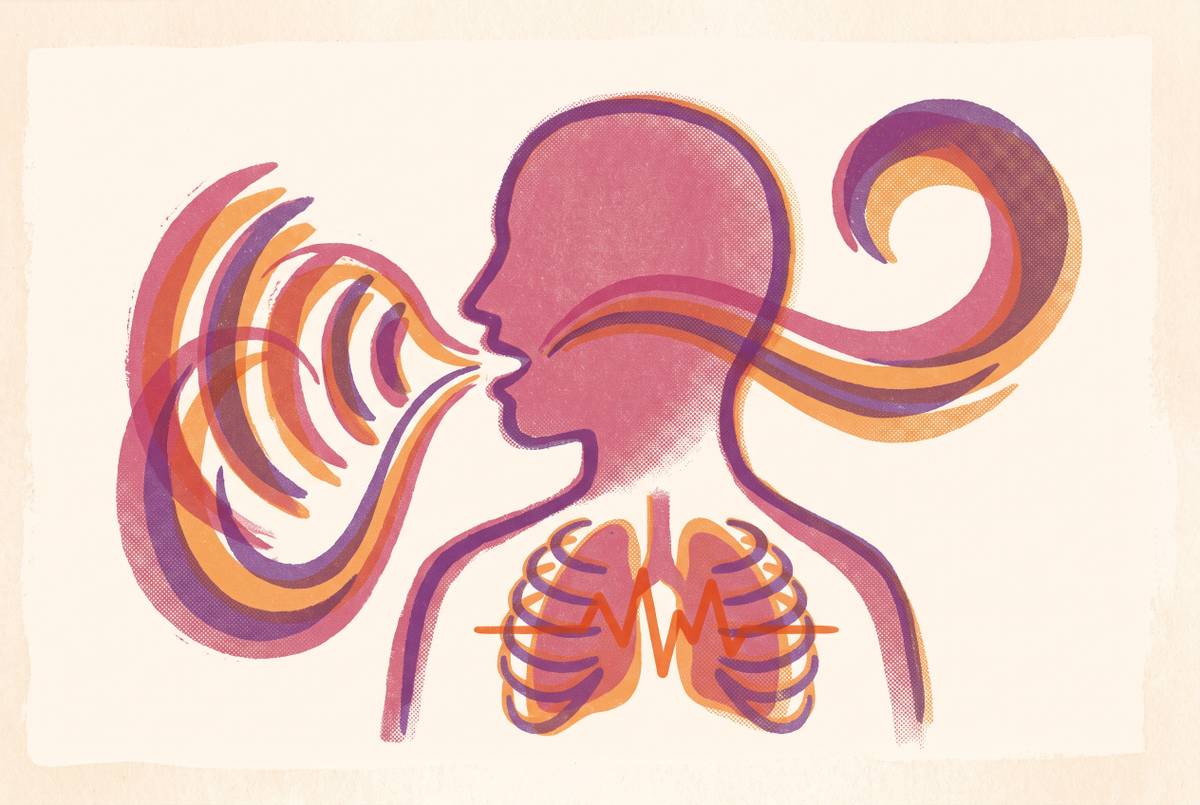
Spoken Entry as Psychological Artifact How Recording Your Voice Changes What You Disclose
Speaking lets thoughts emerge before the internal editor can reshape them.
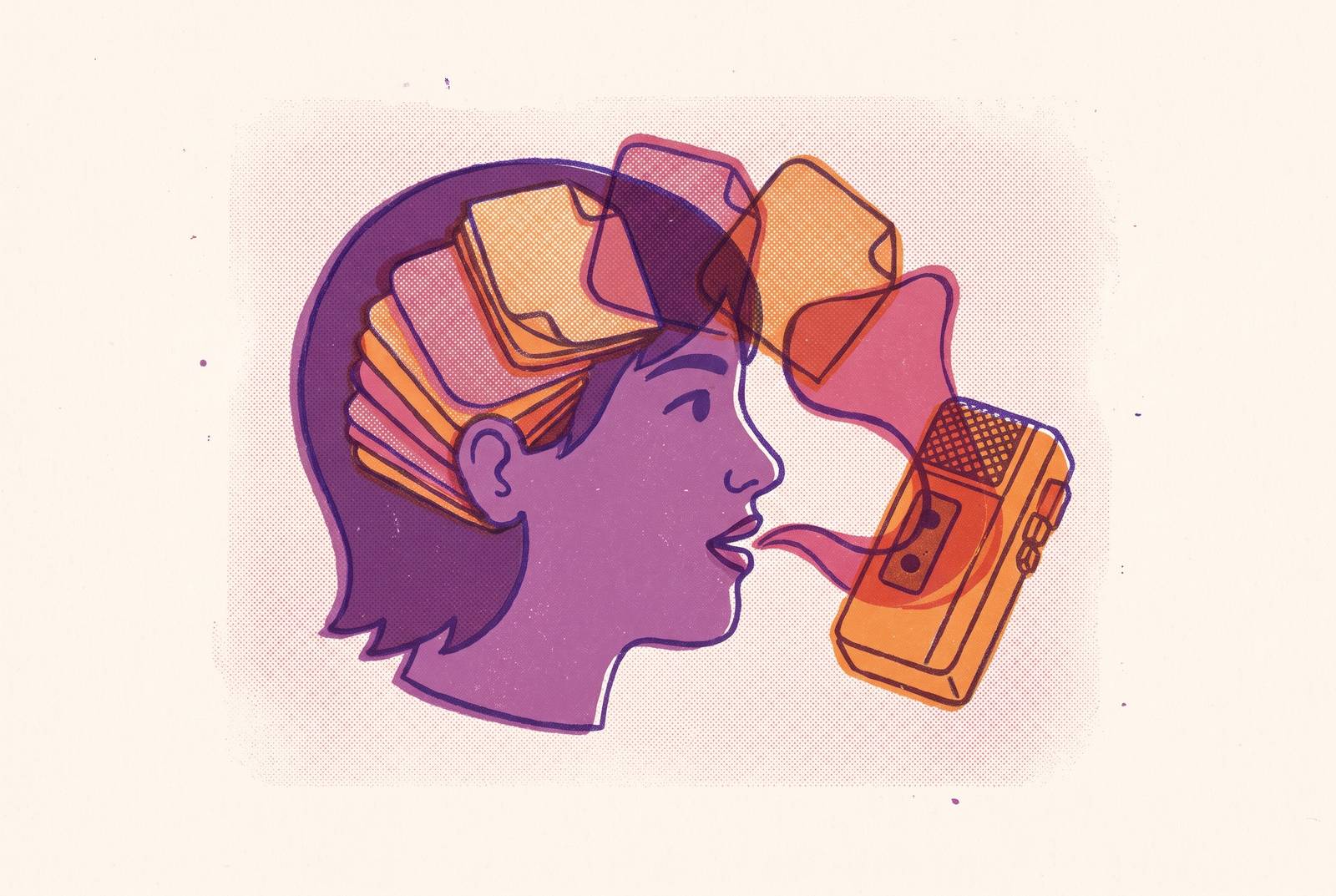
Voice journaling for people who think better out loud offers more than an alternative to typing. Recording sidesteps the read-as-you-write editing loop, allowing longer, less polished, and sometimes more revealing thoughts to survive. The spoken entry becomes a distinct psychological artifact, but its lasting value depends on preserving both audio and text, protecting them, and returning to them.
Why the spoken entry is a different kind of psychological object than a written one
The convenient assumption is that speaking and writing take different routes to the same reflective destination. The evidence allows a more interesting distinction. Pennebaker and Chung’s chapter “Expressive Writing, Emotional Upheavals, and Health” describes talking into a tape recorder as producing “comparable biological, mood, and cognitive effects” to writing. A written entry emerges through simultaneous composition and review, while speech can preserve thoughts before that review reshapes them.
How writing silently edits what you disclose before you know it is happening
Writing brings in a reader before the entry is finished. That reader is also the writer. As each sentence appears, reading it changes what comes next, bringing pressure for coherence, social acceptability, and consistency with a preferred self-image. A contradiction can disappear before it reaches the page because the sentence before it has already taken a position the writer feels bound to keep. The resulting entry records an experience, but also the ongoing negotiation over how that experience should look.
This filter need not involve deliberate concealment. It belongs to the structure of the task. Writing asks someone to produce language while inspecting the language already produced, so disclosure and revision compete within the same act. Under stress, exhaustion, or emotional overload, that filter can tighten precisely when unpolished expression would be useful. The internal reader can demand a finished account before the underlying feeling has become clear.
What voice lets through that writing holds back
Speaking loosens that demand because there is no sentence on the page to inspect before continuing. An admission can be followed by its opposite. Partial thoughts, uncertainty, and associative chains can remain in the entry rather than being reconciled before they become visible. What looks untidy as prose may be valuable as disclosure, since the unresolved contradiction is part of the experience being examined.
Speed adds to the difference between the two processes. Most people speak roughly 150 words per minute but type around 40, allowing spoken expression to move faster than the editing machinery can fully engage. The result tends to be longer and rawer. Voice preserves a richer first draft, including uncomfortable material that a written account might smooth away, and can therefore come closer to what the speaker actually believes before making it presentable.
Three cognitive mechanisms that make speaking aloud therapeutically active
Affect labeling gives a feeling a verbal form. UCLA’s fMRI research showed that naming an emotion reduces amygdala activity, changing what happens inside as the feeling is described. The naming itself does some of the work. This mechanism applies to putting feelings into words, whether spoken or written, and speaking can make the labeling step easier to reach when writing feels demanding.
Narrative self-distancing changes the position from which an experience is considered. University of Michigan research found that looking at experiences as a detached observer, or using third-person language, helps people take a self-distanced perspective linked to better emotional regulation and less rumination. Distance here means considering an experience with some separation from its immediate demands. A spoken account can help with that shift, though speaking alone may not bring it about.
Reduced interference from the internal reader supplies the third mechanism in this account. It concerns the conditions of expression. It gives unfinished thoughts room to develop. Together, these processes allow someone to name a feeling, consider it from another position, and continue without constantly revising the account.
What the voice itself carries that a transcript cannot
The words are only one layer of the entry. Pitch, pace, hesitation, and tone preserve another. A pause before naming a difficult feeling, an acceleration around something important, or a pitch shift when a thought surprises the speaker can reveal something the sentence alone does not. This is prosody, the audible shape of speech. Because it need not be consciously chosen, the recording can contain emotional disclosure beyond what the speaker intended to put into words.
That extra layer also motivates research into voice biomarkers. Changes in pitch, pace, and tone may correlate with mood shifts, suggesting that audio contains information unavailable in a transcript. Not every digitally acquired voice metric has been rigorously established as a true biomarker, so an expressive pause is not a diagnosis.
The recording paradox: how knowing you are being preserved changes what you say
Would knowing that an entry will survive encourage more editing? Permanence appears to invite a performance. Yet a private recording can create a different posture because its intended audience is the speaker’s future self. There is no live listener whose reaction must be managed. At the same time, the knowledge that the entry can be replayed can encourage greater specificity and accountability about what is being said.
The key is the separation between capture and appraisal. While recording, the speaker can continue without inspecting a visible sentence or adjusting to a listener’s face. During playback, the task changes from producing an account to examining one. The analytical capacity that might have interrupted disclosure can now be used on material already preserved. Writing can also be revisited later, but it cannot remove the read-as-you-write loop from its initial composition in the same way.
Cox, Jacobsen, and van Berkel’s 2025 study at CUI’25 found that, when emotional disclosure came first, participants felt more comfortable with a chatbot framed as ephemeral and unacquainted. That finding applies specifically to chatbot framing. Its relevance is the stranger-on-the-train effect, in which reduced expectations of lasting social consequences can ease disclosure. A private recording keeps the encounter for the future self without needing anyone else there to hear it.
Why the conversational frame lowers the barrier to honest disclosure further
Removing the keyboard does not remove the difficulty of beginning. A blank recording screen can be surprisingly eloquent in its silence. An invitation to “record your thoughts” still requires someone to find a topic, choose an opening, and decide how to organize it. A guiding question removes part of that generation task. Instead of inventing a structure, the speaker responds, leaving more attention available for the content of the answer.
The conversational frame can also alter the perceived risk of disclosure. Cox’s 2025 workshop paper at a conference discusses how anticipated judgment discourages self-disclosure and how conversational-interface cues might reduce that concern. The paper’s proposals should not be mistaken for a guarantee that any voice interface will feel safe. Still, the distinction is useful. A question can give someone enough structure to begin without a visible human audience that makes an admission feel socially risky, though how the interface is framed still shapes the experience.
The trade-off the spoken artifact creates: expression versus retrievability
The properties that help a spoken entry capture experience also make it awkward to revisit. Repetitions, pauses, unfinished thoughts, and tangents may be useful parts of the original disclosure, yet they make finding a particular concern harder later. Audio can therefore be a rich expressive artifact and a poor retrieval object at the same time. Ease of capture does not automatically produce ease of review.
Transcription gives the entry a searchable text layer while retained audio preserves its delivery. The two versions serve different jobs. Text helps someone look across entries for concerns that keep coming up or for changes, while audio lets them hear again the hesitation or tone that made an entry stand out. Pure audio preserves the initial expression, but pairing it with text makes that expression more usable as a record accumulated over time.
The privacy reality of a voice artifact: what a recording actually contains
The richer record also creates a richer exposure surface. A recording contains more than deliberately disclosed words. Voiceprints can identify a person through physical characteristics, and unlike a compromised password, those characteristics cannot simply be reset. Prosody also calls for care because it may reveal feelings the speaker did not choose to keep on record. These are distinct reasons to handle an audio journal carefully, even when its transcript would already be highly personal.
The legal distinction depends on how the voice is processed. Under GDPR Article 9, biometric data processed to uniquely identify a natural person is special category data and requires explicit consent or one of the few other legal bases allowed. Plain voice recordings not processed for identification are ordinary personal data rather than automatically special category biometric data. Illinois, Texas, and Washington have biometric privacy laws, but their requirements differ. Illinois explicitly requires written consent, Texas does not state the same written-consent mandate, and Washington allows notice, consent, or a mechanism preventing later commercial use, with applicability to voiceprints derived from recordings not settled.
For someone choosing a tool, local processing addresses the transmission risk by keeping transcription on the device. Models such as Whisper can support on-device transcription, but a model name alone does not establish an app’s full data handling. If an entry can be transcribed without a connection, the tool can do offline transcription, though uploads or synchronization may still happen later. The practical test is to try an entry in airplane mode and distinguish local transcription from the separate question of whether the retained audio ever leaves the device.
What to do with the insight: how to structure a voice journaling practice that captures the artifact's full value
Tie recording to something that already happens, such as a walk home or the minute before sleep, so it fits into the day without another appointment. Make the first step small and already situated. A prompt-guided format then supplies a question, reducing the need to improvise a structure. With a solo recorder, preparing one question in advance serves the same purpose of reducing the work required to begin.
Local processing helps keep the recorded material private, as long as the way it is stored also protects it. No single “speak instead of type” feature establishes that a tool preserves the entry’s full value.
Keep both forms and make time to review them as part of the practice. Use the transcript to find patterns, then return to the audio when the delivery deserves attention. The original recording and the later review do different work. One lets thoughts emerge with less interference, while the other turns those preserved thoughts into something that can be examined across time.