Internal Versus External Self-Awareness Research Distinctions
Research reveals self-awareness splits into two independent skills that don't help each other.
Self-awareness is usually treated as one dial, turned up or down, that a person either has enough of or doesn't. Research on the subject describes something closer to two separate instruments that happen to share a name, and mistaking one for the other is why so much self-improvement effort in this area goes nowhere.
Why most people's understanding of self-awareness is structurally incomplete
Ask a room of people whether they're self-aware. Nearly everyone raises a hand. Tasha Eurich's research found the real figure is far smaller than that, which affects how the gap should be read. A small shortfall between perception and reality could be chalked up to modesty or measurement noise. A gap this wide points to something else: people are confidently answering a question they've misunderstood. They're treating self-awareness as a single trait, like height, when the research describes it as at least two different capacities that happen to get measured with one word. That conflation is the actual error, and it's a correctable one. The rest of this piece is an attempt to correct it, starting with what the two capacities actually are.
What Internal and External Self-Awareness Measure
Internal self-awareness is how clearly someone understands their own values, passions, aspirations, recurring emotional reactions, and the impact they believe they have on others. Its reference point lives entirely inside one head: it's what a person believes to be true about themselves, checked against nothing but their own memory and introspective access. External self-awareness asks a different question. It's how accurately someone understands the way other people actually perceive those same values, reactions, and behaviors, and its reference point is social and observable: what colleagues, friends, or family would say if asked honestly, whether or not that matches the story the person tells themselves.
Daniel Mograbi and colleagues, writing in WIREs Cognitive Science in 2024, frame self-awareness as multidimensional and emergent across different levels of cognitive complexity rather than as one faculty that either switches on or stays off. That framing holds up at the level of brain mechanics, too. Internal self-awareness draws on introspective access to memory, emotion, and value representation, essentially querying internal archives. External self-awareness requires modeling other minds, a social inference operation that has little to do with memory retrieval and everything to do with predicting what someone else is thinking. Mograbi's team situates this within a predictive coding framework, where the brain continuously builds and revises models of self and environment, and the internal and external self-models run on different prediction loops. Two loops, two jobs, two separate things to get right.
Internal self-awareness, understanding your own values, emotional patterns, and how you think you land with others, depends on introspection and on being honest with yourself about what's actually driving your behavior. Some tools now turn the raw material of that introspection, the things people say out loud when they talk through a problem, into searchable patterns that reveal recurring themes, making the slow work of building internal clarity easier to track over months. Joice is one example of a tool built around that idea. But a tool that sharpens internal clarity doesn't, by itself, tell a person anything about the other loop. That's the subject of the next section, and it's where the research gets genuinely surprising.
The counterintuitive finding: the two types do not predict each other
Across a large, multi-study research programme, Eurich's team found virtually no relationship between internal and external self-awareness. Knowing yourself well does not make a person better at knowing how others see them. Being highly attuned to how one is perceived doesn't make a person any more honest with themselves about their own motivations. That correlation is close to statistical independence, which has a direct practical consequence: the two types have to be built through separate practices, because progress in one does not carry over into the other.
But why would that be true? Common sense suggests the opposite: surely someone who has spent real time examining their own values would also have a clearer picture of how those values come across to other people. The research says that intuition doesn't hold. Someone can have rich, well-examined internal clarity about what they care about and still be systematically wrong about how that reads to the people sitting across the table from them in a meeting. The reverse happens just as often: someone can be exceptionally good at reading a room, adjusting tone, picking up on social cues in real time, and still have almost no honest grip on what's actually motivating their own choices. Neither skill set compensates for the other, because depth in one area does not fill in the other.
Cognitive neuroscience offers a mechanical reason for the split. Introspection and social cognition, the technical term for theory of mind, recruit overlapping but distinct neural systems. They're neighbors, not the same tenant. That overlap is probably why it feels intuitive to assume one skill should transfer to the other. The distinction is also why, in practice, it usually doesn't: improvement in one system doesn't automatically propagate to the other, any more than getting better at reading a map makes someone better at reading a compass, even though both involve the word "reading" and both get you somewhere.
Internal work and external feedback therefore function as two separate practices, each demanding its own ongoing effort. The other is about actively seeking out and absorbing honest input from the people in a position to see what's invisible from the inside. Skipping either one leaves half the map blank.
Why the four archetypes clarify where a person stands
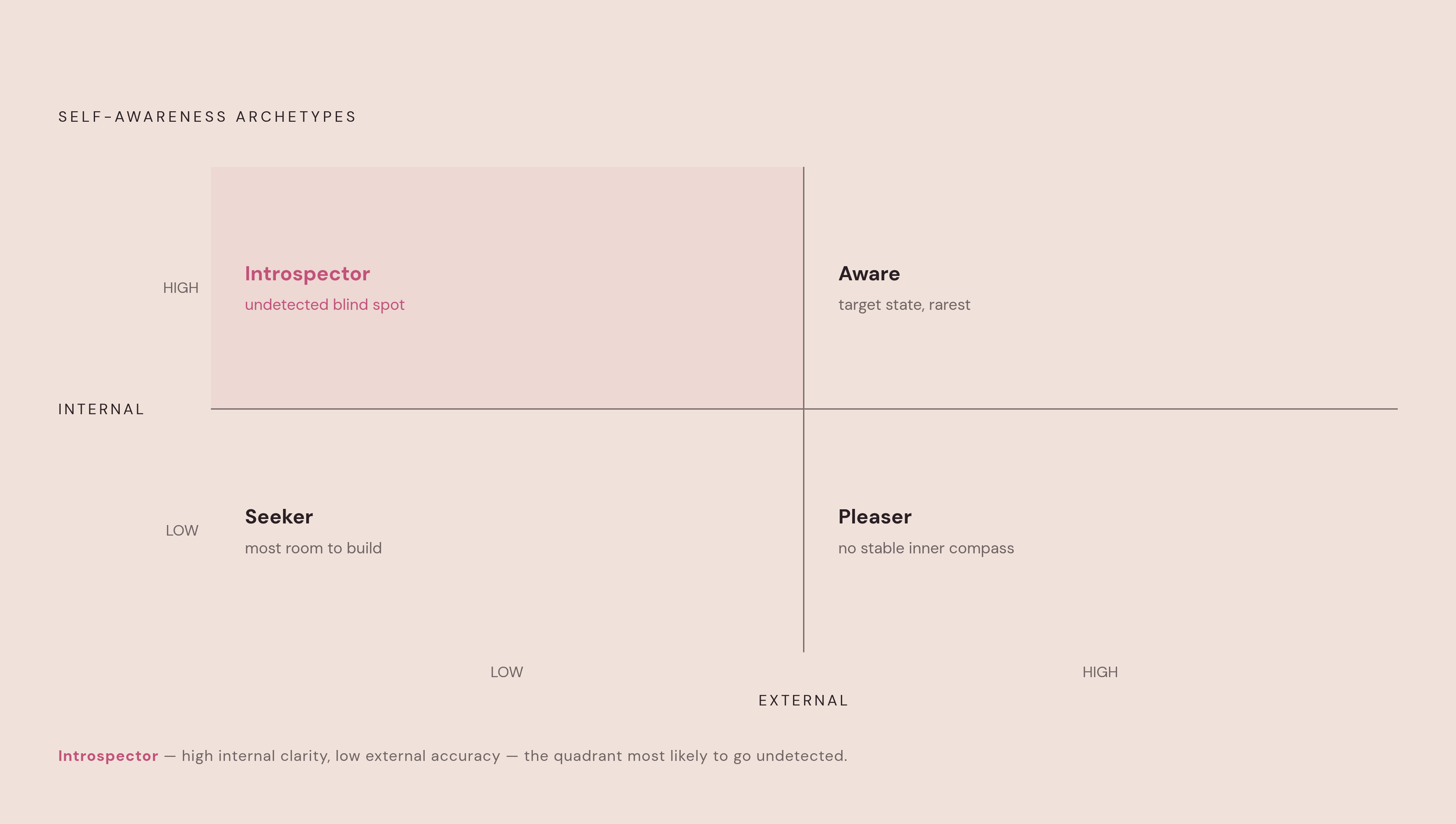
Eurich's four-archetype framework takes the statistical finding from the last section and makes it visible as four distinct, recognizable situations. The value of the framework is that it treats internal and external self-awareness as two axes that cross each other rather than blend into one spectrum, and crossing axes produce four quadrants, not a gradient from low to high. These are positions on a map, not fixed personality types. A person can occupy a different quadrant in their career than they do in their marriage, and can move between quadrants over time with deliberate work. Nobody is sentenced to one for life.
The Aware archetype sits high on both dimensions, understanding their own values clearly and having an accurate read on how others perceive them. Eurich's research describes this as the target state and also as the rarest one, which says something about how hard both halves of the work actually are. The Seeker sits at the opposite end, still developing on both dimensions, which sounds discouraging until it's reframed as having the most room to build deliberately, without entrenched habits to unlearn first.
The other two quadrants are where things get more interesting, because each one feels like success from the inside. The Pleaser has high external accuracy paired with low internal clarity: someone who reads a room with real skill, adjusts fluently to what's expected of them, and yet has little stable inner compass guiding any of it. Spytska, writing in OBM Neurobiology, notes that self-assessment and self-criticism rely on external assessment and criticism, respectively, which points to the risk built into this quadrant: a person who over-indexes on external signals without internal grounding ends up organizing their sense of self almost entirely around other people's expectations. The compass still points somewhere, it just doesn't point anywhere the person chose.
The Introspector is the mirror image, and it's the quadrant most likely to go undetected. These are people with high internal clarity and low external accuracy: they have genuinely reflected, processed difficult emotions, and can articulate their own values with real precision. And yet their colleagues describe them as oblivious to group dynamics or tone-deaf to social impact, a gap the Introspector often can't see, because the internal work feels like proof of complete self-knowledge, which is the trap. Someone who has journaled for years, who can explain exactly why they reacted the way they did in a tense meeting, can still walk out of that meeting having no idea that their tone read as dismissive to three other people in the room. The single-capacity view of self-awareness, the assumption this piece opened with, does the most damage here, because it tells Introspectors they've already finished a project that's actually only half built.
Why more introspection does not reliably produce more self-awareness
None of this means introspection is a waste of time. Eurich offers one concrete, almost deceptively small fix: replace "why" questions with "what" questions when examining values and reactions. Asking "why did I react that way?" tends to invite rationalization, a story built after the fact to make the reaction sound reasonable. Asking "what was happening when I reacted that way?" invites observation instead, pulling up actual evidence as the basis for insight. The wording shift is small. The cognitive shift it produces, from self-defense to evidence-gathering, is not.
Structure turns out to matter on the output side too. Research from Seoul National University, presented at CHI '26 as the InnerPond project, found that spontaneous inner dialogue, the default, unstructured mode most people call "just thinking about it," tends to stay locked inside familiar perspectives or spiral into unproductive rumination. Structured scaffolding, in that same study, produced more generative self-understanding among participants than letting the mind simply loop on its own. Left alone, a thought doesn't organize itself. It tends to just recirculate.
The neuroscience gives a clue about why structure works as well as it does. Matthew Lieberman's fMRI studies at UCLA documented what happens in the brain during affect labeling, the simple act of putting a name to an emotion. When someone labels what they're feeling, amygdala activation drops and activation in the right ventrolateral prefrontal cortex rises, a measurable shift from reactive processing to regulated processing. It's a specific, observable change in which brain regions are doing the work, and it happens because the act of naming forces something diffuse into a defined shape. Research using James Pennebaker's expressive writing protocol, developed at the University of Texas at Austin, found a related effect: expressive writing strengthens the connection between the limbic system and the prefrontal cortex, improving both emotional regulation and the cognitive processing of whatever material is being written about. Writing recruits a circuit spanning the prefrontal cortex, the hippocampus, and language centers, and that circuit takes scattered thoughts and arranges them into something structured, which lightens the load on working memory and leaves more of it free for actually noticing things.
What follows from all this is that externalizing internal material, getting it out of the head and into some fixed form, has to be structured enough to stop a person from rationalizing in circles, while staying open enough to let genuinely uncomfortable material surface. Pennebaker-style expressive writing, loose and unstructured and aimed squarely at emotions and values, processes internal states and surfaces patterns that plain thinking does not reveal. That makes it a good starting point for Seekers and Introspectors early in a reflective practice, when the goal is honest contact with the material. Julia Cameron's morning pages method, three longhand pages of stream-of-consciousness writing done before any media or outside input reaches the brain, was built specifically to get past the inner critic before the day's noise piles up and makes that harder. The direct digital version of the same idea is 750words.com, which sets a free-writing volume target with no prompts at all, best suited to someone who has already outgrown the need for structure and is ready for the blank page on its own terms.
None of these methods closes the external gap, and none of them was built to. The Introspector pattern described earlier, high in internal clarity but blind to external impact, is a useful warning here: regular, honest self-examination deepens internal clarity, but it works best when it's paired with a deliberate external feedback loop, so the two dimensions move forward together. Internal work builds the compass. It does not, on its own, tell a person whether anyone else can see where it's pointing.